Desserts · Part 2 of 3: Instructions
Easy Slow Cooker Vanilla Crème Brûlée Step-by-step instructions
- Prep
- Cook
- Total
- Serves
- 4
Before you start
Before beginning, ensure your slow cooker is clean and that your ramekins fit comfortably inside. Gather all ingredients and measure them accurately. Have a kettle ready to boil water for the bain-marie.
Ensure the eggs are at room temperature to help them emulsify smoothly with the cream. Prepare a space in the refrigerator for the ramekins to chill after they have been removed from the slow cooker, as this step is vital for setting the custard properly before the final caramelization.
Ingredients at a glance (4)
- 4 large egg yolks
- 1 tsp vanilla extract
- 1/2 cup granulated sugar, plus extra for topping
- 2 cups heavy cream
Instructions
Mixing the custard base
- Prepare the custard baseIn a medium mixing bowl, whisk together the egg yolks and granulated sugar until the mixture becomes pale and slightly thickened. Gradually pour in the heavy cream and vanilla extract, stirring constantly until the ingredients are fully incorporated and smooth. Ensure there are no lumps of sugar remaining in the bottom of the bowl before proceeding to the next step.Look for The mixture should be uniform in color and smooth in texture with no visible streaks of egg yolk or granules of sugar remaining.Tip Whisking gently prevents creating too many air bubbles, which can affect the final texture of the custard.
The mixture should be thoroughly combined, smooth, and free of any sugar granules. The consistency should be thin and pourable, similar to a heavy cream, with a consistent pale yellow color throughout the bowl. Check that the vanilla is evenly distributed and that no concentrated pockets of egg yolk remain before you proceed to pour the mixture into the individual ramekins for the cooking process.
Slow cooking the custard
- Cook the custardPour the custard mixture evenly into four ramekins. Place the ramekins inside the slow cooker insert. Add enough hot water to the slow cooker to reach halfway up the sides of the ramekins to create a water bath. Cover and cook on low for approximately three hours. To ensure the eggs are cooked through, the custard must reach 160°F (71°C).Look for The edges of the custard should look firm and matte, while the center should still wobble slightly like gelatin when the ramekin is gently nudged.Safe temperature 160°F (71°C) internal temperature (egg dishes)Tip Using a water bath acts as an insulator, ensuring the custard cooks slowly and evenly without curdling.
The custards are ready when they have set around the edges and show a slight, uniform jiggle in the center. They should be firm enough to hold their shape when tilted slightly, but still appear delicate.
Use a thermometer to verify the internal temperature has reached 160°F (71°C). Once reached, carefully remove the ramekins from the water bath and allow them to rest on a wire rack before transferring them to the refrigerator.
Chilling and caramelizing
- Chill and caramelizeRemove the ramekins from the slow cooker and let them cool to room temperature. Transfer to the refrigerator for at least two hours to chill completely. Before serving, sprinkle a thin, even layer of granulated sugar over the top of each chilled custard. Use a kitchen torch to melt and caramelize the sugar until it turns a deep golden brown and hardens into a crisp shell.Look for The sugar should bubble and darken rapidly under the flame; watch closely to prevent burning the caramel to a bitter black state.Tip For the best crust, ensure the custard is thoroughly chilled before applying the sugar and torching.
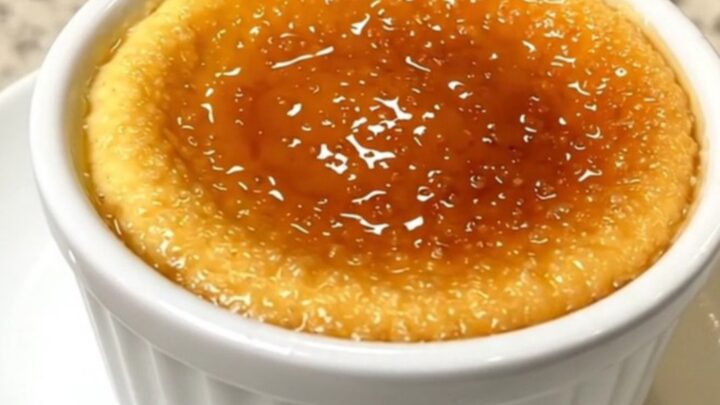
After chilling, the custard should be firm, cool, and set. When you sprinkle the sugar, it should cover the surface in a thin, even layer. During the torching phase, the sugar will first melt into a liquid, then rapidly turn a deep, golden amber color. Once the crust has hardened and cooled for a few seconds, it should be crisp, glass-like, and shatter easily when tapped with a spoon, revealing the smooth custard beneath.
Common mistakes
A common mistake is rushing the cooling process; the custard must be completely chilled before you attempt to caramelize the sugar, or the heat from the torch will turn the custard into soup.
Another error is overcooking the custard, which results in a grainy texture rather than a smooth, silky one. Keep a close eye on the thermometer and the wobble of the ramekins. Finally, ensure the sugar layer is thin and even, as a layer that is too thick will be difficult to caramelize uniformly.
How to tell it’s done
The custard is done when the edges are set and the center has a uniform, gentle wobble. Using an instant-read thermometer, ensure the custard reaches 160°F (71°C) to guarantee the eggs are safely cooked. The texture should be soft and creamy, not grainy or separated.
If the center seems too liquid, return the ramekins to the slow cooker for an additional 15 to 20 minutes. Proper chilling after cooking is just as important as the cooking time itself for achieving the ideal final consistency.
- Egg dishes: 160°F (71°C) in the thickest part
Up next · Part 3 of 3
2 variations · storage & make-ahead · 3 answers · printable card
Tips, FAQ & printable recipe (Part 3)← Back to the ingredients (Part 1)