Desserts · Part 2 of 3: Instructions
Easy Slow Cooker Quince Paste Step-by-step instructions
- Prep
- Cook
- Total
- Serves
- 8
Before you start
Before beginning, ensure the slow cooker bowl is clean and dry. Prepare the quince by peeling the fruit thoroughly, removing the tough core, and cutting the flesh into uniform cubes.
Having all ingredients measured and ready before starting the slow cooker ensures a smooth workflow.
Verify that the baking dish is prepared with parchment paper to avoid any issues during the final setting phase. If using a newer slow cooker, ensure it is positioned on a heat-safe surface away from other appliances to allow for proper airflow during the long cooking time.
Ingredients at a glance (5)
- 2 lb quince, peeled, cored, and cut into 1-inch cubes
- 2 cups granulated sugar
- 1 packet (approx. 0.3 oz) vanilla sugar
- 1/2 cup water
- 2 tbsp fresh lemon juice
Instructions
Preparation and initial cooking
- Prepare and combine ingredientsPeel, core, and dice the quince into uniform 1-inch cubes. Place the quince cubes into the slow cooker bowl. Scatter the granulated sugar and vanilla sugar over the fruit. Pour the water and lemon juice over the mixture to ensure even distribution.Look for The sugar should be evenly distributed over the quince cubes before starting the slow cooker.Tip Ensure the quince pieces are roughly the same size so they cook evenly throughout the process.
At the end of this phase, the quince cubes should be fully submerged in the sugar and liquid mixture. The slow cooker will begin to release a pleasant, fruity aroma as the fruit starts to soften and release its own juices, creating the base for the eventual paste.
Slow simmering
- Slow cook until tenderCover the slow cooker and cook on low heat for 7 to 8 hours. The quince should be very tender and have turned a deep, translucent ruby-amber color. If the mixture appears too liquid, remove the lid for the final hour to allow excess moisture to evaporate.Look for The quince is ready when it is soft enough to mash easily with a fork and the liquid has thickened into a syrup.Tip Do not stir the fruit too frequently, as this can affect the texture of the final paste.
By the end of the long simmer, the quince should be incredibly tender and have taken on a translucent, deep color. The liquid should be significantly reduced and syrupy, indicating that the pectin has activated and the sugars have concentrated into the fruit.
Blending and setting
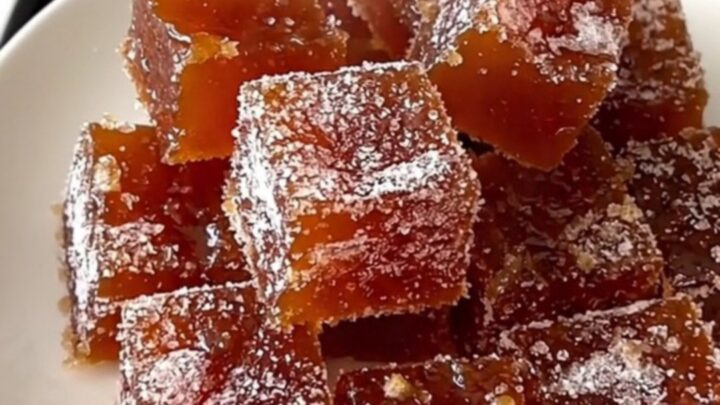
- Blend and setTransfer the cooked quince mixture to a blender or food processor and purée until completely smooth. Pour the mixture into a parchment-lined baking dish, smoothing the top with a spatula. Allow the paste to cool completely at room temperature, then refrigerate until firm and sliceable.Look for The paste is ready when it is firm to the touch and holds its shape when sliced into squares.Tip Lightly dust the finished squares with a little extra granulated sugar if desired for a traditional presentation.
Once blended, the paste should look like a thick, smooth, and glossy purée. After cooling in the refrigerator, it will transform into a dense, solid block that can be easily sliced into neat squares, ready for serving alongside your favorite accompaniments.
Common mistakes
A common mistake is failing to peel or core the quince properly, which can leave hard, gritty bits in the otherwise smooth paste. Another error is neglecting the final reduction phase; if the mixture is too liquid when transferred to the baking dish, it will not set properly.
Avoid the temptation to increase the heat to speed up the process, as this will likely result in burnt edges and a bitter flavor rather than the desired sweet, concentrated fruit essence.
How to tell it’s done
The quince paste is done when the mixture has achieved a thick, jam-like consistency that is smooth and holds its shape when cooled. The color should be a deep, dark ruby-amber, indicating that the sugars have caramelized properly.
When touched, the surface of the set paste should feel firm and slightly tacky, but not sticky or runny. If the mixture feels too soft, it needs additional time to cook down or cool in the refrigerator to reach the desired sliceable texture.
Up next · Part 3 of 3
2 variations · storage & make-ahead · 3 answers · printable card
Tips, FAQ & printable recipe (Part 3)← Back to the ingredients (Part 1)