Desserts · Part 2 of 3: Instructions
Easy Glazed Donut Bread Pudding with Cinnamon Sugar Step-by-step instructions
- Prep
- Cook
- Total
- Serves
- 6
Before you start
Preheat your oven to 350°F (175°C) to ensure it reaches the correct temperature before the pudding goes in.
Arrange the baking dish on a stable workspace, and have the vanilla custard and cinnamon sugar measured and ready for assembly.
Check that you have enough room in your oven for the dish, and ensure your serving spoon is clean and ready for the final presentation.
Ingredients at a glance (3)
- 8 plain glazed ring donuts, torn into chunks
- 2 cups vanilla custard
- 2 tbsp cinnamon sugar
Instructions
Base Preparation
- Prepare the Donut BasePlace the torn chunks of plain glazed ring donuts into a large rectangular ceramic baking dish. Ensure the pieces are distributed evenly across the bottom of the dish to allow for consistent custard absorption during the soaking process.Look for The dish is filled with donut pieces.Tip Use slightly stale donuts as they hold their shape better when soaked in custard.
The donut chunks should fill the baking dish in a loose, even layer. Ensure the pieces are roughly uniform in size to promote even soaking of the custard during the next phase of the process.
Custard Incorporation
- Add Custard and ToppingPour the vanilla custard evenly over the torn donut pieces in the baking dish, ensuring every piece is well-moistened. Sprinkle the cinnamon sugar uniformly over the top of the custard-soaked donuts to create a flavorful crust while baking.Look for The custard is absorbed into the donut pieces.Tip Let the mixture sit for five minutes before baking to ensure deep absorption.
The custard should be poured slowly to ensure even coverage. Look for the liquid to seep into the crevices between the donut chunks. The cinnamon sugar should be sprinkled in a light, even dusting across the entire surface.
Final Baking
- Bake the PuddingPlace the baking dish into a preheated oven at 350°F (175°C). Bake until the top is golden and crackly, and the internal temperature reaches 160°F (71°C) to ensure the eggs in the custard are fully cooked. Remove from the oven and let rest before serving.Look for The top is puffed, golden, and crackly.Safe temperature 160°F (71°C) internal temperature (egg dishes)Tip Cover loosely with foil if the top browns too quickly before the center sets.
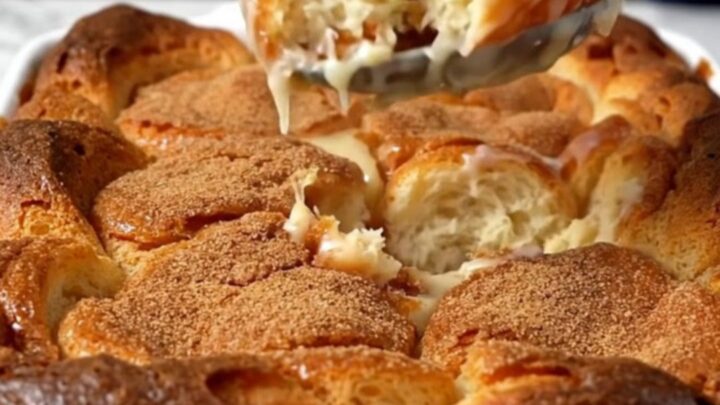
The pudding is finished when the top is golden brown and crackly. The center should be firm to the touch, and the internal temperature must reach the required 160°F (71°C) to ensure the custard is fully cooked.
Common mistakes
Avoid over-soaking the donuts, which can lead to a dense, soggy texture rather than a light, custardy one. Another common mistake is using a dish that is too deep, which prevents the center from setting properly while the top browns.
Always use a thermometer to verify the internal temperature rather than relying solely on the visual appearance of the crust.
How to tell it’s done
The bread pudding is done when the custard is fully set and the top has puffed up and turned a deep, golden brown.
A knife inserted into the center should come out clean, and the internal temperature must reach 160°F (71°C). The edges should look slightly crisp and pulled away from the sides of the ceramic dish.
- Egg dishes: 160°F (71°C) in the thickest part
Up next · Part 3 of 3
2 variations · storage & make-ahead · 3 answers · printable card
Tips, FAQ & printable recipe (Part 3)← Back to the ingredients (Part 1)