Desserts · Part 2 of 3: Instructions
Easy Crockpot Pistachio Baklava Custard Cake Step-by-step instructions
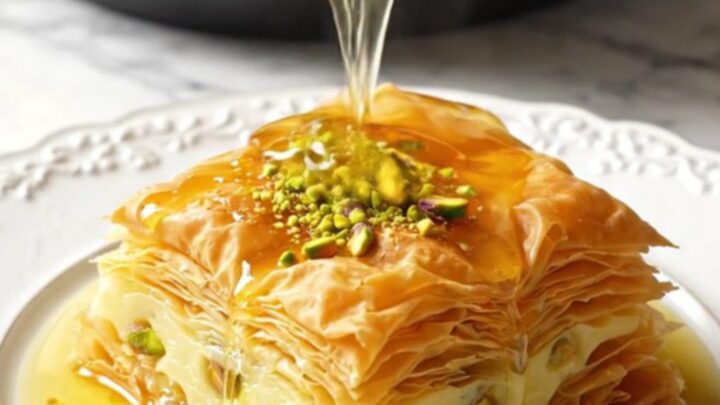
- Prep
- Cook
- Total
- Serves
- 8
Before you start
Before you begin, ensure your filo pastry has been thawed in the refrigerator overnight. Prepare your ingredients by finely chopping the roasted pistachios and measuring out the honey and orange blossom water.
Have your butter melted and ready, and place a clean paper towel nearby. Clear a space on your counter for the Crockpot and ensure you have a pastry brush and a whisk ready. Organizing your workspace ahead of time is essential for smooth assembly.
Ingredients at a glance (5)
- 1 package filo pastry, thawed
- 1/2 cup unsalted butter, melted
- 2 cups roasted pistachios, finely chopped
- 1 tsp ground cinnamon
- 1 batch warm honey-orange-blossom custard
Instructions
Layering the pastry
- Layering the pastryBrush the bottom and sides of the Crockpot with a little melted butter. Take the filo pastry sheets, ruffle each sheet individually, and arrange them in the bottom of the Crockpot to create volume and texture. Sprinkle the finely chopped pistachios and ground cinnamon evenly between the layers of ruffled filo, ensuring they are well distributed to provide a nutty crunch in every bite.Look for The filo should look light and ruffled like a mountain range rather than pressed flat.Tip Keep the filo covered with a damp towel while working to prevent it from drying out and cracking.
At this stage, you should have a beautiful, ruffled layer of filo pastry in your Crockpot. Check that the butter has been applied evenly to the sheets to encourage crispiness. The pistachios and cinnamon should be scattered throughout, creating a consistent flavor base.
Ensure the pastry is not packed too tightly, as this will prevent the custard from flowing through the layers effectively. Everything should look neat, airy, and ready for the liquid component.
Adding the custard
- Adding the custardPour the warm honey-orange blossom custard mixture evenly over the ruffled filo and nut layers in the slow cooker. Ensure the custard reaches every part of the pastry so it can soak in and bind the layers together during the cooking process.Look for The custard should be fully incorporated into the filo layers.Tip Pour slowly to ensure even coverage across all ruffled pastry edges.
The custard should be a smooth, pale golden mixture with no visible streaks of egg whites. When poured over the filo, it should seep into the gaps naturally. Verify that the custard has reached the bottom of the Crockpot.
If you notice any dry spots of filo on top, you can gently nudge the pastry to allow the liquid to distribute. The assembly should now look like a moist, well-integrated mixture ready for the gentle heat of the slow cooker.
Slow cooking the bake
- Slow cooking the bakePlace a clean paper towel over the top of the Crockpot bowl before securing the lid; this helps absorb excess moisture and keeps the top crispy. Set the Crockpot to high and cook for 2 hours. Once the custard has set and the edges are bubbling with honey syrup, verify the internal temperature of the custard reaches 160°F (71°C) to ensure the eggs are fully cooked through.Look for The edges should be golden and bubbling, and the center should be firm to the touch.Safe temperature 160°F (71°C) internal temperature (egg dishes)Tip Do not lift the lid during the first 90 minutes to maintain consistent heat.
After two hours, the bake should look golden and smell intensely aromatic with hints of honey and orange blossom. The custard should be fully set and wobble slightly but firmly. The edges should show bubbling honey, indicating the sugars have caramelized properly.
Before serving, verify the internal temperature of the center to ensure safety. The final result should be a harmonious blend of crispy pastry, crunchy nuts, and a delicate, sweet custard.
Common mistakes
Avoid skipping the paper towel step, as it is crucial for preventing condensation from dripping back onto the filo, which would make the top soggy. Do not rush the cooking time; opening the lid too frequently lets heat escape, which can lead to an uneven set. Additionally, be careful not to press the filo layers down too hard; the ruffling is intentional to create texture and space for the custard to permeate, so keep it loose and airy.
How to tell it’s done
The bake is done when the custard has set firmly in the center and the edges are golden brown and bubbling. Using a digital thermometer, check the center of the custard to ensure it reaches a safe internal temperature of 160°F (71°C). The pastry should be crisp to the touch, and the overall dish should look cohesive and hold its shape when scooped. Allow it to rest for about 15 minutes before serving to let the custard stabilize.
- Egg dishes: 160°F (71°C) in the thickest part
Up next · Part 3 of 3
2 variations · storage & make-ahead · 3 answers · printable card
Tips, FAQ & printable recipe (Part 3)← Back to the ingredients (Part 1)