Dinner · Part 2 of 3: Instructions
Easy Crockpot Meatball Stew with Rich Brown Gravy Step-by-step instructions
- Prep
- Cook
- Total
- Serves
- 6
Before you start
Before starting, gather all the ingredients and prepare the potatoes. Cut the potatoes into uniform chunks so they cook evenly. Having everything prepped makes assembly incredibly fast.
Ensure the meatballs are kept refrigerated until the exact moment you are ready to assemble the stew. Clean and sanitize the prep area, cutting boards, and utensils after handling the ingredients to maintain high food safety standards in the kitchen.
Ingredients at a glance (3)
- 4 large potatoes, cut into chunks
- 24 seasoned meatballs
- 3 cups thick brown gravy
Instructions
Layering the Ingredients
- Layer the Potatoes and MeatballsPlace the potato chunks in an even layer at the bottom of a slow cooker. Arrange the seasoned meatballs gently on top of the potatoes to ensure they cook evenly without breaking apart.Look for The potatoes and meatballs should be evenly distributed.Tip Keep the meatballs in a single layer if possible.
At the end of this phase, the bottom of the slow cooker is lined with a clean layer of chopped potatoes.
The seasoned meatballs are arranged uniformly on top of the potatoes, ready to be covered with the rich gravy. There should be no loose ingredients outside the slow cooker crock.
Slow Cooking and Simmering
- Pour the Brown GravyPour the thick brown gravy evenly over the meatballs and potatoes in the slow cooker, ensuring all ingredients are well coated.Look for The gravy should cover most of the ingredients.Tip Use a spatula to get every last drop of gravy into the pot.
- Slow Cook the StewCover the slow cooker with the lid. Cook on low for six to eight hours, or on high for three to four hours, until the potatoes are tender and the meatballs reach a safe internal temperature of 160°F (71°C).Look for The stew should be bubbling gently and steaming.Safe temperature 160°F (71°C) internal temperature (ground meat)Tip Avoid lifting the lid during cooking to keep the heat trapped.
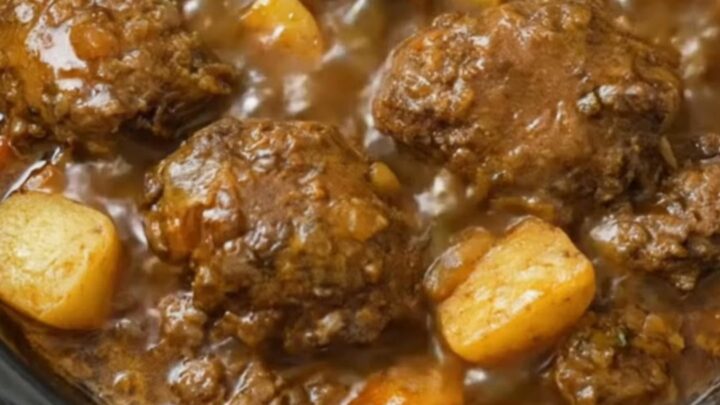
After several hours of slow cooking, the kitchen will be filled with a rich, savory aroma. The meatballs will appear fully opaque and firm, and the potatoes will be fork-tender. Gentle steam will rise from the slow cooker, and the gravy will be hot and bubbling around the edges.
Resting and Thickening
- Stir and RestGently stir the stew to combine the bubbling gravy with the tender meatballs and potatoes. Let the stew rest for ten minutes before serving to allow the gravy to thicken slightly.Look for The gravy should look glossy and cling to the meatballs.Tip Stir very gently so the soft potatoes do not break.
At the final checkpoint, the gravy is bubbling gently, having transformed into a thick, glossy, and glistening brown sauce that clings beautifully to the meatballs and potatoes. The stew looks incredibly rich, steaming hot, and ready to be ladled into bowls for a comforting meal.
Common mistakes
One common mistake is stirring the stew too vigorously during the cooking process, which can break apart the tender meatballs and turn the potatoes into mush. Stir gently only at the very end.
Another error is lifting the slow cooker lid frequently; every time the lid is opened, significant heat escapes, which can extend the cooking time by twenty minutes per lift. Finally, ensure the potatoes are cut to a uniform size so they all finish cooking at the same time.
How to tell it’s done
To determine doneness, insert an instant-read food thermometer into the center of several meatballs. The internal temperature must reach at least 160°F (71°C) to ensure the ground meat is safely cooked through.
Additionally, the potatoes should be easily pierced with a fork but still hold their shape without collapsing. The brown gravy should be thick enough to coat the back of a spoon, glistening under the light, and bubbling gently around the edges of the slow cooker.
- Ground meat: 160°F (71°C) in the thickest part
Up next · Part 3 of 3
2 variations · storage & make-ahead · 3 answers · printable card
Tips, FAQ & printable recipe (Part 3)← Back to the ingredients (Part 1)