Dinner · Part 2 of 3: Instructions
Easy Baked Cream Cheese Chicken Step-by-step instructions
- Prep
- Cook
- Total
- Serves
- 4
Before you start
Before beginning the cooking process, ensure all ingredients are measured and ready to go. Soften the cream cheese at room temperature for at least thirty minutes so it blends smoothly with the dried herbs without clumping.
Clean and dry the fresh parsley, then chop it finely for the final garnish. Preheating the oven to 375°F (190°C) ensures a hot environment for baking. Keep the raw chicken breasts refrigerated until the exact moment they are placed into the skillet to maintain proper food safety.
Ingredients at a glance (4)
- 4 pieces boneless skinless chicken breasts
- 8 oz cream cheese, softened
- 1 tbsp dried herbs
- 2 tbsp fresh parsley, chopped
Instructions
Preparing the Chicken and Topping
- Prepare the ChickenPlace the boneless, skinless chicken breasts in a single layer inside a skillet. Keep the chicken cold in the refrigerator until you are ready to assemble the dish to maintain food safety.Look for The chicken breasts should fit comfortably in the skillet without overlapping.Tip Pat the chicken dry with paper towels before placing it in the skillet to help the topping adhere.
- Mix the Herb ToppingIn a medium mixing bowl, vigorously stir the softened cream cheese and dried herbs together until the mixture is completely smooth and the herbs are evenly distributed.Look for The mixture should be creamy and uniform, with no white lumps remaining.Tip Make sure the cream cheese is fully softened to room temperature for easy mixing.
At the end of this initial phase, the chicken breasts are arranged in the skillet, and the cream cheese mixture is completely smooth and uniform. The dried herbs should be distributed evenly throughout the cheese, with no white lumps remaining. The kitchen will begin to smell faintly of fresh herbs as the topping is prepared.
Assembling the Dish
- Spread the ToppingCarefully spread the prepared creamy herb topping evenly over the top of each chicken breast in the skillet, ensuring each piece is fully covered.Look for Each breast should be heavily blanketed with the cheese topping.Tip Use the back of a spoon or a small spatula to spread the mixture smoothly.
The cream cheese mixture should form a thick, secure layer that completely blankets the chicken breasts. The topping should cling to the meat without sliding off, ensuring that every inch of the chicken is protected and ready for the oven.
Baking and Finishes
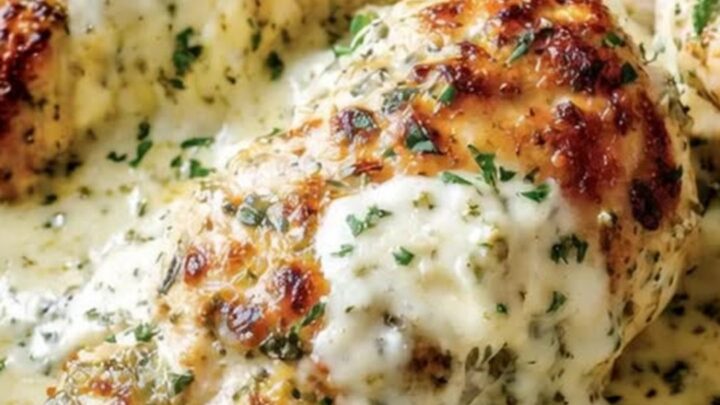
- Bake the ChickenPlace the skillet into a preheated oven at 375°F (190°C). Bake for 20 to 25 minutes, or until the cream cheese topping is bubbling vigorously and has a golden-brown crust. Ensure the chicken reaches a safe internal temperature of 165°F (74°C) using a meat thermometer inserted into the thickest part. Let the chicken rest for 5 minutes before serving.Look for The sauce is bubbling vigorously and the topping is golden-brown.Safe temperature 165°F (74°C) internal temperature (poultry)Tip Insert the thermometer into the thickest part of the meat without touching the pan.
- Garnish and ServeSprinkle the freshly chopped parsley over the bubbling, glistening chicken breasts just before serving.Look for The bright green parsley should contrast beautifully with the golden cheese sauce.Tip Serve immediately while the cheese is molten and warm.
The dish is ready when the cream cheese topping is bubbling vigorously and has developed a beautiful, glistening golden-brown crust. Rising steam will carry the rich aroma of melted cheese and herbs throughout the room.
The chicken juices will have combined with the melting cheese to form a thick, cohesive sauce. A meat thermometer inserted into the thickest part must read 165°F (74°C).
Common mistakes
One common mistake is using cold cream cheese directly from the refrigerator, which makes it incredibly difficult to spread smoothly over the chicken. This can cause the cheese to slide off or tear the chicken surface.
Another error is overcooking the chicken, as breasts can quickly become dry and chalky if left in the oven past their safe temperature. Lastly, ensure the chicken breasts are not overlapping in the skillet, which can lead to uneven cooking.
How to tell it’s done
Determining the exact doneness of poultry requires a reliable instant-read meat thermometer rather than visual cues alone. Insert the thermometer probe into the thickest part of the largest chicken breast, making sure not to touch the bottom of the skillet.
The chicken is fully cooked and safe to consume when the internal temperature reaches exactly 165°F (74°C). Once this temperature is achieved, remove the skillet from the oven immediately and let the meat rest for five minutes to allow the juices to redistribute.
- Poultry: 165°F (74°C) in the thickest part
Up next · Part 3 of 3
2 variations · storage & make-ahead · 3 answers · printable card
Tips, FAQ & printable recipe (Part 3)← Back to the ingredients (Part 1)