Dinner · Part 2 of 3: Instructions
Crispy Duck Fat Roasted Fingerlings with Cipollini Onions Step-by-step instructions
- Prep
- Cook
- Total
- Serves
- 4
Before you start
Before you begin, heat the oven to 425°F (220°C) and place a cast-iron skillet inside to preheat. Halve the fingerling potatoes and peel the cipollini onions, keeping them whole. Measure the duck fat and melt it gently if it's solid.
Strip the rosemary leaves from the stems for the crispy garnish, and have the aged balsamic vinegar measured in a small bowl. Set out the kosher salt and flaky salt so they are within reach.
Ingredients at a glance (8)
- 500 g fingerling potatoes
- 200 g baby cipollini onions
- 60 g duck fat
- 1 tbsp kosher salt
- 4 sprigs fresh rosemary
- 2 tbsp aged balsamic vinegar
- Crispy fried rosemary needles, for serving
- Flaky salt, for serving
Instructions
Prep and Sear
- Prep the VegetablesHeat the oven to 425°F (220°C). Halve the fingerling potatoes lengthwise. Peel the cipollini onions, trimming the root end but keeping them intact. In a large bowl, toss the potatoes and onions with the melted duck fat, kosher salt, and 4 sprigs of fresh rosemary, making sure everything is well coated.Look for The potatoes and onions are evenly coated with glossy duck fat and seasoned throughout.Tip Use a heavy cast-iron skillet for the best heat retention and crust formation.
- Preheat the SkilletPlace a cast-iron skillet in the oven while it preheats. Once the oven reaches temperature, carefully remove the hot skillet and add the seasoned vegetables, arranging them cut-side down in a single layer. Return the skillet to the oven immediately.Look for The skillet is hot enough that the vegetables sizzle when they touch the surface.Tip Be cautious when handling the hot skillet; use thick oven mitts.
At the end of phase 1, the vegetables are coated in duck fat and arranged cut-side down in the preheated skillet. The potatoes should sizzle when they touch the pan, and the rosemary sprigs are tucked between them. The onions are nestled among the potatoes, and the whole skillet is ready to go into the oven. You should see a slight shimmer of fat around the edges.
Roast and Glaze
- Roast the PotatoesRoast the vegetables cut-side down for 28 minutes, without stirring, until the flat faces of the potatoes develop a deep mahogany crust and the onions are caramelized at the edges. The potatoes should be tender when pierced with a knife.Look for The potato cut sides are deeply browned and crisp, and the onions are golden and softened.Tip Resist the urge to flip; leaving them undisturbed builds the crust.
- Glaze with BalsamicRemove the skillet from the oven and drizzle the aged balsamic vinegar over the hot vegetables. Return the skillet to the oven for 60 seconds, allowing the balsamic to caramelize and glaze the potatoes and onions with a sticky, glossy finish.Look for The balsamic bubbles and reduces, coating the vegetables with a shiny glaze.Tip Watch closely to prevent the balsamic from burning; 60 seconds is enough.
After 28 minutes, the cut sides of the potatoes should be a deep mahogany brown, and the onions should be caramelized and soft. The kitchen will smell rich and savory.
When you add the balsamic, it will bubble and steam immediately, and after 60 seconds, the vegetables should be glossy with a sticky sheen. Do not let the balsamic burn; it should smell sweet and tangy, not acrid.
Finish and Serve
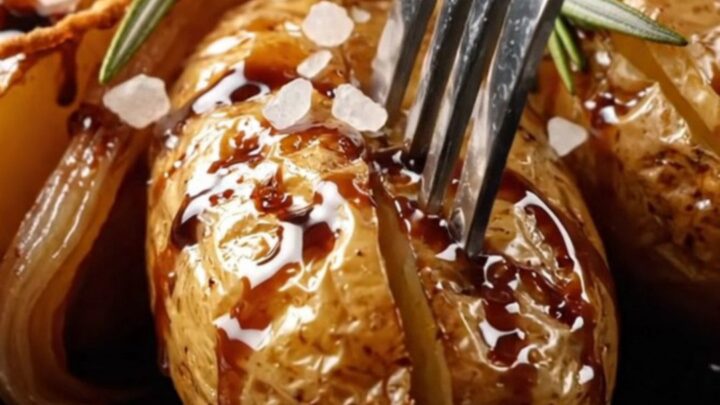
- Finish and ServeTransfer the roasted potatoes and onions to a serving platter. Scatter crispy fried rosemary needles over the top and finish with a sprinkle of flaky salt. Serve immediately while hot and crisp.Look for The potatoes are glossy with balsamic, topped with crispy rosemary and sparkling salt flakes.Tip For extra crispness, serve straight from the skillet if preferred.
Once plated, the potatoes and onions are coated in a dark, sticky glaze, topped with crispy fried rosemary needles and sparkling flakes of salt. The dish looks glossy and appetizing, with visible browned crusts on the potato cut sides. The rosemary adds a fragrant, herbal note, and the flaky salt provides a final burst of seasoning. Serve immediately to enjoy the crisp texture.
Common mistakes
The most common mistake is overcrowding the skillet, which traps steam and prevents browning. Use a large enough pan so the potatoes are in a single layer with a little space between them.
Another mistake is stirring the vegetables during roasting; this disrupts crust formation. Let them roast undisturbed for the full 28 minutes. Finally, do not add the balsamic too early; it should only caramelize for 60 seconds, or it can turn bitter.
How to tell it’s done
The potatoes are done when they are deeply browned on the cut sides, with a crust that crackles when pierced with a fork. The interiors should be tender and fluffy, and the onions should be soft and caramelized with golden edges.
After the balsamic glaze, the vegetables should look glossy and sticky. Since this dish has no protein, no internal temperature check is needed; rely on visual and textural cues.
Up next · Part 3 of 3
4 variations · storage & make-ahead · 5 answers · printable card
Tips, FAQ & printable recipe (Part 3)← Back to the ingredients (Part 1)