Desserts · Part 2 of 3: Instructions
Decadent Tiramisu Cheesecake with Coffee Crust Step-by-step instructions
- Prep
- Cook
- Total
- Serves
- 12
Before you start
Before beginning, ensure all refrigerated ingredients have reached room temperature to facilitate a smooth, lump-free batter. Preheat the oven to 325°F (163°C) and prepare a 9-inch springform pan by wrapping the exterior base securely with heavy-duty aluminum foil.
Brew the espresso and let it sit until completely cool. Have your piping bag ready if you intend to decorate with extra mascarpone, and ensure you have a large roasting pan available to act as the water bath container.
Ingredients at a glance (8)
- 500 g mascarpone cheese
- 450 g cream cheese
- 200 g granulated sugar
- 3 large eggs
- 45 ml Marsala wine
- 1 package Savoiardi ladyfingers
- 1 cup strong espresso, brewed and cooled
- 2 tbsp Dutch cocoa powder, for dusting
Instructions
Filling Preparation
- Prepare the FillingIn a large mixing bowl, combine the mascarpone cheese, cream cheese, and granulated sugar. Beat on medium speed until smooth and creamy. Add the eggs one at a time, mixing well after each addition. Incorporate the Marsala wine until fully combined, ensuring the texture remains silky and uniform throughout the mixture.Look for The mixture should be completely smooth, glossy, and free of any lumps.Tip Ensure the cream cheese and mascarpone are at room temperature to avoid lumps in the batter.
The filling should look thick, pale, and completely smooth. When lifted with a spatula, it should fall in a heavy ribbon without showing any streaks of unmixed cream cheese or pockets of sugar. Check that the mascarpone and cream cheese are fully incorporated into a unified, glossy mixture that smells lightly of vanilla and wine.
Assembly and Baking
- Layer and BakePour a portion of the batter into the prepared springform pan. Briefly dip the ladyfingers into the cooled espresso and arrange them in the center of the batter. Cover with the remaining batter. Place the pan in a larger tray filled with hot water to create a gentle water bath. Bake at 325°F (163°C) for 55 minutes, or until the center is set and reaches 160°F (71°C) to cook the eggs through.Look for The cheesecake should look set around the edges but remain slightly wobbly in the center.Safe temperature 160°F (71°C) internal temperature (egg dishes)Tip Do not over-soak the ladyfingers; a quick dip is sufficient to prevent the cake from becoming soggy.
The ladyfingers should be evenly distributed within the batter, completely submerged to ensure they stay moist. The water bath should reach about halfway up the sides of the springform pan.
The cheesecake will look set around the perimeter and have a soft, trembling center that indicates it is ready to be removed from the heat, though note the eggs must reach 160°F (71°C) to be fully cooked through.
Final Decoration
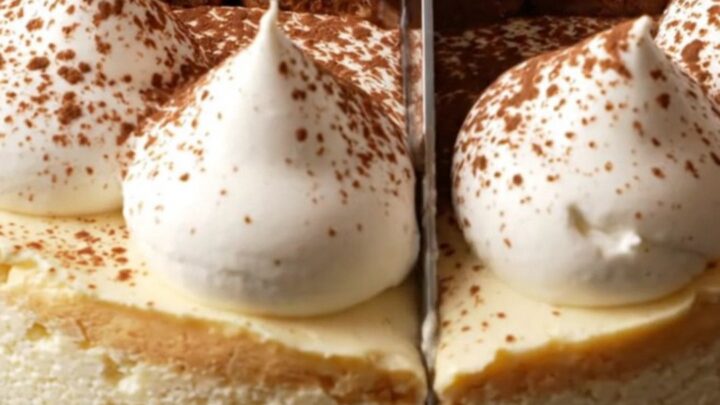
- Finish and ChillRemove the cheesecake from the oven and allow it to cool completely on a wire rack. Once cooled, refrigerate for at least two hours to firm up. Before serving, pipe mascarpone chantilly peaks on top and dust generously with Dutch cocoa powder using a fine mesh sieve. Slice carefully and serve chilled.Look for The top should be firm to the touch and the cocoa powder should form a smooth, velvet-like layer.Tip Use a warm, dry knife for clean, professional-looking slices.
The cheesecake should be completely firm and chilled throughout. The piped mascarpone peaks should hold their shape, and the cocoa powder should be distributed in a thin, even layer across the entire surface. The interior should reveal distinct, dark coffee-soaked layers contrasted against the light, ivory-colored cheesecake base.
Common mistakes
A common error is over-mixing the batter after adding the eggs, which can incorporate excess air and cause the cake to puff up and then collapse during cooling. Another mistake is using hot espresso for the ladyfingers, which can cause them to disintegrate before the cake even enters the oven.
Always use room temperature dairy to ensure a smooth emulsion. Finally, neglecting the water bath can result in uneven cooking or a dry, cracked surface that ruins the presentation.
How to tell it’s done
The cheesecake is done when the edges are firm and slightly puffed, while the center still has a slight, uniform jiggle. Using an instant-read thermometer, the center should reach 160°F (71°C), ensuring the eggs are fully cooked.
Avoid over-baking, as this will lead to a dense or grainy texture rather than the desired creamy consistency. Allow the cake to cool gradually in the oven with the door slightly ajar to prevent sudden temperature shocks that could cause cracking.
- Egg dishes: 160°F (71°C) in the thickest part
Up next · Part 3 of 3
2 variations · storage & make-ahead · 3 answers · printable card
Tips, FAQ & printable recipe (Part 3)← Back to the ingredients (Part 1)