Desserts · Part 2 of 3: Instructions
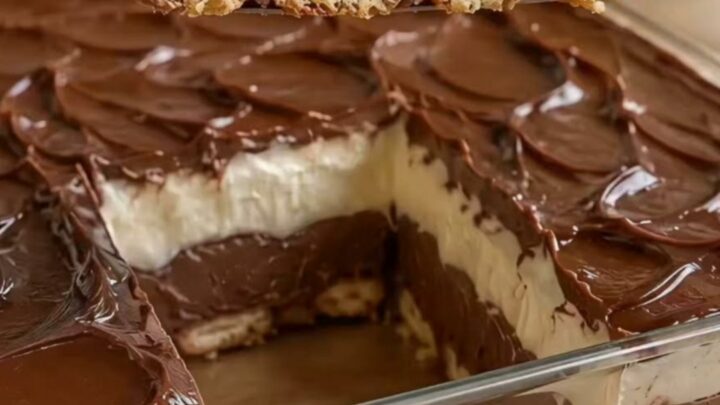
Decadent Chocolate and Vanilla Bonbon Pavé Step-by-step instructions
- Prep
- Cook
- Total
- Serves
- 8
Before you start
Before you begin, ensure all ingredients are measured and ready to use. Chop the chocolate into very small, uniform pieces to ensure it melts evenly when the hot cream is added.
Prepare your glass baking dish by clearing a space in the refrigerator, as the dish will need to go in immediately after assembly. Having your spatula and whisk within reach will make the assembly process much smoother and more efficient.
Ingredients at a glance (5)
- 24 count tea biscuits
- 1 cup whole milk
- 1 1/2 cups vanilla pastry cream, store-bought or made ahead
- 8 oz dark chocolate, chopped
- 1/2 cup heavy cream
Instructions
Base assembly
- Prepare the biscuit baseDip each tea biscuit briefly into the whole milk, ensuring they are moistened but not soggy. Arrange the soaked biscuits in an even layer at the bottom of the glass baking dish to create a solid foundation for the dessert.Look for The biscuits should be soft enough to hold together but not falling apart when lifted.Tip Work quickly so the biscuits do not absorb too much milk and lose their structure.
The biscuit base should be completely uniform, covering the entire bottom of the dish without any large gaps. Each biscuit must be adequately moistened so that it becomes tender, but not so saturated that it turns into a mushy paste. Check that the layer is level and firm before moving on to the cream.
Cream layering
- Assemble the vanilla layerSpread a generous, even layer of the vanilla pastry cream over the prepared biscuit base. Use a flat spatula to smooth the surface, ensuring the cream reaches all the edges of the glass dish for a clean, layered look.Look for The cream layer should be perfectly smooth and level across the entire dish.Tip Chill the dish for fifteen minutes after this step to help the cream layer set slightly before adding the ganache.
The vanilla cream layer should appear smooth and consistent across the surface. Ensure that there are no visible lumps in the pastry cream and that it is spread all the way to the edges of the glass dish. The surface should be flat, providing an ideal canvas for the final chocolate ganache layer.
Ganache finish
- Finish with ganacheHeat the heavy cream until just simmering, then pour it over the chopped dark chocolate. Whisk until smooth and glossy. Pour the chocolate ganache over the vanilla cream layer and swirl gently with a spatula to create an even, decadent top finish. Refrigerate for at least two hours before slicing.Look for The ganache should be completely smooth, glossy, and free of any lumps.Tip Use a warm, dry knife when slicing the chilled pavé to get clean, professional-looking edges.
The ganache should have a deep, mirror-like shine and a uniform, dark color. When you swirl the ganache, it should move slowly and smoothly over the vanilla cream.
Ensure the entire surface is covered completely, with no patches of vanilla cream visible, before placing the dish into the refrigerator to set.
Common mistakes
A common mistake is using chocolate that is chopped too coarsely, which can lead to unmelted lumps in the ganache. Another error is rushing the chilling process; if the dessert is sliced too soon, the layers will slide apart and lose their definition.
Always ensure the vanilla cream is spread evenly, as air pockets can form if the edges are not properly filled, which might compromise the structural integrity of the final slice.
How to tell it’s done
The pavé is considered done once it has been thoroughly chilled in the refrigerator for at least two hours. The ganache should be firm to the touch, and the entire dessert should hold its shape when lifted with a spatula.
If the ganache remains tacky or soft, continue to refrigerate until it sets completely, as this is crucial for achieving the clean, distinct layers characteristic of a professional pavé.
Up next · Part 3 of 3
2 variations · storage & make-ahead · 3 answers · printable card
Tips, FAQ & printable recipe (Part 3)← Back to the ingredients (Part 1)