Dinner · Part 2 of 3: Instructions
Crockpot Sausage and Sage Stuffing — Hands-Off Holiday Side Step-by-step instructions
- Prep
- Cook
- Total
- Serves
- 8
Before you start
Start the day before if the schedule allows: cut the loaf into cubes and leave them out overnight to dry, or shortcut with twenty minutes in a 300°F (150°C) oven. On cooking day, dice the celery and onion into small, even pieces, remove the casings from the sausage if it has them, and set everything beside the cooker in the order it will be used.
Melt the butter into the broth in a small saucepan just before assembly so it pours warm. Confirm the insert is clean and the cooker is positioned with clearance around it, then grease it lightly if the model tends to stick. With the mise in place, the whole assembly takes about five minutes.
Ingredients at a glance (7)
- 12 cups dried bread cubes (about 1 pound, cut from day-old bread)
- 1 lb raw breakfast sausage, casings removed
- 3 celery stalks, diced
- 1 yellow onion, diced
- 2 tsp rubbed sage
- 2 1/2 cups chicken broth
- 6 tbsp unsalted butter
Instructions
Prep the bread and vegetables
- Dry the bread cubesCut a day-old loaf into cubes about 3/4 inch across and spread them in a single layer on a baking sheet. Leave them at room temperature overnight, or dry them in a 300°F (150°C) oven for about 20 minutes, stirring once halfway through.Look for The cubes feel crisp at the edges and no longer bend when pressed.Tip Fully dried bread drinks up the buttery broth without turning to paste, the single biggest win for texture.
- Dice the celery and onionTrim the celery and cut the stalks into small, even dice, then do the same with the onion. Aim for pieces close in size to the sausage crumbles so every scoop of the finished stuffing has a little of everything in it.Look for Uniform dice, roughly 1/4 inch, with no large pale chunks of onion left behind.Tip Small pieces soften completely during the long, gentle cook, so nobody bites into a raw crunch.
At the end of this phase, the bread cubes are fully dried — crisp at the edges, light in the hand, and no longer bending under gentle pressure. The celery and onion sit in a small, even dice, roughly a quarter inch, with no thick pale chunks left. Nothing is cooked yet, and nothing should be: this phase is about texture and size, the two things that cannot be fixed later.
If the cubes still feel soft or springy, give them more drying time before moving on; if the dice is uneven, trim the large pieces now. Everything else in the recipe depends on this groundwork, so treat it as the foundation it is rather than a formality.
Build the layers
- Layer the bread into the insertPlace the dried bread cubes in the stoneware insert of a 6-quart slow cooker, filling it loosely rather than packing it down. Leave an inch of headspace at the rim so the stuffing has room to swell as it absorbs the broth.Look for The insert holds all the cubes loosely, with visible air pockets between them.Tip Packed bread steams unevenly; a loose fill lets heat and moisture travel through every cube.
- Scatter the sausage and vegetablesPinch the raw sausage into small crumbles directly over the bread, then scatter the diced celery and onion across the top. Distribute them evenly rather than leaving them in one layer, so the flavor reaches every corner of the cooker.Look for Crumbles the size of a marble, spread edge to edge over the bread.Tip Keep raw sausage away from ready-to-eat foods and wash hands and surfaces after handling.
- Sprinkle the sageSprinkle the rubbed sage evenly over the sausage and vegetables, letting it fall across the whole surface rather than in one spot. The long, slow cook blooms the herb gently, carrying its warm, earthy flavor through the entire dish.Look for A fine, even green-gray dusting across the top of everything.Tip Rubbed sage disperses better in a slow cooker than whole leaves, which can stay tough.
- Pour in the buttery brothMelt the butter into the chicken broth in a small saucepan over low heat, whisking until the two come together. Pour the warm mixture slowly and evenly over the stuffing, pausing to let it soak in rather than pooling in one place.Look for The bread darkens as it drinks the liquid, with no dry corners left on top.Tip Pouring warm broth starts the absorption right away, which helps the cooker reach temperature sooner.
Assembly complete, the insert tells the whole story at a glance: a loose bed of bread cubes filling the stoneware to about an inch below the rim, sausage crumbles and vegetables scattered edge to edge, an even dusting of rubbed sage across the top, and the buttery broth just poured, darkening the bread as it soaks in.
No corner should stay dry and no spot should flood. The surface should glisten, not swim. Before the lid goes on, tilt the insert slightly and watch for liquid running freely — a little at the bottom is fine, a visible pool means the pour was concentrated and should be nudged outward with a spoon. The cooker then goes on low with the lid seated firmly.
Cook, check and serve
- Cover and cook on lowPut the lid on the slow cooker and cook on low for about 4 hours, without lifting the lid during the first 3. The sausage crumbles cook gently right in the stuffing and finish safely at 160°F (71°C) measured in the center.Look for Steam collects under the lid and the edges of the stuffing look set and pull slightly from the walls.Safe temperature 160°F (71°C) internal temperature (ground meat)Tip Every peek releases heat and can add 15 to 20 minutes to the cook time.
- Check, fluff and serveVerify the sausage reaches 160°F (71°C) at the center, then remove the lid and fluff the stuffing with a spoon, breaking up any clumps. Let it stand uncovered for a couple of minutes so steam escapes, then scoop onto plates and serve hot.Look for Moist, tender cubes with golden-tan edges, fully browned sausage and no trace of pink.Tip A few minutes uncovered at the end dries the surface just enough for those appealing golden edges.
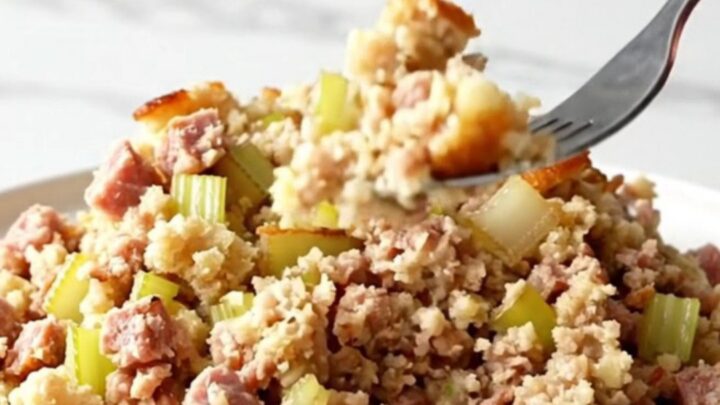
After about four hours on low, lift the lid to a wave of steam and a dish that looks finished: moist, tender cubes with golden-tan edges, fully browned sausage crumbles, soft celery, and a surface that pulls slightly from the walls. The smell is warm sage and savory sausage, unmistakably stuffing. Press a spoon into the center — it should hold its mark without liquid flooding back. Confirm 160°F (71°C) in the thickest spot before anything else, then fluff with a spoon and let it stand uncovered for a couple of minutes so the edges take on a little extra color. Scoop onto plates while hot and serve right away.
Common mistakes
The most common failure is bread that was never truly dried. Moist cubes turn to paste under the lid, so dry them fully before they go in. The second mistake is packing the insert; compressed bread steams unevenly and stays dense in the middle, so fill loosely with headspace at the rim.
Pouring all the broth into one corner is another trap — spread it slowly across the surface instead. Lifting the lid early and often releases heat and stretches the cook time, so wait at least three hours before checking. Finally, do not skip the thermometer: the only reliable doneness test for sausage is 160°F (71°C) at the center, not appearance alone.
How to tell it’s done
The stuffing is done when the sausage reads 160°F (71°C) at the center of the insert, verified with an instant-read thermometer pushed into the thickest part. Visually, the bread cubes look moist and tender with golden-tan edges, the sausage crumbles are fully browned with no trace of pink anywhere, and the celery has softened completely. The top should look set rather than soupy: press a spoon gently into the surface and it should hold the impression. If liquid still pools when the spoon is drawn across, cook uncovered on high for 20 to 30 minutes, then check again before serving.
- Ground meat: 160°F (71°C) in the thickest part
Up next · Part 3 of 3
4 variations · storage & make-ahead · 5 answers · printable card
Tips, FAQ & printable recipe (Part 3)← Back to the ingredients (Part 1)