Dinner · Part 2 of 3: Instructions
Crockpot Parmesan Meatball Alfredo Penne Step-by-step instructions
- Prep
- Cook
- Total
- Serves
- 6
Before you start
Before starting, make sure the slow cooker is clean and dry. If using frozen meatballs, measure them straight from the freezer—no need to thaw. For the broccoli, cut it into uniform florets so they cook evenly. Grate the Parmigiano-Reggiano fresh for the best melt.
Have the Alfredo sauce jar ready to open, and measure the shredded cheese blend. Set out the measuring cups and a large spoon for layering. This recipe is truly dump-and-go, so there is no need to pre-cook the pasta or brown the meatballs. Just gather the ingredients and follow the layers.
Ingredients at a glance (6)
- 2 lb homestyle Italian beef meatballs
- 12 oz penne pasta
- 3 cups fresh broccoli florets
- 1 jar (15 oz) creamy garlic parmesan Alfredo sauce
- 2 cups shredded Italian four-cheese blend
- 1/2 cup freshly grated Parmigiano-Reggiano
Instructions
Layer and Top
- Layer the IngredientsPlace the beef meatballs in an even layer in the bottom of a 6-quart slow cooker. Add the penne pasta and broccoli florets on top, then pour the Alfredo sauce over everything, making sure the sauce covers the pasta and vegetables as much as possible.Look for The meatballs form a single layer, with pasta and broccoli piled on top.Tip No need to stir—the slow cooker will do the work.
- Top with CheesesSprinkle the shredded Italian four-cheese blend evenly over the top, followed by the freshly grated Parmigiano-Reggiano. Do not stir; leave the cheese as a crust.Look for A generous layer of cheese covers the top.Tip Freshly grated Parmesan melts better than pre-shredded.
At the end of this phase, the slow cooker contains distinct layers: meatballs on the bottom, then penne and broccoli, all coated in Alfredo sauce, with a generous blanket of shredded Italian cheese and grated Parmesan on top.
The ingredients are piled high but manageable. The raw pasta is still hard, and the broccoli is crisp. The cheese looks like a snowy mound. This is the 'dump it in' stage—no heat yet, just assembly.
Slow Cook
- Slow Cook on LowCover the slow cooker and cook on low for 4 hours, or until the meatballs are cooked through and the pasta is tender. Avoid opening the lid during cooking to keep the heat steady.Look for The sauce is bubbling gently at the edges after about 3 hours.Safe temperature 160°F (71°C) internal temperature (ground meat)Tip If your slow cooker runs hot, check at 3 1/2 hours.
- Check Meatball TemperatureAfter 4 hours, use an instant-read thermometer to check that the meatballs have reached an internal temperature of 160°F (71°C). The pasta should be tender but not mushy.Look for The meatballs are firm and the sauce is thick and creamy.Safe temperature 160°F (71°C) internal temperature (ground meat)Tip If not done, continue cooking in 15-minute increments.
After 4 hours on low, the slow cooker is bubbling gently around the edges. The cheese has melted into a golden, blistering crust, and the sauce is thick and creamy. The aroma of garlic, Parmesan, and simmering meat fills the kitchen. The meatballs are firm and cooked through, and the pasta is tender. The broccoli is soft but not mushy. This is the 'forget it' stage—the magic has happened.
Stir and Serve
- Stir GentlyStir the mixture gently to combine the sauce, pasta, and cheese. The cheese will have formed a golden crust on top; fold it in for extra flavor.Look for The cheese crust breaks into ribbons of melted cheese.Tip Use a soft spatula to avoid breaking the meatballs.
- Serve HotSpoon the hot pasta and meatballs onto plates or into bowls. Serve immediately, with extra Parmesan on the side if desired.Look for Steam rises from the creamy, cheesy pasta.Tip Pair with a crisp green salad for a complete meal.
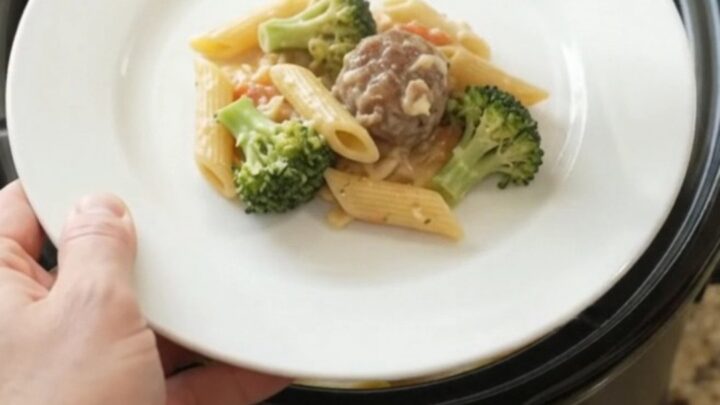
After stirring, the sauce is velvety and coats every piece of pasta and broccoli. The cheese crust has folded into ribbons of melted cheese throughout. The meatballs remain intact and juicy. Spooning onto plates, the mixture holds together in a creamy, steaming heap. The dish looks and smells like a hearty Italian-American comfort meal, ready to be devoured.
Common mistakes
One common mistake is lifting the lid to check on the progress, which lets out heat and extends cooking time. Trust the process and wait until the timer goes off. Another is using a thin Alfredo sauce that separates or turns watery; choose a thicker, creamier variety.
Overcrowding the slow cooker can also lead to uneven cooking, so use a 6-quart model if possible. Finally, resist the urge to stir during cooking—stirring can break the meatballs and turn the cheese into a gummy mess. Let the layers do their thing.
How to tell it’s done
The dish is done when the meatballs are cooked through and register 160°F (71°C) on an instant-read thermometer. The pasta should be tender but still have a slight bite, and the broccoli should be easily pierced with a fork.
The sauce will be thick and creamy, and the cheese on top will have melted into a golden crust. If the pasta is still hard after 4 hours, continue cooking in 15-minute increments, checking the temperature each time. Do not overcook, or the pasta may become too soft.
- Ground meat: 160°F (71°C) in the thickest part
Up next · Part 3 of 3
4 variations · storage & make-ahead · 5 answers · printable card
Tips, FAQ & printable recipe (Part 3)← Back to the ingredients (Part 1)