Breakfast · Part 2 of 3: Instructions
Crockpot Denver Omelet Breakfast Casserole That Cooks Itself Step-by-step instructions
- Prep
- Cook
- Total
- Serves
- 6
Before you start
Thaw the frozen hash browns ahead of time, either overnight in the refrigerator or in a quick microwave pass, then blot them thoroughly with paper towels so no surface water remains. Dice the ham and the bell pepper into half-inch pieces, shred the cheddar if it is not already shredded, and crack the eggs into a glass measuring cup. Grease the slow cooker insert lightly, set out a rubber spatula and an instant-read thermometer, and clear a spot on the counter for the pot before beginning.
Ingredients at a glance (5)
- 20 oz frozen diced hash browns, thawed and patted dry
- 1 1/2 cups diced cooked ham
- 1 cup diced bell peppers, about 1 medium pepper
- 1 1/2 cups shredded cheddar cheese
- 8 large eggs, whisked
Instructions
Building the layers
- Grease and build the potato baseLightly grease the ceramic insert of a 6-quart slow cooker, then scatter the thawed, patted-dry hash browns across the bottom in an even layer. Press them down gently with a spatula so they form a compact base that will hold its shape when the casserole is sliced.Look for The potatoes should cover the bottom edge to edge, with no bare ceramic showing through anywhere.Tip Thaw the hash browns in the refrigerator overnight and blot them with paper towels; drier potatoes mean a firmer, less watery casserole.
- Scatter the ham and peppersSprinkle the diced cooked ham evenly over the hash browns, then follow with the diced bell peppers. Spread both across the whole surface rather than piling them in the center, so every slice picks up ham, pepper and potato in the same bite.Look for The pink ham and bright peppers should sit in one fairly flat layer, easily visible between the potato pieces.Tip Dicing the ham and peppers small, about half an inch, keeps the layers tidy and helps the casserole cut into clean squares.
- Add the cheddar layerSprinkle the shredded cheddar cheese evenly over the ham and peppers, reaching all the way to the edges. The cheese will melt into the potatoes as it bakes and also form a light, golden top where the eggs settle around it.Look for Every patch of ham and pepper should have cheese over or around it before the eggs go in.Tip Shred the cheese from a block rather than using pre-shredded; it melts more smoothly and is less likely to turn grainy during the long bake.
At the end of this phase, the cold insert holds four distinct, even layers: a compact bed of potatoes, a scattered layer of pink ham and bright pepper, and a full blanket of shredded cheddar reaching to the edges.
Look down into the pot from above; no bare ceramic should show anywhere, and no ingredient should be piled in one spot. The layers should look flat and tidy, almost like a layered salad, because an even build now is what produces clean, uniform squares later. If anything is clumped, spread it out with the spatula before moving on.
Eggs in and lid on
- Whisk the eggsCrack the eggs into a glass measuring cup and whisk them thoroughly until the yolks and whites are completely combined and the mixture looks uniformly pale yellow. A smooth, well-blended pour distributes evenly through the layers instead of leaving streaks of white behind.Look for No streaks of white or yolk should remain, and the surface should look smooth and slightly glossy.Tip Whisking in the measuring cup you will pour from saves a bowl and makes it easy to see how the eggs will spread across the layers.
- Pour the eggs over the layersPour the whisked eggs slowly and evenly over the cheese, potatoes, ham and peppers, letting them seep down through the layers. Give the insert a gentle shake or one careful pass with a spatula so the eggs reach every corner of the slow cooker.Look for The eggs should just come up around the top of the layers without flooding far above them.Tip Pour around the perimeter first, then fill the middle; this keeps the cheese from sliding into one corner as the eggs push through.
- Cover and cook on lowPut the lid on the slow cooker and cook on low for about 3 hours, until the casserole is puffed, set in the middle and golden on top. The eggs are done when an instant-read thermometer reads 160°F (71°C) at the center of the casserole; cooking to this temperature is how the eggs are cooked all the way through.Look for The top looks matte and lightly golden, the edges are set, and the center no longer moves when the insert is nudged.Safe temperature 160°F (71°C) internal temperature (egg dishes)Tip Resist lifting the lid during the first two hours; every peek releases heat and can add thirty minutes or more to the cooking time.
After the eggs are poured and the lid is closed, the hard work is finished. The eggs should have seeped down between the layers, with just the tips of potatoes and cheese peeking through the surface; if the egg sits far above the layers, the casserole will need extra time.
Once cooking begins, the kitchen fills with a mellow, savory smell of ham and melting cheese within the first hour. Check only near the end of the cook time, and expect a puffed, golden-topped casserole that looks set across the whole surface before any thermometer is inserted.
Resting and serving
- Check for donenessInsert an instant-read thermometer into the very middle of the casserole, taking care not to touch the ceramic. Look for 160°F (71°C) throughout; if the center reads lower, replace the lid and continue cooking, checking every twenty minutes until it reaches temperature.Look for The thermometer reads 160°F (71°C) or above in the center, and the eggs look uniformly set from edge to edge.Safe temperature 160°F (71°C) internal temperature (egg dishes)Tip Slow cookers vary widely in temperature; older or larger models may need closer to three and a half hours on low.
- Rest, slice and serveSwitch off the slow cooker and let the casserole rest, lid on, for about 10 minutes so it firms up and releases steam. Cut it into squares right in the insert or lift it out onto a cutting board, then plate it warm with nothing more than a fork.Look for Clean-cut squares hold their shape, with layers of potato, ham and cheese clearly visible in each one.Tip A flexible silicone spatula or a liner lifts the whole casserole out in one piece, making it much easier to cut into neat portions.
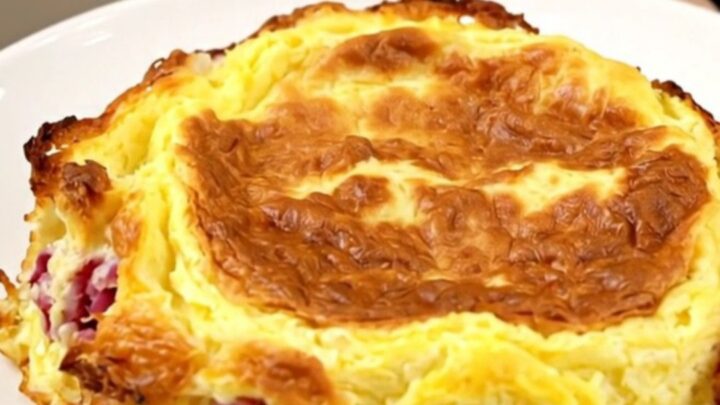
The finished casserole looks golden and slightly domed, with cheese melted into every seam and the edges lightly browned where they touched the ceramic. Steam should rise the moment the lid comes off, and the surface should spring back when pressed rather than denting.
After the ten-minute rest, a knife or spatula should cut through cleanly, revealing defined layers of potato, ham, pepper and egg without any pooling in the bottom of the insert. Each square should lift out whole; if the center still clings loosely, give it another twenty minutes on low.
Common mistakes
The most common missteps are easy to avoid. Pouring watery thawed potatoes straight from the bag releases excess moisture and leaves the base dense instead of tender, so always pat them dry. Under-whisked eggs leave pale streaks through the finished casserole, so whisk until the mixture is one uniform color.
Lifting the lid repeatedly drops the temperature and stretches the cook time well past three hours. Finally, skipping the thermometer risks guessing at doneness; eggs must reach 160°F (71°C) in the center, and slow cooker heat is too uneven to judge by eye alone.
How to tell it’s done
The casserole is done when the center reads 160°F (71°C) on an instant-read thermometer, the safe internal temperature for eggs. Visually, the top will look matte and lightly golden rather than glossy, the edges will have pulled slightly away from the ceramic, and the middle will feel springy when pressed gently with a spatula. When the insert is tilted, no pooling egg should slide across the surface. If the center still looks unset, keep cooking and recheck every twenty minutes; slow cookers vary, so trust the thermometer over the clock.
- Egg dishes: 160°F (71°C) in the thickest part
Up next · Part 3 of 3
4 variations · storage & make-ahead · 5 answers · printable card
Tips, FAQ & printable recipe (Part 3)← Back to the ingredients (Part 1)