Dinner · Part 2 of 3: Instructions
Crockpot Creamy French Herb Goat Cheese Chicken Step-by-step instructions
- Prep
- Cook
- Total
- Serves
- 4
Before you start
Before anything goes into the pot, take ten minutes to set up. Trim and halve the leeks lengthwise, fan the layers under cold running water to flush out the grit that hides between them, and slice them into thin half-moons. Pat the chicken breasts dry with paper towels, trim any ragged tail pieces, and butterfly any breast noticeably thicker than the rest so every piece cooks at the same pace.
Ingredients at a glance (4)
- 2 lb boneless skinless chicken breasts
- 2 large leeks, white and light green parts, sliced
- 1 packet French herb seasoning mix (about 1 oz)
- 8 oz plain chèvre, in rounds
Instructions
Layer the crock
- Wash and slice the leeksTrim the root ends and dark green tops from the leeks, halve them lengthwise and fan the layers under cold running water to rinse out the grit that hides between them. Shake off the water, then cut the white and pale green parts into thin half-moons.Look for No sand should sit in the bottom of the colander once the layers have been fanned open and rinsed.Tip Slice the leeks in half lengthwise first; it opens the layers so the rinse actually reaches the dirt in the middle.
- Prep the chicken breastsPat the chicken breasts dry with paper towels and trim any excess fat or thin tail pieces so every piece cooks at the same pace. Keep the breasts whole; they will shred easily once they are tender, and whole pieces stay far juicier through a long cook.Look for The surface of each breast should feel dry to the touch so the seasoning can cling instead of sliding off.Tip If one breast is much thicker than the others, butterfly it in half so all the pieces finish cooking together.
- Layer the chicken in the slow cookerLay the chicken breasts in a single snug layer on the bottom of the slow cooker insert. Avoid piling them on top of one another if the crock is wide enough; even contact with the heat means even cooking and no dry edges by the end.Look for Every breast should touch the ceramic bottom, with at most slight overlap at the edges of the crock.Tip No liquid goes in at this stage; the leeks and chicken release plenty of their own as they cook low and slow.
By the end of this phase, the crock is fully loaded and ready for the lid: chicken breasts in a single even layer on the bottom, leeks scattered across them in a loose blanket, the herb seasoning dusted evenly over the surface with no bare patches, and chèvre rounds spaced across the top.
Nothing has been stirred, and nothing should be. Give the insert one gentle look before covering it: every breast should touch the ceramic, the leeks should cover most of the meat, and the cheese should sit proud on top. That is the whole picture; the pot now does the rest of the work alone.
Cook low and slow
- Scatter the leeks over the chickenSpread the sliced leeks evenly across the chicken so every breast gets some of their sweetness as they soften. They will wilt down to a fraction of their volume, so cover the surface generously; the leek layer also shields the meat from direct, drying heat.Look for The leeks should form a loose, even blanket rather than sitting in one clump on a single breast.Tip Save a small handful of the darkest sliced rings; a few can be stirred back in at the end for a touch of color.
- Sprinkle on the herb seasoningShake the herb seasoning packet evenly over the leeks and chicken, aiming for full coverage of the surface rather than one concentrated spot. Give the crock a gentle side-to-side nudge if any spot looks bare, but do not stir; the layers cook best left as they are.Look for The whole top surface should show a fine, even dusting of the herb mix with no large bare patches.Tip If using a homemade blend instead of a packet, sprinkle it from a little height so it distributes evenly across the pot.
- Top with the chèvre and cookArrange the chèvre rounds across the top, spacing them out so they melt down through the layers as they soften. Cover the slow cooker and cook on low for 4 to 5 hours, until the chicken is tender enough to shred with almost no resistance.Look for After about 2 hours, the cheese rounds will have slumped and the pot will smell of warm herbs and sweet leeks.Tip Resist lifting the lid during the first 3 hours; every peek lets heat escape and stretches the cooking time.
Midway through the long cook, around the two-hour mark, the transformation is already visible through the lid: the cheese rounds have slumped and begun to melt, the leeks have wilted into soft, translucent ribbons, and a gently bubbling rim of juices has formed around the chicken.
The kitchen smells of warm herbs and sweet alliums. By hour four, the sauce should look creamy and lightly golden, and the chicken should feel tender when pressed with a fork through a gap in the lid. Resist lifting the cover before then; each peek costs heat and stretches the cook.
Shred and serve
- Check the temperatureInsert an instant-read thermometer into the thickest breast, aiming for the center without touching the ceramic. The chicken is safe and ready to shred at 165°F (74°C). If it reads lower, cover and continue cooking, checking again every 30 minutes.Look for A fully cooked breast should read 165°F (74°C) in the center and feel firm but yield easily to gentle pressure.Safe temperature 165°F (74°C) internal temperature (poultry)Tip Check two or three pieces, since the pieces nearest the wall of the crock always finish ahead of the ones in the middle.
- Shred the chicken in the sauceWorking directly in the crock, pull the chicken apart with two forks, letting the shreds fall into the melted chèvre, leeks and released juices. Stir everything together so the shreds soak up the silky sauce, then let the lid rest on the pot for 5 minutes off the heat.Look for The meat should separate into soft strands with a flick of the fork, no knife needed, and the sauce should look glossy.Tip A few minutes of stirring is all the shredding takes; smaller bits turn the sauce creamy rather than chunky.
- Serve it hotGive the chicken one final stir and taste for seasoning, adjusting only if the sauce needs it. Pile generous spoonfuls onto warm plates while the sauce is at its glossiest and smoothest, and carry the crock straight to the table for easy second helpings.Look for The sauce should coat the back of a spoon and stay creamy, never separating into pools of fat.Tip If the sauce seems thicker than you like, stir in a spoonful of hot water to loosen it just before serving.
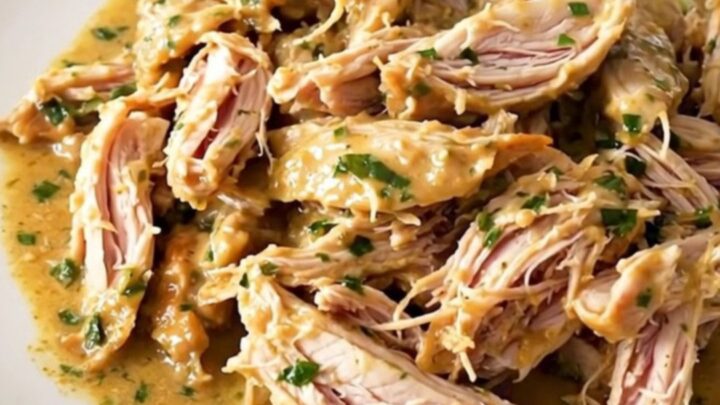
The final phase is quick and satisfying. The thermometer confirms 165°F (74°C) in the thickest breast, the meat pulls apart into soft strands with two forks, and the shreds tumble into the melted chèvre, leeks and pot juices to form a glossy, creamy sauce that coats every piece.
Give it one last stir, taste, and adjust only if needed. The finished chicken should look silky and pale gold, flecked with green leek, and hold together loosely on a spoon without any pooling of fat. Serve it straight from the crock while it is hot, when the sauce is at its smoothest and most spoonable.
Common mistakes
The most common slip is skipping the leek rinse. Leeks trap sandy soil between their layers, and un-rinsed slices turn the whole sauce gritty, so halve them lengthwise and fan them under running water before slicing.
The second mistake is adding liquid; the chicken and leeks release more than enough, and extra water or broth thins the sauce into something watery. Lifting the lid repeatedly stretches the cooking time and costs heat, so trust the pot for the first three hours.
How to tell it’s done
The chicken is done when it reaches 165°F (74°C) at the center of the thickest breast, measured with an instant-read thermometer, and when it shreds with barely any resistance from a fork. Visually, the meat should look opaque all the way through with no pink in the thickest part, and the sauce around it should be glossy and creamy, with the chèvre fully melted into the leeks and juices.
- Poultry: 165°F (74°C) in the thickest part
Up next · Part 3 of 3
4 variations · storage & make-ahead · 5 answers · printable card
Tips, FAQ & printable recipe (Part 3)← Back to the ingredients (Part 1)