Dinner · Part 2 of 3: Instructions
Crockpot Creamy Dill Pork Chops and Potatoes — One-Pot Dinner Step-by-step instructions
- Prep
- Cook
- Total
- Serves
- 4
Before you start
Slice the potatoes into even 1/4-inch rounds and keep them in a bowl of cold water for no more than a few minutes to prevent browning, then drain well before layering.
Trim the pork chops of any large fat caps or silverskin and pat them dry. Have the dill measured, the can of soup opened and the spoon ready, since the assembly itself takes barely five minutes from first chop to closed lid.
Ingredients at a glance (4)
- 4 boneless pork chops (about 2 lb), trimmed of excess fat
- 1 1/2 lb gold potatoes, sliced into 1/4-inch rounds
- 2 tsp dried dill weed
- 1 can (10.5 oz) canned condensed cream soup
Instructions
Layering the crock
- Prep the pork chopsTrim any large pieces of fat or silver skin from the boneless pork chops and pat them dry with paper towels. Dry chops sit flat in the slow cooker and the sauce clings to them better during the long cook. Keep the pieces whole; they braise beautifully without browning.Look for The surface of each chop should look dry and matte, with no wet shine from the packaging.Tip Chops of similar thickness finish at the same time, so pick four that match before they go in.
- Layer the chops in the crockArrange the pork chops in a single, slightly fanned layer across the bottom of the slow cooker insert. Overlapping the edges a little is fine, but keep them mostly in one layer so each chop stays submerged in the sauce once the potatoes and soup go on top.Look for The bottom of the crock should be covered with no chop stacked fully on top of another.Tip If the crock is small, tuck the thinnest chops toward the center where the heat is gentlest.
- Add the potato layerSlice the gold potatoes into rounds about 1/4 inch thick and lay them in an even layer over the pork chops. Covering the meat completely keeps it moist and lets the potatoes soak up the cooking liquid from above and below at the same time.Look for No pork should peek through the potato layer once it is arranged.Tip Slice the rounds evenly; thin slices turn silky, thick ones stay firmer at the end.
- Sprinkle the dillSprinkle the dried dill weed evenly over the potatoes, reaching the edges of the crock. Dried dill blooms slowly in the moist heat, seasoning the potatoes, the sauce and the pork all at once as the cooker works through the hours.Look for Every potato round should carry some visible dill before the soup goes on.Tip Saving a small pinch of dill for the end adds a fresh green note to each plate.
- Spoon on the soupSpoon the canned condensed cream soup over the potatoes in dollops, then spread it gently with the back of the spoon so it covers most of the surface. As it heats, the soup thins into the sauce that braises everything below it.Look for The potato layer should be mostly covered, with the soup sitting in soft mounds on top.Tip No water is needed; the condensed soup plus the juices from the meat and potatoes make the sauce.
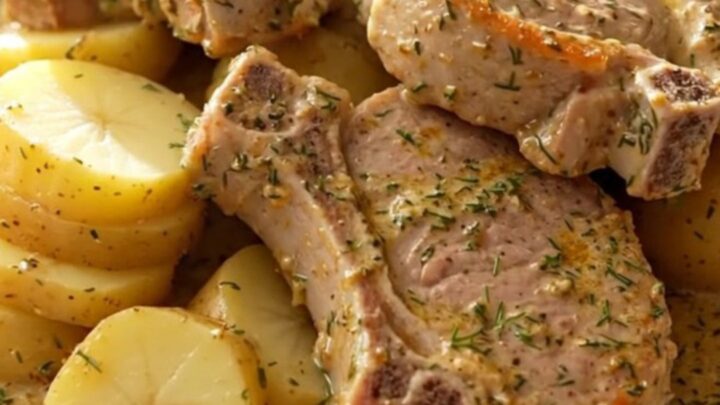
By the end of this phase, the slow cooker holds a complete, untouched stack: chops fanned across the bottom, potatoes covering them fully, dill visible on every round, and the cream of chicken soup spread in soft mounds over the top.
Nothing should be stirred. Check that no pork shows through the potato layer and that the lid sits level before plugging in the cooker and setting it to low.
The slow cook
- Cover and cook lowPut the lid on the slow cooker and cook on low for 6 to 7 hours, or on high for 3 to 4 hours. Resist lifting the lid during cooking; every peek releases heat and adds 15 to 20 minutes to the clock without improving anything in the crock.Look for Steady, gentle steam gathers on the glass lid and the edges bubble very slightly.Tip Low heat gives the most tender chops; use high only when the day is short.
During cooking, the only work is patience. Steam gathers on the lid and the crock warms through; the sauce loosens and begins to move gently at the edges. When the time is nearly up, the kitchen smells of dill and cream, the potatoes look pale gold and swollen, and the chops have relaxed into the sauce. Resist every urge to lift the lid; the trapped heat is doing exactly what it should.
Testing and plating
- Check the temperatureNear the end of the cook, insert an instant-read thermometer into the thickest chop. It should register at least 145°F (63°C). If it reads lower, recover and continue cooking, checking again every 30 minutes until the pork reaches the safe temperature.Look for The chops look relaxed and slightly loosened, and a fork slides into the meat with no resistance.Safe temperature 145°F (63°C) internal temperature (steaks, chops and roasts)Tip Test the thickest chop, not the thinnest; the rest will be at or past temperature.
- Rest and serveTurn off the cooker and let the pork chops rest in the sauce for at least 3 minutes so the juices settle back into the meat. Then plate a chop with a scoop of potatoes, spoon the thick creamy dill sauce generously over both, and bring the plates to the table while steaming hot.Look for The sauce coats the back of a spoon thickly and clings to the potatoes instead of pooling.Safe temperature 145°F (63°C) internal temperature (steaks, chops and roasts)Tip Lift the chops out gently; fully braised pork is tender enough to break apart if rushed.
The final phase confirms the cook. A thermometer in the thickest chop reads at least 145°F (63°C), the potatoes yield to a fork with no resistance, and the sauce has thickened enough to coat a spoon. After a short rest in the crock, the chops lift out whole and the sauce spoons over the plates in a glossy, dill-flecked ribbon, steaming as it lands.
Common mistakes
The most common slip is lifting the lid to check progress; each peek costs heat and stretches the cook. Slicing the potatoes unevenly is the second: thick rounds stay firm while thin ones dissolve, so keep the cuts consistent.
Overcrowding a small crock with stacked chops leaves some pieces above the sauce, where they dry out — use a single mostly-flat layer. Finally, do not add water; the soup and released juices are the sauce, and extra liquid thins it past the point of creaminess.
How to tell it’s done
The dish is done when the thickest pork chop registers at least 145°F (63°C) on an instant-read thermometer and the potato slices offer no resistance to a fork. The meat should look relaxed and pull apart easily, never springy.
Let the chops rest in the sauce at least 3 minutes before serving; the sauce should be thick enough to coat a spoon and cling to the potatoes rather than run off the plate.
- Steaks, chops and roasts: 145°F (63°C) in the thickest part, then a 3-minute rest
Up next · Part 3 of 3
4 variations · storage & make-ahead · 5 answers · printable card
Tips, FAQ & printable recipe (Part 3)← Back to the ingredients (Part 1)