Dinner · Part 2 of 3: Instructions
Crockpot Chicken Pesto Farfalle: 5-Ingredient Dump Dinner Step-by-step instructions
- Prep
- Cook
- Total
- Serves
- 6
Before you start
Before starting, cut the chicken into bite-sized cubes and set aside. Measure out the farfalle, spinach, and pesto. Soften the cream cheese by letting it sit at room temperature for about 30 minutes, then cut it into chunks. Have all your ingredients ready and your slow cooker plugged in. No need to preheat or pre-cook anything—this recipe is truly dump-and-go. Make sure your slow cooker is clean and dry before adding the ingredients.
Ingredients at a glance (6)
- 2 lb boneless skinless chicken breasts, cut into bite-sized cubes
- 12 oz farfalle (bow-tie) pasta
- 4 cups fresh baby spinach leaves
- 1 cup basil pesto
- 8 oz cream cheese, softened and cut into chunks
- 2 cups shredded whole-milk mozzarella cheese
Instructions
Layer and Cook
- Layer the IngredientsPlace the cubed chicken breasts evenly across the bottom of a 6-quart slow cooker. Scatter the farfalle pasta over the chicken, then add the fresh baby spinach leaves. Spoon the basil pesto over the top, spreading it as evenly as possible. Set the cream cheese chunks in the center of the mixture, and sprinkle the shredded mozzarella over everything.Look for The slow cooker should be filled with layered ingredients, with the cream cheese visible in the middle and mozzarella covering the top.Tip No need to stir—the slow cooker will blend everything as it cooks. Keeping the cream cheese in a chunk helps it melt slowly and evenly.
- Cover and Cook on LowPut the lid on the slow cooker and set it to LOW. Cook for 4 hours, or until the chicken is cooked through and the pasta is tender. Avoid opening the lid during the first 3 hours to keep the heat steady.Look for After 4 hours, the mixture should be bubbling gently around the edges, and the cheese should be fully melted.Safe temperature 165°F (74°C) internal temperature (poultry)Tip If the sauce seems too thick at the end, stir in a splash of warm chicken broth or milk to loosen it.
At the end of this phase, the slow cooker should be full of layered ingredients: raw chicken at the bottom, pasta and spinach on top, and a blanket of pesto, cream cheese, and mozzarella covering everything.
The cream cheese will still be in a visible chunk, and the mozzarella will look like a snowy topping. The aroma is fresh and herbal from the pesto, with the cool scent of raw chicken and spinach. No browning yet—this is the calm before the slow simmer.
Stir and Perfect
- Stir and Check TemperatureAfter 4 hours, remove the lid and stir the mixture well. The chicken should be fork-tender and no longer pink in the center. Check the internal temperature with an instant-read thermometer: it must read at least 165°F (74°C). The pasta should be al dente, and the spinach should be wilted into the sauce.Look for The sauce should be creamy and well combined, with the cheese fully melted and the pasta coated.Safe temperature 165°F (74°C) internal temperature (poultry)Tip If the pasta is still too firm, cover and cook for another 20–30 minutes, then check again.
- Adjust ConsistencyIf the mixture looks dry or the sauce is too thick, stir in 1/4 cup of warm chicken broth or milk until it reaches a creamy, spoonable consistency. Taste and adjust seasoning with salt and pepper if needed. The dish should be rich and cheesy, with the pesto flavor coming through.Look for The sauce should coat the back of a spoon, and the pasta should be glossy with cheese.Tip Be careful not to over-stir, which can break up the chicken too much. Fold gently to keep the cubes intact.
After stirring, the mixture should be transformed: the chicken is opaque and tender, the pasta is al dente, and the spinach has wilted into the sauce. The cream cheese and mozzarella have melted into a silky, golden sauce that coats everything.
The smell is rich and savory, with the pesto's basil and garlic notes now mellowed and blended. The texture should be creamy and cohesive, not watery or greasy. Check that the chicken is fully cooked and the sauce is the right consistency.
Serve
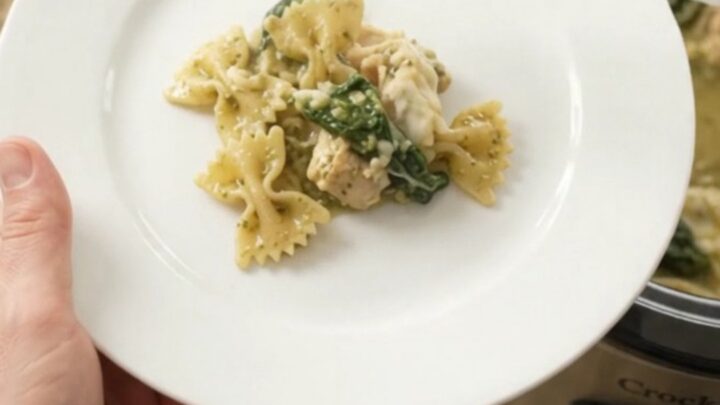
- Serve HotSpoon the chicken pesto farfalle onto a white dinner plate, making sure each serving gets plenty of sauce, chicken, and pasta. Serve immediately while hot and bubbling. The cheese will stretch as you scoop, and the creamy sauce will coat every bite.Look for The dish should be steaming hot, with melted mozzarella stretching from the spoon.Tip For a pretty presentation, sprinkle a little extra chopped basil or a few pine nuts on top before serving.
The final dish is a beautiful, comforting sight: creamy, cheesy pasta with tender chicken and flecks of green from the pesto and spinach. The sauce is glossy and rich, and the mozzarella stretches as you scoop.
Steam rises invitingly, and the aroma is irresistible. Each bite is a balance of savory chicken, al dente pasta, and the bright, herby pesto, all wrapped in a velvety cheese sauce. Serve hot, straight from the slow cooker, for the best experience.
Common mistakes
One common mistake is lifting the lid too often during cooking, which lets out heat and extends the cooking time. Another is using a slow cooker that's too small, causing ingredients to overflow or cook unevenly.
Overcooking can make the pasta mushy and the chicken dry, so check at the 4-hour mark. If the sauce seems too thick, resist adding too much liquid—start with a small splash and stir. Finally, don't skip the temperature check; it's the only way to know the chicken is safe to eat.
How to tell it’s done
The dish is done when the chicken reaches an internal temperature of at least 165°F (74°C) and the pasta is tender but not mushy. The sauce should be creamy and well combined, with the spinach wilted and the cheese fully melted. If the pasta is still firm, continue cooking in 20-minute increments until it reaches the desired texture. The mixture should be bubbling gently around the edges when it's ready.
- Poultry: 165°F (74°C) in the thickest part
Up next · Part 3 of 3
4 variations · storage & make-ahead · 5 answers · printable card
Tips, FAQ & printable recipe (Part 3)← Back to the ingredients (Part 1)