Dinner · Part 2 of 3: Instructions
Crockpot Cheesy Scalloped Potatoes and Country Ribs, Hands-Off Step-by-step instructions
- Prep
- Cook
- Total
- Serves
- 6
Before you start
Set up before anything touches the insert, because assembly takes barely ten minutes. Peel the russet potatoes and slice them into thin rounds, about 1/4 inch thick, then keep them in a bowl of cold water if a delay is unavoidable and drain well before layering.
Pat the pork ribs dry with paper towels so their surfaces are not wet going in. Measure the onion powder and black pepper into a small ramekin, open the can of condensed cheddar soup into a bowl, and confirm the slow cooker insert is clean and undamaged.
Ingredients at a glance (5)
- 2 1/2 lb boneless country-style pork ribs
- 3 lb russet potatoes, peeled and cut into thin round slices
- 1 tsp onion powder
- 1/2 tsp ground black pepper
- 1 can condensed cheddar cheese soup (10.5 oz)
Instructions
Build the layers
- Fit the ribs into the insertArrange the boneless country-style pork ribs in a single snug layer across the bottom of a 6-quart slow cooker insert. Keep the pieces flat and side by side so they braise evenly, and leave only small gaps so the potatoes above settle without collapsing into empty space.Look for The base is covered edge to edge, with the ribs touching but not stacked more than one piece deep.Tip Pat the ribs dry with paper towels first; drier surfaces hold their shape better and keep the finished sauce from thinning.
- Slice the potatoes thinPeel the russet potatoes and cut them into thin round slices, about 1/4 inch thick. Work steadily so the cut surfaces do not brown, and aim for even pieces; a sharp chef's knife or a mandoline makes slices that cook through at the same rate as the ribs below.Look for The slices are thin enough to see light through the thinnest ones, with no wedge-shaped pieces mixed in.Tip Rinse the slices briefly and drain well if the potatoes feel very starchy; excess surface starch can make the sauce pasty.
- Layer the potatoes over the ribsSpread the potato slices in an even layer over the ribs, letting them overlap slightly like shingles. Press down gently with a silicone spatula so the layer sits close to the meat and cooks in the steam and sauce rather than drying out above it.Look for No rib shows through the potato layer, and the slices slope gently toward the walls of the insert.Tip Save a few of the largest slices for the very top; they give the finished dish a neat, scalloped look.
- Season the layersSprinkle the onion powder and the black pepper evenly across the potatoes, reaching all the way to the edges of the insert. Shake each from a small ramekin from a few inches up so it drifts instead of clumping in one spot over the center of the dish.Look for The pale potato surface is evenly speckled, with no dark patches of concentrated pepper in the middle.Tip The condensed cheddar soup seasons the dish as it thins, so resist adding extra salt at this stage.
At the end of this phase, the insert should look deliberately stacked: ribs covering the base edge to edge, a shingled layer of thin potato slices above with no meat showing through, and an even, light speckle of onion powder and pepper across the entire surface. Nothing is stirred, nothing is salted, and no liquid has been added yet. Press gently on the potatoes with a spatula; the layer should feel compact and moist from contact with the meat, not loose and airy.
Sauce, cover and cook
- Pour the cheddar sauce overPour the condensed cheddar cheese soup evenly over the seasoned potatoes, scraping the can and the bowl clean with the spatula. Spread it gently to the edges so every slice is touched, but do not stir; the layers keep their shape and the sauce finds its own way down.Look for Every potato slice glistens with sauce, and a shallow pool forms at the edges of the insert.Tip No extra liquid is needed; the potatoes release moisture as they cook and thin the sauce to the right consistency.
- Cover and cook low and slowPut the lid on and cook on low for 7 to 8 hours, or on high for about 4 hours. Resist lifting the lid; each peek releases heat and can add 20 minutes or more to the cook. Trust the timer until the final temperature check near the end.Look for The kitchen smells of cheddar and onion, and thin bubbles show at the edges of the sauce under the lid.Tip Set the cooker so the finish lands on dinner time; low heat is more forgiving than high for this dish.
- Check the pork temperatureNear the end of cooking, insert an instant-read thermometer into the thickest rib without touching the insert. The pork is fully cooked and tender at 145°F (63°C), followed by a rest of at least 3 minutes. If it reads short of that, cover and keep cooking, checking every 30 minutes.Look for The thermometer reads at least 145°F (63°C) in the center of the thickest piece, and the meat feels slack under the probe.Safe temperature 145°F (63°C) internal temperature (steaks, chops and roasts)Tip Check two or three ribs if sizes differ; the largest piece sets the true reading for the whole insert.
After the pour, every potato slice should glisten and a shallow pool of sauce should sit at the edges of the insert; the surface stays undisturbed from here, so take a mental picture now.
Once cooked, the lid comes off to a strong smell of cheddar and onion, thin bubbles at the sauce line, and potatoes that yield to a fork pressed straight down. Before serving, confirm the pork: the thickest rib must read at least 145°F (63°C) on an instant-read thermometer, with the 3-minute rest to follow.
Rest and serve
- Rest the dishTurn the slow cooker off and let the dish rest, covered, for at least the 3-minute rest and up to 10 minutes. The sauce settles and thickens slightly, the potatoes hold their layers when served, and the ribs stay juicier than they would plated straight away.Look for The surface stops visibly bubbling and the sauce looks glossy rather than loose around the edges.Tip Leave the lid slightly ajar for the last few minutes if the sauce looks thinner than expected; steam escapes and it tightens.
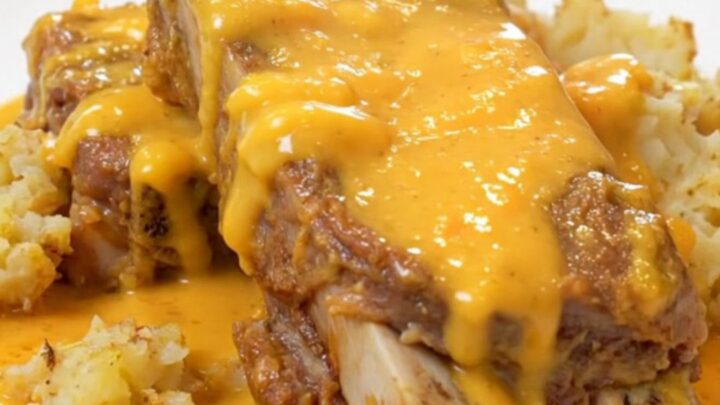
- Plate and serve hotLift a rib onto each plate with tongs, then spoon a generous scoop of the cheesy scalloped potatoes alongside, letting the cheddar sauce run over both. Serve straight from the insert at the table while everything is steaming, with the sauce spooned generously over each portion.Look for Steam rises as the lid comes off, the sauce coats the back of the spoon, and a rib pulls apart with a fork.Tip Warm the plates briefly first; the cheddar sauce stays fluid and glossy longer on a warm surface.
During the rest, the visible bubbling stops and the sauce tightens from loose to glossy, coating the back of the spoon used to nudge it at the edge. The ribs should pull apart under a fork with light pressure, showing moist, tender fibers rather than a dry or stringy interior, and the potato layer should lift in tidy scoops that keep their slice pattern. Steam should rise steadily when the lid comes off — a dish that has cooled shows almost none.
Common mistakes
The most common error is lifting the lid during the cook; every peek costs heat and stretches the timing by twenty minutes or more. Slicing the potatoes too thick is the second; wedges and half-inch rounds stay firm long after the ribs are done, so keep the slices thin and even.
Overfilling a small insert leads to a watery, half-cooked edge, so use at least a 5-quart cooker for these amounts. Stirring the layers to distribute the sauce breaks up the scalloped structure; spread the soup instead and let it seep down.
How to tell it’s done
Three signs say this dish is ready. First, the potatoes: a fork slides into the center of the layer with no resistance, and the slices hold together rather than crumbling.
Second, the pork: the thickest rib reads at least 145°F (63°C) on an instant-read thermometer, followed by the 3-minute rest, and a fork twists into the meat easily. Third, the sauce: it looks thick and glossy, coats the back of a spoon, and pools only shallowly around the edges instead of sitting in a watery layer.
- Steaks, chops and roasts: 145°F (63°C) in the thickest part, then a 3-minute rest
Up next · Part 3 of 3
4 variations · storage & make-ahead · 5 answers · printable card
Tips, FAQ & printable recipe (Part 3)← Back to the ingredients (Part 1)