Dinner · Part 2 of 3: Instructions
Crockpot Cheesy Cranberry Swiss Chicken Step-by-step instructions
- Prep
- Cook
- Total
- Serves
- 4
Before you start
Before you begin, ensure your slow cooker is clean and placed on a stable, heat-resistant surface away from any edges. Have all your ingredients measured and ready to go. Since this recipe relies on a few key pantry staples, keep the cranberry sauce, onion soup mix, and French dressing within easy reach.
If you have any fresh herbs or side dishes planned, such as steamed vegetables or rice, prepare those while the chicken is cooking so everything is ready to serve at the same time.
Ingredients at a glance (5)
- 4 pieces boneless, skinless chicken breasts
- 1 cup whole berry cranberry sauce
- 1 packet onion soup mix
- 1/2 cup French dressing
- 4 slices Swiss cheese
Instructions
Layering the ingredients
- Prepare the slow cooker basePlace the raw chicken breasts at the bottom of the slow cooker. Ensure they are arranged in a single layer to promote even cooking throughout the process.Look for Chicken is arranged flat at the baseTip Pat the chicken dry with paper towels before placing it in the cooker for better browning.
At the end of this phase, the chicken should be neatly arranged at the bottom of the slow cooker, topped with the cranberry sauce, soup mix, and dressing.
Everything is ready for the slow cooking process to begin. Verify that all ingredients are distributed evenly to ensure uniform flavor distribution across all pieces of chicken.
Slow cooking the chicken
- Add flavoringsSpoon the whole berry cranberry sauce over the chicken, then sprinkle the onion soup mix evenly across the top. Finally, pour the French dressing over the entire mixture.Look for Ingredients are layered over the chickenTip Spread the cranberry sauce slightly to ensure even coverage across all chicken pieces.
The chicken has finished its long, slow simmer. It should be fork-tender and aromatic, with the sauce having thickened into a rich, glossy glaze. Check that the liquid has reduced to a syrupy consistency and that the chicken is fully cooked through before proceeding to the final step of melting the cheese.
Melting the cheese
- Cook and melt cheeseCover and cook on low for 4 hours until the chicken reaches an internal temperature of 165°F (74°C). Once cooked, place a slice of Swiss cheese on each breast and cover for 5 minutes until melted.Look for Cheese is melted and glossySafe temperature 165°F (74°C) internal temperature (poultry)Tip Check the internal temperature with a meat thermometer to ensure safety.
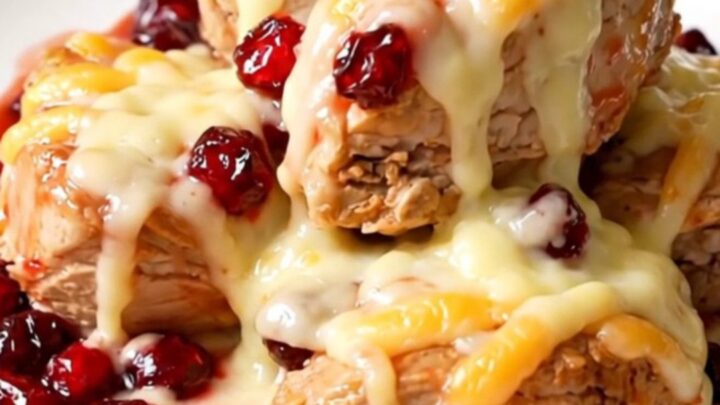
The final result is a beautiful, cheesy masterpiece. The Swiss cheese should be perfectly melted over each piece of chicken, creating a creamy contrast to the tangy cranberry sauce. Ensure the cheese is fully melted and the chicken is hot before serving immediately to enjoy the best texture and flavor.
Common mistakes
A common mistake is opening the slow cooker lid too frequently during the cooking process. Each time you lift the lid, heat escapes and the cooking time is extended, which can lead to uneven results. Trust the process and keep the lid closed.
Another potential error is overcrowding the slow cooker; ensure the chicken is in a single layer for the best texture. Finally, do not add the cheese too early, as it will lose its texture and become overly oily if cooked for the entire duration.
How to tell it’s done
The chicken is done when it is opaque throughout and reaches a safe internal temperature of 165°F (74°C) at its thickest point. Use a reliable digital meat thermometer to verify this. The texture should be tender and easily pulled apart with a fork.
Once the cheese is added, it should be completely melted and slightly bubbly. Let the chicken rest for 5 minutes after removing it from the slow cooker to allow the juices to redistribute, ensuring every bite remains moist and flavorful.
- Poultry: 165°F (74°C) in the thickest part
Up next · Part 3 of 3
2 variations · storage & make-ahead · 3 answers · printable card
Tips, FAQ & printable recipe (Part 3)← Back to the ingredients (Part 1)