Dinner · Part 2 of 3: Instructions
Crockpot Balsamic Fig Chicken with Creamy Polenta Step-by-step instructions
- Prep
- Cook
- Total
- Serves
- 4
Before you start
Take the chicken breasts out of the packaging, pat them dry and let them sit on the counter only while the crockpot gets loaded — no longer than 30 minutes before cooking starts. Halve the dried figs with kitchen shears or a sharp knife; halves melt into the glaze far better than whole figs.
Smash the garlic cloves with the flat of a knife so their flavor releases without peeling precision. Measure the balsamic and honey before anything touches the insert, because once the layering starts the whole thing takes under five minutes.
Ingredients at a glance (10)
- 4 boneless skinless chicken breasts (about 2 lb)
- 1 cup dried Black Mission figs, halved
- 1/2 cup aged balsamic vinegar
- 1/4 cup honey
- 4 garlic cloves, smashed
- 2 fresh rosemary sprigs
- 4 cups chicken broth
- 1 cup coarse polenta (cornmeal)
- 2 oz chevre (soft goat cheese), crumbled
- Fresh thyme leaves, for serving
Instructions
Layer and load
- Prep the chicken and figsPat the chicken breasts dry with paper towels and set them on a cutting board. Halve the dried figs with kitchen shears or a sharp knife, and smash the garlic cloves with the flat of the blade. Drying the surface of the meat helps the balsamic mixture cling to it instead of sliding off, so every bite carries flavor from the very first hour of cooking.Look for The chicken surfaces look dry and matte, and the figs sit in even halves on the board.Tip Blotting well also keeps excess water out of the crockpot, so the glaze reduces instead of diluting.
- Layer the crockpotArrange the chicken breasts in a single layer in the ceramic insert. Scatter the halved dried figs around and on top of the meat, then pour in the balsamic vinegar and honey. Tuck the garlic cloves and rosemary sprigs between the breasts, and latch on the lid without stirring.Look for The figs sit mostly submerged, and the balsamic-honey mixture pools about halfway up the chicken.Tip Resist stirring here; the layered liquid steams the chicken while the figs break down against the hot ceramic.
At the end of this phase the crockpot is loaded, latched and set — five minutes of work at most. The chicken sits in a single layer with the halved figs scattered over it, the balsamic and honey pooled around the base, and the garlic and rosemary tucked between the breasts. Nothing needs to look arranged; the cooker will do the arranging. What to check before walking away: the lid seats flush with no gap, the setting reads LOW, and the liquid comes roughly halfway up the chicken.
Slow cook and shred
- Cook on LOWSet the slow cooker to LOW and cook, covered, for 4 hours. Keep the lid on the whole time — every lift releases heat and adds minutes. As the chicken cooks, the figs soften and swell, the honey dissolves, and the liquid slowly darkens and thickens around the meat into a deep, jewel-toned syrup.Look for The sauce has turned mahogany and slightly syrupy, and the figs look swollen and collapsed at the edges.Tip If the schedule demands it, HIGH for about 2 1/2 hours works, but LOW gives the jammiest glaze and the most tender shredding.
- Check for donenessNear the end of cooking, insert an instant-read thermometer into the thickest breast without touching bone or the ceramic wall. The chicken is safe to shred once it registers 165°F (74°C). If it reads below that, relatch the lid and keep cooking, checking every 20 minutes until every breast reaches temperature.Look for The meat registers 165°F (74°C) at its thickest point and the breasts look plump but intact.Safe temperature 165°F (74°C) internal temperature (poultry)Tip Breasts vary in size, so test each one; smaller pieces may finish early and can be lifted out to rest.
- Shred into the glazeTransfer the breasts to a cutting board and shred them with two forks into large ribbons. Skim out the rosemary stems, then return the chicken to the crockpot and toss it through the fig-balsamic glaze. The sauce should coat every strand like warm jam; if it seems thin, stir on HIGH, lid off, for 10 minutes.Look for The glaze clings to the shredded chicken in a dark, glossy sheet, and the figs have mostly melted into it.Tip Shredding directly into the sauce lets the meat drink up the glaze — the flavor difference is noticeable on the plate.
After four hours on LOW, the kitchen smells of caramelized vinegar and fig, and the sauce has turned a deep, jewel-toned mahogany with a syrupy sheen. The figs look swollen and half-dissolved, and the chicken breasts hold their shape but split easily under a fork. Confirm the temperature: 165°F (74°C) at the thickest point of each breast, no exceptions. Then shred into large ribbons directly in the crockpot and toss everything together — the meat should come out coated in a glaze that clings like warm jam, not a thin pan juice.
Polenta and plate
- Start the polentaAbout 20 minutes before serving, bring the chicken broth to a steady simmer in a medium saucepan over medium-high heat. Rain in the polenta while whisking constantly so no lumps form. Drop the heat to low and cook, stirring often with a wooden spoon, until the grains turn tender and the mixture pulls away from the spoon.Look for The polenta bubbles in slow, thick waves and the grains no longer taste gritty when bitten.Tip Whisking as the cornmeal goes in is the single step that separates creamy polenta from a lumpy one.
- Finish the polentaOff the heat, stir the hot polenta vigorously for a minute until it turns smooth and glossy. The texture should be soft enough to spread on a spoon but still hold its shape on a plate. Cover the pan to keep it warm while the chicken gets plated, and loosen with a splash of hot broth if it tightens.Look for The surface turns smooth and glossy, with gentle ripples when the pan is tilted.Tip Polenta tightens as it sits; a splash of hot broth loosens it right back to spoonable.
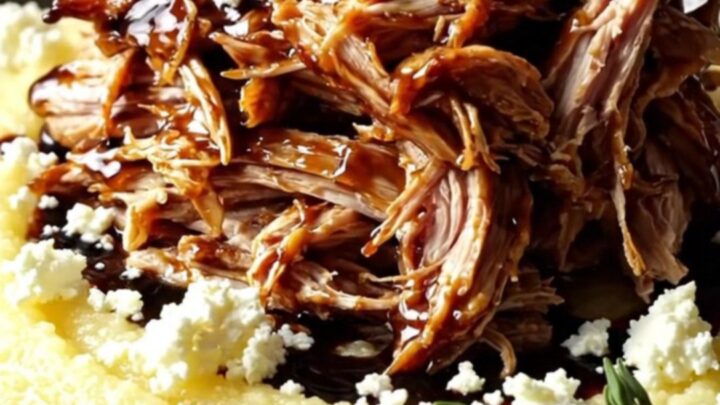
- Plate and serveSpoon a wide bed of creamy polenta onto each warm plate. Pile the balsamic fig chicken alongside and over it, making sure plenty of the jammy glaze runs onto the polenta. Finish each plate with crumbled chevre and a scatter of fresh thyme leaves, and bring the crockpot to the table for seconds.Look for The glaze pools slightly at the edge of the polenta, and the chevre softens where it touches the hot chicken.Tip Warm plates hold the polenta's texture longer; a minute in a low oven or under hot tap water does it.
The final phase ends at the table, and the signs are all visual. The polenta spreads in a soft, glossy bed that holds a spoon's trail for a second before leveling out; the grains taste tender with zero grittiness. The shredded chicken lands on top in a dark, shiny mound with the glaze running down into the polenta.
Chevre softens on contact, and the thyme leaves sit bright green against the brown glaze. Before serving, check the polenta's texture — if it tightened while waiting, a splash of hot broth brings it back. Everything should be eaten promptly while the glaze is warm and pourable, since it thickens as it cools on the plate.
Common mistakes
The most common slip is lifting the lid during the four hours of cooking — every peek releases heat and stretches the timeline, so trust the process and keep it latched. Overcrowding is next: the breasts need a single layer, or the meat cooks unevenly and the glaze thins where it matters.
Shredding too finely is another one; large ribbons hold the glaze and give the plate structure, while fine shreds disappear into the sauce. Skipping the thermometer and going purely by time risks undercooked thick breasts, so always confirm 165°F (74°C) at the center.
How to tell it’s done
The chicken is done when an instant-read thermometer reads 165°F (74°C) at the thickest point of every breast — test each one, since sizes differ. Visually, the meat looks plump but starts to split along the grain, and a fork twists into it with no resistance.
The glaze is done when it has turned deep mahogany and coats the back of a spoon like warm jam; the figs should be swollen, collapsed at the edges and mostly dissolved into the sauce. If the glaze still pools thin and watery, cook on HIGH with the lid off for 10 minutes and check again.
- Poultry: 165°F (74°C) in the thickest part
Up next · Part 3 of 3
4 variations · storage & make-ahead · 5 answers · printable card
Tips, FAQ & printable recipe (Part 3)← Back to the ingredients (Part 1)