Desserts · Part 2 of 3: Instructions
Crispy Turkish Mussel Baklava with Lemon Syrup Step-by-step instructions
- Prep
- Cook
- Total
- Serves
- 8
Before you start
Before starting, measure all ingredients and bring the milk, yogurt, and egg to room temperature. Prepare a clean, flat surface for rolling and have a damp kitchen towel ready to cover the dough balls.
Preheat the oven to 360°F (182°C) and have a baking tray ready. Make the syrup while the pastry bakes so it is ready to pour over the hot baklava.
Ingredients at a glance (13)
- 3 cups all-purpose flour
- 1/2 cup milk
- 1/2 cup plain yogurt
- 1/4 cup vegetable oil
- 1 large egg
- 1 tbsp white vinegar
- 1 tsp baking powder
- 1/2 cup cornstarch, for rolling
- 1 cup crushed walnuts
- 1/2 cup clarified butter, melted
- 1 cup granulated sugar
- 1 cup water
- 2 tbsp fresh lemon juice
Instructions
Dough and Shaping
- Make and rest the doughIn a large bowl, combine the flour, milk, yogurt, oil, egg, vinegar, and baking powder. Knead until a silky, soft dough forms, about 5 minutes. Divide the dough into 12 equal balls, cover with a damp towel, and let rest for 30 minutes.Look for The dough is smooth and elastic, not sticky.Tip Resting relaxes the gluten, making the dough easier to roll thin.
- Roll and shape the musselsOn a surface dusted with cornstarch, roll each dough ball into a paper-thin circle. Roll the circle into a tight cylinder, then slice into rounds. Flatten each round with your palm to create textured shell ridges, placing a pinch of crushed walnuts in the center.Look for The rounds are thin and pliable, with visible ridges.Tip Keep the dough covered while working to prevent drying.
At the end of this phase, you should have 12 smooth dough balls resting, and after rolling, thin sheets that are slightly translucent.
The shaped shells should have visible ridges and hold a small amount of walnuts. The dough should be pliable and not sticky, and the shells should hold their shape when placed on the tray.
Baking to Golden
- Arrange and butterArrange the shaped mussel shells on a baking tray. Pour the melted clarified butter evenly over all the pastries, making sure each one is coated.Look for The butter pools slightly around the shells.Tip Brushing the butter helps ensure even coverage.
- Bake until goldenBake in an oven preheated to 360°F (182°C) for 35 minutes, until the pastries are puffed and intensely golden. The layers should be crisp and shatter when touched.Look for The shells are deep golden brown and sound hollow when tapped.Safe temperature 160°F (71°C) internal temperature (egg dishes)Tip Rotate the tray halfway through for even browning.
After baking, the shells should be puffed and deeply golden brown, with a fragrant buttery aroma. The pastries should look glossy from the butter and feel firm to the touch. They should not be pale or doughy. If they are not golden enough, bake for a few more minutes, watching closely to avoid burning.
Syrup and Finish
- Make the lemon syrupWhile the baklava bakes, combine the sugar, water, and lemon juice in a small saucepan. Bring to a boil, then reduce heat and simmer for 5 minutes. Remove from heat and let cool slightly.Look for The syrup is clear and slightly thickened.Tip The syrup should be warm, not boiling, when poured over the hot pastry.
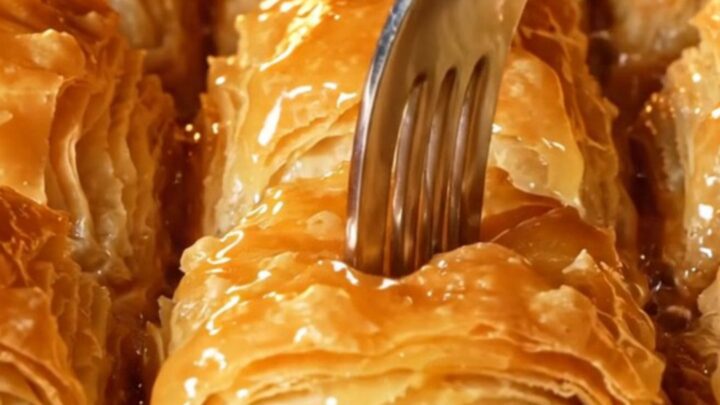
- Soak and servePour the warm syrup evenly over the hot baked baklava. Let it soak in for a few minutes, then serve warm or at room temperature.Look for The syrup sizzles as it hits the hot pastry.Tip Serve immediately for the crispiest texture.
When the syrup is poured over the hot pastry, it should sizzle and be absorbed quickly. The baklava should look glossy and wet, with the syrup pooling slightly. After a few minutes, the syrup should be mostly absorbed, leaving a shiny, sticky surface. The shells should still be crisp, not soggy.
Common mistakes
A common mistake is rolling the dough too thick, which prevents the layers from becoming crisp. Another is overworking the dough, which makes it tough.
When shaping the shells, do not press too hard or the layers will stick together. Also, ensure the syrup is not too cold when poured over the hot pastry; a cold syrup will not be absorbed properly and can make the bottom soggy.
How to tell it’s done
The baklava is done when it is deep golden brown and puffed, and the layers look crisp and dry. The internal temperature of the pastry should reach at least 160°F (71°C) to ensure the egg is fully cooked.
When tapped, the shells should sound hollow and feel firm. If the tops brown too quickly, cover loosely with foil for the remaining baking time.
- Egg dishes: 160°F (71°C) in the thickest part
Up next · Part 3 of 3
4 variations · storage & make-ahead · 5 answers · printable card
Tips, FAQ & printable recipe (Part 3)← Back to the ingredients (Part 1)