Appetizers · Part 2 of 3: Instructions
Crispy Parmesan-Crusted Delicata Squash Rings Step-by-step instructions
- Prep
- Cook
- Total
- Serves
- 4
Before you start
Before you begin, organize your workspace to ensure a seamless cooking experience. Wash the delicata squash thoroughly under cold water and pat it dry with a clean kitchen towel. Prepare your baking sheet by applying a generous layer of olive oil, and place it in the cold oven while it preheats to 425°F (220°C).
This simple step ensures that the pan is ready to sear the squash immediately. Have your bowls ready for the dredging station and ensure your ingredients are measured and ready for assembly.
Ingredients at a glance (10)
- 2 delicata squash, unpeeled
- 1 egg, beaten
- 1 tbsp Dijon mustard
- 80 g panko breadcrumbs
- 60 g parmesan cheese, finely grated
- 2 tbsp fresh sage, finely chopped
- 2 tbsp olive oil, for the sheet pan
- 3 tbsp unsalted butter
- 1 tbsp maple syrup
- 1/3 cup pomegranate arils
Instructions
Slicing and prepping the squash
- Prepare the squash ringsPreheat your oven to 425°F (220°C). Wash the delicata squash thoroughly. Slice the squash crosswise into 1.5cm scalloped rings. Use a ring mold or small round cutter to carefully scoop out the seeds and fibrous pulp from the center of each ring, ensuring they remain intact.Look for The rings are uniform in thickness and completely hollowed out.Tip Keep the skin on as it is thin, tender, and perfectly edible after roasting.
The delicata squash should be sliced into even, scalloped rings. Each ring must be completely hollowed out, with all seeds and fibers removed, resulting in clean, circular shapes that are ready for the coating process. The squash should feel firm and look vibrant, with the thin skin intact, ready to be seasoned and breaded.
Dredging and roasting the rings
- Coat and roast the squashWhisk together the egg and Dijon mustard in a small bowl. In a separate shallow dish, combine the panko, parmesan, and half the chopped sage. Brush each squash ring with the egg mixture, then press firmly into the panko-parmesan mixture to coat both sides. Arrange the rings on an oiled baking sheet and roast for 20 minutes, flipping halfway through until the crust is golden and the squash is tender.Look for The crust turns a deep golden brown and the squash yields easily to a fork.Safe temperature 160°F (71°C) internal temperature (egg dishes)Tip Ensure the baking sheet is preheated with the oil to help the bottom of the crust crisp immediately.
Each squash ring should be thoroughly coated in the egg and Dijon mixture, followed by a generous, even layer of the parmesan-panko crust. Upon roasting, the rings should be arranged in a single layer on the preheated sheet. Check that the crust has developed a deep, golden-brown color and that the squash is tender to the touch.
Glazing and final garnish
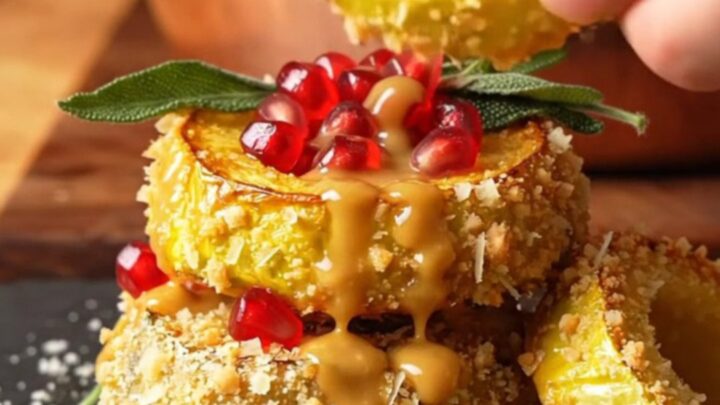
- Glaze and garnishWhile the squash roasts, melt the butter in a small saucepan over medium heat until it begins to brown and smells nutty. Stir in the remaining sage and maple syrup. Once the squash is removed from the oven, drizzle the warm maple-sage butter over the rings and sprinkle with pomegranate arils before serving immediately.Look for The butter is fragrant and golden brown, and the pomegranate seeds add a vibrant pop of color.Tip Watch the butter closely during browning to prevent it from burning.
The maple-sage butter should be a warm, golden-brown color with a nutty aroma. Once drizzled over the roasted rings, the butter should be absorbed slightly into the crust.
The addition of the pomegranate arils provides a final, vibrant visual finish, indicating that the dish is ready to be served immediately while the crust remains perfectly crisp.
Common mistakes
Avoid slicing the rings too thin, as they may lose their shape and become overly soft during roasting. Aim for a consistent 1.5cm thickness to ensure even cooking across all pieces. Do not crowd the baking sheet, as this will lead to steaming rather than roasting, preventing the crust from becoming adequately crispy.
If the rings are too close together, the moisture released by the squash will soften the panko. Always ensure the oven is fully preheated before placing the tray inside, as a lower initial temperature will prevent the necessary crisping.
How to tell it’s done
The squash is perfectly done when the rings are tender and can be pierced effortlessly with a fork. The parmesan-panko crust should be deep golden brown and crispy to the touch. The internal temperature of the egg-washed coating will have reached 160°F (71°C), ensuring the binder is fully set.
The squash flesh should be soft and caramelized, providing a sweet contrast to the savory, salty exterior. Avoid overcooking, as the squash can lose its structural integrity and become mushy if left in the oven for too long.
- Egg dishes: 160°F (71°C) in the thickest part
Up next · Part 3 of 3
2 variations · storage & make-ahead · 3 answers · printable card
Tips, FAQ & printable recipe (Part 3)← Back to the ingredients (Part 1)