Dinner · Part 2 of 3: Instructions
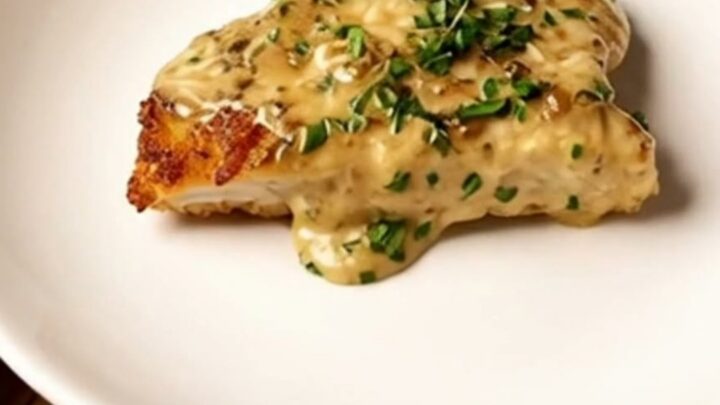
Crispy Parmesan Crusted Chicken with Creamy Herb Sauce Step-by-step instructions
- Prep
- Cook
- Total
- Serves
- 4
Before you start
Before beginning, ensure the chicken breasts are thoroughly patted dry with paper towels, as excess moisture will prevent the crust from crisping up properly.
Prepare a dedicated workstation for the dredging process, placing the parmesan in a wide, shallow bowl for easy access. Have all measuring tools and the creamy herb sauce ready near the stove, as the final steps move quickly once the chicken is searing in the hot pan.
Ingredients at a glance (3)
- 4 pieces boneless skinless chicken breasts, pounded thin
- 1 cup grated parmesan cheese
- 1 cup creamy herb sauce, made beforehand
Instructions
Dredging and Coating
- Prepare and Coat ChickenPlace the chicken breasts between sheets of plastic wrap and pound to an even half-inch thickness. Press each chicken piece into the grated parmesan cheese until well-coated on both sides.Look for The chicken should be evenly coated with a thick layer of the parmesan.Tip Pounding the chicken to an even thickness ensures it cooks through uniformly.
The chicken should be completely and evenly coated in the parmesan. Check that there are no bare spots on the meat, as these will not crisp properly during the searing phase.
The parmesan should adhere well to the surface, forming a cohesive layer that will protect the meat during the high-heat cooking process.
Searing the Cutlets
- Pan-Sear the ChickenHeat a large skillet over medium-high heat. Add the chicken cutlets and cook until the crust is deep golden brown and the meat is cooked through, reaching an internal temperature of 165°F (74°C). Remove the chicken from the skillet and let it rest for 5 minutes.Look for The crust should be crispy and golden brown, and the meat opaque throughout.Safe temperature 165°F (74°C) internal temperature (poultry)Tip Avoid overcrowding the pan to maintain the crispiness of the parmesan crust.
The chicken is ready when it is deep golden brown on both sides. The crust should be firm to the touch and sound crisp when tapped with a spatula. Ensure the internal temperature has reached 165°F (74°C) before removing the cutlets from the pan to rest for five minutes, which allows the juices to redistribute.
Finishing the Sauce
- Finish with SauceIn the same skillet, warm the creamy herb sauce until heated through. Serve the chicken immediately, drizzled with the creamy herb sauce.Look for The sauce should be warm and fragrant with herbs.Tip Deglazing the pan with the sauce helps pick up any flavorful browned bits left behind.
The sauce is finished when it has warmed through and is fragrant. It should be creamy and herb-forward. If the sauce becomes too thick, a splash of water or additional cream can be stirred in to reach the desired consistency before serving the dish immediately.
Common mistakes
A common mistake is using chicken breasts that are too thick, which leads to a burnt crust before the center is cooked. Always pound the meat to a uniform thinness.
Another error is adding the sauce to the pan while the heat is too high, which can cause the sauce to break or curdle. Keep the heat at a steady, gentle simmer once the sauce is added to ensure a smooth, emulsified texture that clings perfectly to the chicken.
How to tell it’s done
The chicken is perfectly cooked when the crust is a deep, uniform golden brown and the internal temperature reaches 165°F (74°C). The meat should be opaque and firm to the touch, with no pink remaining in the center.
Because the cutlets are thin, it is easy to overcook them, so monitor the heat carefully and remove them from the skillet as soon as the target temperature is reached to preserve the juiciness of the protein.
- Poultry: 165°F (74°C) in the thickest part
Up next · Part 3 of 3
2 variations · storage & make-ahead · 3 answers · printable card
Tips, FAQ & printable recipe (Part 3)← Back to the ingredients (Part 1)