Dinner · Part 2 of 3: Instructions
Crispy Parmesan-Crusted Chicken Caesar Cutlets Step-by-step instructions
- Prep
- Cook
- Total
- Serves
- 2
Before you start
Before starting, ensure your chicken breasts are trimmed of any excess fat. Prepare your breading station by laying out three wide, shallow bowls to make the dipping process efficient.
Have your romaine lettuce washed, dried, and chopped into bite-sized pieces, and ensure your Caesar dressing is ready to go. Having all ingredients measured and your workspace organized will make the frying process smooth and stress-free.
Ingredients at a glance (11)
- 2 chicken breasts, pounded thin
- 1/2 cup all-purpose flour
- 2 eggs, beaten
- 1 cup panko breadcrumbs
- 1 cup finely grated parmesan
- 1 tsp lemon zest
- 1/3 cup olive oil
- 2 tbsp butter
- 4 cups romaine lettuce, chopped
- 1/4 cup Caesar dressing
- 2 tbsp shaved Parmigiano-Reggiano
Instructions
Preparation and Breading
- Prepare the chickenPlace the chicken breasts between two sheets of plastic wrap and pound them with a meat mallet until they are an even 1/4-inch thickness. This ensures rapid and uniform cooking during the pan-frying process.Look for The chicken should be consistently thin and tenderized throughout.Tip Cover the chicken with plastic wrap to prevent meat juices from splashing onto your countertop.
- Dredge and breadSet up three shallow bowls: one with flour, one with beaten eggs, and one with a mixture of panko, grated parmesan, and lemon zest. Dip each cutlet first into the flour, shaking off the excess, then into the egg wash, and finally press firmly into the panko mixture until well coated on both sides.Look for The cutlets should be fully coated and dry to the touch.Tip Press the breading firmly into the meat to ensure it stays attached during the frying.
The chicken should be pounded to an even thickness and coated thoroughly with the panko-parmesan mixture. The breading should feel dry and firm, with no large gaps or exposed meat, ensuring an even crust during the cooking process.
Pan-Frying
- Pan-fry to goldenHeat the olive oil and butter in a stainless steel skillet over medium-high heat until the butter is melted and bubbling. Carefully add the breaded cutlets to the pan and cook for 3 minutes per side until they reach a deep golden brown color and the internal temperature reaches 165°F (74°C).Look for The coating should be golden brown and crispy.Safe temperature 165°F (74°C) internal temperature (poultry)Tip Do not overcrowd the pan; cook in batches if necessary to maintain the oil temperature.
The chicken is ready when it is a deep golden brown color and produces a satisfying sizzle when moved in the pan. The crust should be rigid and well-attached to the chicken, indicating a successful fry with the correct oil temperature.
Final Assembly
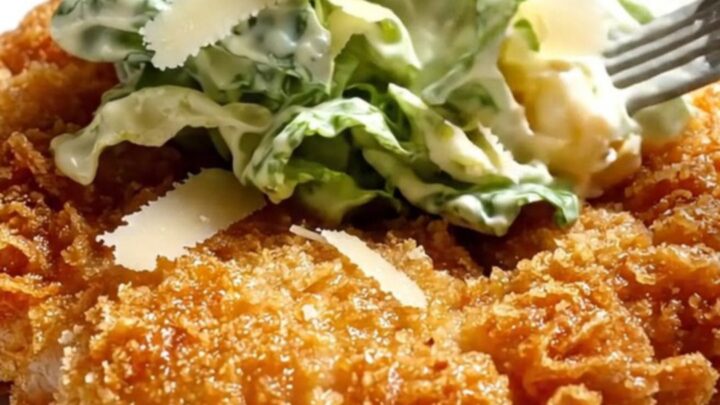
- Assemble the saladIn a medium bowl, toss the chopped romaine lettuce with the Caesar dressing until evenly coated. Once the chicken is cooked, transfer the hot cutlets to plates and pile the dressed romaine directly on top, finishing with a generous sprinkle of shaved Parmigiano-Reggiano.Look for The salad should be lightly coated and glossy.Tip Add the salad just before serving to keep the chicken crispy and the lettuce cold and crunchy.
The salad should look glossy and vibrant, with every leaf of romaine evenly coated in the creamy Caesar dressing.
The temperature contrast between the hot, crispy cutlet and the cold, crisp salad should be immediately apparent upon serving.
Common mistakes
A common mistake is using chicken that is too thick, which prevents the center from cooking through before the crust burns. Another error is failing to dry the chicken thoroughly before dredging, which can cause the breading to slide off.
Avoid overcrowding the pan, as this causes the oil temperature to drop rapidly, leading to soggy, oily cutlets instead of a crisp crust.
How to tell it’s done
The chicken is perfectly cooked when the breading is a deep, uniform golden brown on both sides and the internal temperature has reached 165°F (74°C).
The meat should be opaque throughout and tender when sliced. Use an instant-read meat thermometer inserted into the thickest part of the cutlet to confirm it is safe to eat.
- Poultry: 165°F (74°C) in the thickest part
Up next · Part 3 of 3
2 variations · storage & make-ahead · 3 answers · printable card
Tips, FAQ & printable recipe (Part 3)← Back to the ingredients (Part 1)