Dinner · Part 2 of 3: Instructions
Crispy Panko Tonkatsu Sandwich with Tangy Katsu Sauce Step-by-step instructions
- Prep
- Cook
- Total
- Serves
- 2
Before you start
Before you start, make sure your pork cutlets are pounded to an even thickness. Set up your breading station with three shallow dishes for flour, egg, and panko. Have your oil heating in a heavy skillet while you bread the pork.
Prepare the tonkatsu sauce by whisking together the ingredients. Shred the cabbage finely and set aside. Have the milk bread slices ready to assemble. Make sure your wire rack is nearby for resting the fried cutlets.
Ingredients at a glance (12)
- 4 slices Japanese milk bread (shokupan), thick-cut
- 2 pork loin cutlets, pounded to 1/2-inch thickness (about 200g each)
- 1/2 cup all-purpose flour
- 1 large egg, beaten
- 1 cup panko breadcrumbs
- Neutral oil, for frying, to taste
- 1 cup finely shaved green cabbage
- 2 tbsp ketchup
- 2 tbsp Worcestershire sauce
- 1 tbsp oyster sauce
- 1 tsp sugar
- Kewpie mayonnaise, for spreading, to taste
Instructions
Breading and Sauce Prep
- Prepare the pork and breading stationPlace each pork loin cutlet between two sheets of plastic wrap and pound with a meat mallet or rolling pin to an even 1/2-inch thickness. Set up three shallow dishes: one with flour, one with beaten egg, and one with panko breadcrumbs. Season the pork lightly with salt and pepper, then dredge each cutlet in flour, shaking off excess. Dip into the egg, allowing excess to drip off, then press firmly into the panko, coating both sides evenly. Transfer to a plate and repeat with the remaining cutlet.Look for The panko coating should be thick and even, with no bare spots.Tip Press the panko gently but firmly so it adheres well and creates a craggy crust.
- Make the tonkatsu sauceIn a small bowl, whisk together the ketchup, Worcestershire sauce, oyster sauce, and sugar until the sugar dissolves. Set aside. The sauce can be made up to a day ahead and stored in the refrigerator.Look for The sauce should be glossy, thick, and balanced between sweet, tangy, and savory.Tip Taste and adjust the sugar or Worcestershire to your liking.
At the end of this phase, you should have two well-coated pork cutlets ready for frying, and a bowl of glossy tonkatsu sauce with a balanced sweet-tangy flavor. The breading should be evenly distributed and adhere firmly to the pork.
The sauce should be smooth and slightly thick, with no sugar granules remaining. The cabbage should be finely shredded and crisp, and the bread slices should be soft and fresh.
Frying and Assembly
- Fry the tonkatsuPour about 1 inch of neutral oil into a large heavy skillet and heat over medium-high to 350°F (175°C). Carefully place the breaded pork cutlets into the hot oil, one at a time if necessary, and fry for about 2-3 minutes per side, until deep golden amber and crispy. The internal temperature should reach 145°F (63°C). Transfer to a wire rack and let rest for at least 3 minutes before slicing.Look for The crust should be deep golden and shatteringly crisp when tapped.Safe temperature 145°F (63°C) internal temperature (steaks, chops and roasts)Tip Do not crowd the pan; fry in batches if needed to maintain oil temperature.
- Assemble the sandwichSpread a layer of Kewpie mayonnaise on one side of each slice of milk bread. Dip the hot fried cutlet into the tonkatsu sauce, coating both sides generously. Place the sauced cutlet on one slice of bread, top with the finely shaved cabbage, and close with the second slice of bread, mayo-side down.Look for The bread should be soft and pillowy, the cutlet glossy with sauce.Safe temperature 160°F (71°C) internal temperature (egg dishes)Tip Add extra cabbage for crunch and to balance the richness.
The fried cutlets should be deep golden and crispy, with the internal temperature at 145°F (63°C). After resting, the cutlets should be juicy inside. The sandwich should be assembled with the mayo on the bread, the sauced cutlet in the middle, and a generous layer of cabbage on top. The bread should be soft and slightly compressed when pressed, and the whole sandwich should be tall and inviting.
Slicing and Serving
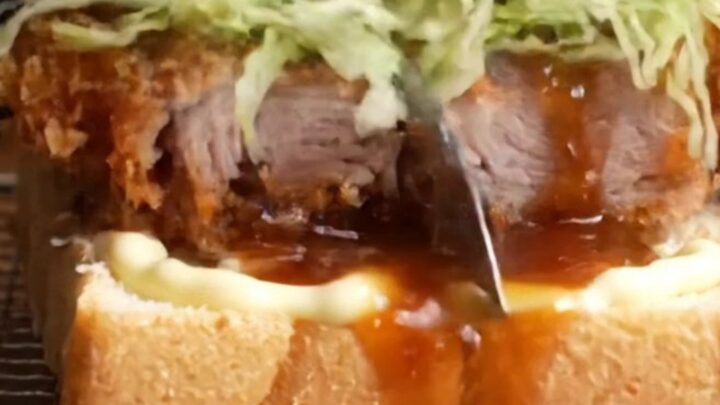
- Slice and servePress down gently on the sandwich with the palm of your hand to compact it slightly. Using a sharp serrated bread knife, slice the sandwich in half cleanly, with a gentle sawing motion to preserve the crispy crust. Serve immediately, while the cutlet is still hot and the bread is soft.Look for The cut should reveal a clean cross-section with layers of bread, cabbage, and crispy pork.Tip Wipe the knife between cuts for a clean slice.
The final sandwich should be sliced cleanly in half, revealing a cross-section with distinct layers of bread, cabbage, and pork. The crust should remain crispy, and the interior should be hot and juicy. The sandwich should be served immediately, with the bread still soft and the cutlet still warm. The aroma of fried pork and tangy sauce should be prominent and appetizing.
Common mistakes
One common mistake is not pounding the pork evenly, leading to uneven cooking. Another is overcrowding the pan, which lowers the oil temperature and results in greasy, soggy crust. Also, be careful not to overcoat the pork with too much flour or egg, which can make the crust heavy.
When assembling, don't skip the resting time—slicing too soon will cause the juices to run out, making the pork dry. Finally, use a serrated knife to slice the sandwich, as a regular knife can crush the crispy crust.
How to tell it’s done
The tonkatsu is done when the crust is deep golden amber and the internal temperature of the pork reaches 145°F (63°C). Let the cutlets rest for at least 3 minutes before slicing to allow the juices to redistribute.
The sandwich should be assembled while the cutlet is still hot so the bread softens slightly and the sauce melds with the pork. When you slice the sandwich, the crust should crackle audibly, and the interior should be juicy and tender.
- Steaks, chops and roasts: 145°F (63°C) in the thickest part, then a 3-minute rest
- Egg dishes: 160°F (71°C) in the thickest part
Up next · Part 3 of 3
4 variations · storage & make-ahead · 5 answers · printable card
Tips, FAQ & printable recipe (Part 3)← Back to the ingredients (Part 1)