Breakfast · Part 2 of 3: Instructions
Crispy Monte Cristo Melt with Raspberry Jam Step-by-step instructions
- Prep
- Cook
- Total
- Serves
- 1
Before you start
Set up everything before the pan goes on the heat, because the fry itself moves fast. Take the ham, turkey, and Swiss out of the refrigerator and arrange them on a board so they can be layered without stopping. Measure the mustard, milk, and clarified butter, and put the confectioners' sugar in a small bowl beside a fine-mesh sieve. Crack the eggs into the shallow dish but hold the whisking until just before dipping, so the custard stays freshly aerated.
Ingredients at a glance (10)
- 2 slices thick-cut brioche bread
- 1 tbsp Dijon mustard
- 3 oz shaved black forest ham
- 3 oz roasted turkey
- 2 slices Swiss cheese
- 2 large eggs, beaten
- 2 tbsp milk
- 2 tbsp clarified butter
- Confectioners' sugar, for serving
- Seedless raspberry jam, for serving
Instructions
Build the layered stack
- Spread the mustard baseSpread the Dijon mustard in a thin, even layer over one side of each brioche slice. Mustard straight onto the bread keeps the filling moist from the inside and adds the tangy backbone that balances the sweet finish, so take a few extra seconds to reach all the way to the edges.Look for The mustard should coat the bread in a pale, even film with no bare spots at the corners.Tip If the brioche is very fresh and soft, toast the slices briefly first so they hold their structure during the dip.
- Shingle the ham layerShingle the shaved black forest ham over the mustard side of one slice, folding the slices into soft ruffles rather than a flat slab. Those ruffled layers trap little pockets of melted cheese later and give each bite more height, texture, and contrast between meat and bread.Look for The ham should cover the mustard edge to edge in two or three ruffled layers with no bald patch in the middle.Tip Pull the ham from the refrigerator just before assembling; well-chilled deli meat handles cleanly and will not tear.
- Add turkey and Swiss, then closePile the roasted turkey on top of the ham, then lay the Swiss slices over the turkey so the cheese touches both meats. Cap with the second brioche slice, mustard side down, and press gently so the sandwich holds together without crushing the layers flat.Look for The stack should stand about an inch and a half tall and feel cohesive when lifted from the board.Tip Keep the cheese as the outermost filling layer; once it melts it acts as edible glue, sealing the meats inside the sandwich.
At the end of this phase, the sandwich is assembled and holding its shape: mustard on both inner faces, ham ruffled edge to edge, turkey piled evenly, and the Swiss slices bridging both meats so nothing sits dry against the bread. Pick it up by the top slice and give it a gentle shake — nothing should slide.
The stack should stand tall, roughly an inch and a half, and feel compact without being compressed. If the filling overhangs anywhere, tuck it back in now, because loose edges will catch and burn in the butter later. Only when the sandwich closes cleanly is it ready for the custard.
Custard soak, both sides
- Whisk the egg custardCrack the eggs into a shallow dish, add the milk, and whisk until completely uniform, about thirty seconds — no streaks of white or yolk should remain. Choose a dish wide enough to hold the sandwich flat, since an even soak depends on full contact between the bread and the custard.Look for The custard should look pale gold and perfectly smooth, with a thin foam settled on top.Tip Whisk in one direction and lift the fork often; incorporating a little air gives the fried crust a lighter, puffier texture.
- Soak the sandwichLay the sandwich in the custard and let it sit for about fifteen seconds, then flip and soak the second side for another fifteen seconds. Press gently with a spatula so the brioche drinks the custard all the way to the crust without collapsing — thick bread needs full saturation but not a long bath.Look for The bread should look evenly moist and noticeably heavier, but still firm enough to lift in one piece.Tip Count the seconds out loud; even a short extra soak can leave the exterior soggy before it ever reaches the pan.
The sandwich should now look like French toast waiting for the pan: uniformly moist from crust to crust, a shade deeper in color, and noticeably heavier in the hand. Run a finger lightly over the surface — the bread should feel saturated but still firm, with no wet patches pooling at the corners and no dry spots where the custard missed.
Lift it with the spatula from underneath, supporting the whole base; a properly soaked sandwich moves as one piece. If any corner looks pale and dry, touch it to the remaining custard for two seconds. Head to the stove immediately — a soaked sandwich should never sit and stew in its own custard.
Fry, dust, and serve
- Heat the clarified butterWarm the clarified butter in a large skillet over medium heat until it reaches 350°F (175°C) on an instant-read thermometer and shimmers across the surface without smoking. Adjust the heat as needed while you work; a steady temperature is the single biggest factor in an even, deep golden crust.Look for The butter should shimmer across the whole pan, and a drop of custard should sizzle gently on contact.Tip Clarified butter tolerates this heat without burning; a skillet at least ten inches wide lets the sandwich turn freely.
- Fry until golden and puffedLay the sandwich in the hot butter and fry for about two and a half minutes per side, flipping once, until both faces are deep golden brown and the sandwich is visibly puffed. The center must reach 165°F (74°C), which cooks the egg custard through completely, heats the turkey safely, and melts the Swiss into every layer.Look for Listen for a steady, gentle sizzle the whole time; loud crackling means the heat is running too high.Safe temperature 165°F (74°C) internal temperature (poultry)Tip Press the sandwich lightly with the spatula after flipping to keep contact even and the browning uniform.
- Dust, slice, and dunkTransfer the sandwich to a board and let it rest for one minute so the molten cheese settles back into the layers. Dust the top generously with confectioners' sugar through a fine-mesh sieve, slice diagonally, and serve at once with seedless raspberry jam for dunking the gooey Swiss corner.Look for The crust should feel crisp under the sieve, and the sugar should fall in an even, snow-like layer.Tip Warm the jam for ten seconds first; it clings to the crisp crust far better than jam straight from the jar.
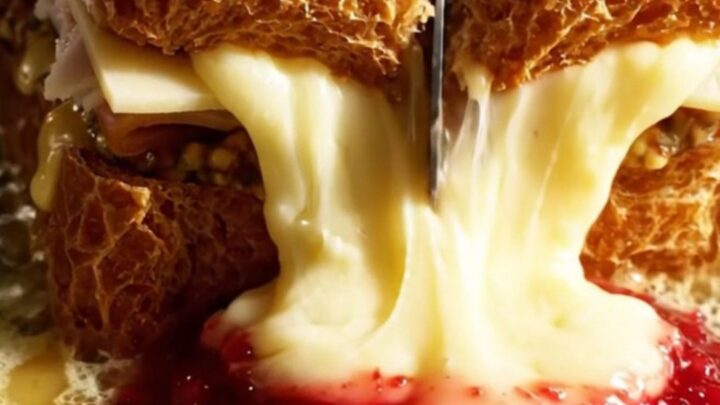
The finished sandwich should be deep golden brown on both faces with crisp, ruffled edges, visibly puffed in the middle, and glossy where the butter lacquered the crust. The thermometer is the final word: at least 165°F (74°C) in the center, ensuring the egg custard is fully cooked and the turkey is heated through. The cheese should ooze at the edges when the sandwich is nudged. After one minute of rest, the diagonal cut should reveal steam escaping, layers in clean order, and Swiss stretching from corner to corner.
Common mistakes
The most common failure is a soggy crust, and it almost always comes from the custard bath running long. Brioche saturates fast; fifteen seconds per side with a gentle press is plenty, and anything more leaves the surface wet before it ever meets the pan.
The second trap is heat management: butter that smokes means the pan is too hot, and the crust will darken long before the center warms through, while a timid flame produces pale, steamed bread that never crisps. Flipping too early tears the set custard, so wait for a deep golden underside before turning.
How to tell it’s done
A finished Monte Cristo tells on itself in three ways. First, color: both fried faces should be deep, even golden brown — darker than French toast, with crisp, lacquered edges where the custard pooled. Second, shape: the sandwich should look puffed and slightly domed, a sign the custard has set and the steam inside has done its work.
Third, the thermometer: the center should read at least 165°F (74°C), which guarantees the egg custard is cooked through, the turkey is heated safely, and the Swiss has gone fully molten. Tap the crust; it should sound crisp, not damp.
- Poultry: 165°F (74°C) in the thickest part
- Egg dishes: 160°F (71°C) in the thickest part
Up next · Part 3 of 3
4 variations · storage & make-ahead · 5 answers · printable card
Tips, FAQ & printable recipe (Part 3)← Back to the ingredients (Part 1)