Appetizers · Part 2 of 3: Instructions
Crispy Ham and Cheese Puff Pastry Step-by-step instructions
- Prep
- Cook
- Total
- Serves
- 4
Before you start
Before beginning, ensure that the puff pastry is fully thawed but still very cold to the touch. Preheat the oven to 400°F (200°C) so that it is thoroughly heated when the pastries are ready to go in. Line a large, sturdy baking sheet with a fresh piece of parchment paper.
Finely chop the fresh parsley and set it aside. Grate the Gruyère cheese and portion out the ham slices so that the assembly process can proceed quickly and efficiently without warming up the delicate dough.
Ingredients at a glance (4)
- 1 sheet puff pastry, thawed but cold
- 4 oz sliced ham
- 1 cup Gruyère cheese, shredded
- 1 tbsp fresh parsley, finely chopped
Instructions
Assembly and Prep
- Prepare Pastry SquaresPreheat the oven to 400°F (200°C) and line a baking sheet with parchment paper. Gently unfold the thawed puff pastry sheet onto a lightly floured surface. Cut the sheet into four equal squares. Transfer the squares onto the prepared baking sheet, leaving space between each.Look for The pastry squares are cut cleanly and arranged on the baking sheet.Tip Work quickly so the pastry remains cold, which ensures a dramatic rise.
- Assemble Ham and CheeseFold the sliced ham to fit neatly in the center of each puff pastry square, leaving a border of about half an inch around the edges. Sprinkle the shredded Gruyère cheese generously over the ham slices, allowing some of the cheese to spill slightly toward the edges.Look for The ham and cheese are centered neatly on each pastry square.Tip Grate the cheese yourself from a block for the absolute best melt.
The puff pastry sheet is unfolded, cut into neat squares, and arranged on the parchment-lined baking sheet. Each square is topped with folded ham slices and a generous mound of shredded Gruyère cheese.
The pastry edges should still feel cold and firm to the touch, indicating that the butter inside has not melted yet.
Baking and Rising
- Bake Until Golden and PuffedPlace the baking sheet in the preheated oven. Bake for 18 to 20 minutes. Watch for the pastry to rise rapidly, turning a deep golden-brown, while the Gruyère cheese melts completely and bubbles, forming a beautiful caramelized crust on top and around the edges.Look for The pastry is high, flaky, and golden-brown with bubbling cheese.Tip Avoid opening the oven door during the first 10 minutes of baking.
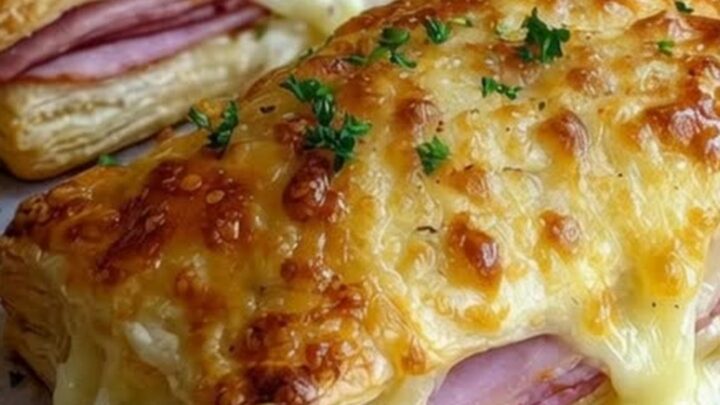
The pastries are puffed high, displaying distinct flaky layers along the edges. The pastry dough has turned a beautiful deep golden-brown, and the Gruyère cheese on top is completely melted, bubbling vigorously, and starting to form a crispy, caramelized brown crust where it has dripped onto the parchment paper.
Cooling and Garnish
- Garnish and CoolRemove the baking sheet from the oven and place it on a wire rack. Immediately sprinkle the finely chopped fresh parsley over the hot, bubbly cheese. Let the pastries cool on the baking sheet for 5 minutes before serving so the melted cheese sets slightly.Look for The pastries are warm, the cheese is set, and the parsley is bright green.Tip Letting them cool slightly prevents the cheese from sliding off when handled.
The baked pastries are resting on the baking sheet, and the bubbling cheese has settled into a firm, golden crust. A sprinkle of bright green chopped parsley adds a beautiful contrast. The pastries should feel light and crisp when lifted, and the cheese should pull apart in warm, gooey strands when broken.
Common mistakes
One of the most common mistakes is letting the puff pastry get too warm before baking. If the butter in the dough melts before entering the oven, the layers will stick together, resulting in a flat, dense pastry instead of a light, flaky rise.
Another error is overloading the pastries with too much damp filling, which releases excess moisture and makes the bottom soggy. Keep the ham dry and stick to the recommended amount of cheese to ensure a perfect bake.
How to tell it’s done
These pastries are perfectly done when the puff pastry dough is a rich golden-brown all over, especially on the bottom. The edges should look dry, crisp, and multi-layered, not pale or doughy.
The cheese on top must be thoroughly melted and bubbly with deep golden patches. Let the pastries cool on the baking sheet for five minutes; this allows the melted cheese to set slightly so it stays intact when served.
Up next · Part 3 of 3
2 variations · storage & make-ahead · 3 answers · printable card
Tips, FAQ & printable recipe (Part 3)← Back to the ingredients (Part 1)