Breakfast · Part 2 of 3: Instructions
Crispy Cinnamon Roll French Toast Stack Step-by-step instructions
- Prep
- Cook
- Total
- Serves
- 2
Before you start
Before starting, make sure the butter and cream cheese are softened to room temperature. This ensures they mix smoothly and spread easily.
Gather all ingredients and equipment: a chef's knife, cutting board, mixing bowls, tongs, a large skillet or griddle, and a spatula. Have a small saucepan or microwave-safe bowl ready for warming the glaze.
Ingredients at a glance (8)
- 8 slices thick white bread
- 1/2 cup unsalted butter, softened
- 2 tbsp ground cinnamon
- 2 tbsp granulated sugar
- 4 oz cream cheese, softened
- 1 cup confectioners' sugar
- 1 tsp vanilla extract
- 2-3 tbsp milk
Instructions
Prep and Assemble
- Make the Cinnamon Butter and Assemble the StackIn a small bowl, combine the softened butter, ground cinnamon, and granulated sugar. Mix until smooth and evenly combined. Lay out 8 slices of thick white bread on a cutting board. Spread a generous layer of the cinnamon butter on each slice, covering the entire surface. Stack 4 slices on top of each other to form a tall stack. Repeat with the remaining 4 slices to make a second stack. Using a sharp chef's knife, trim off the crusts from all four sides of each stack, creating clean, straight edges.Look for The butter should be spreadable and evenly coat the bread. The stacks should be uniform and hold together when trimmed.Tip If the butter is too firm, microwave for a few seconds to soften, but do not melt completely.
- Cut the Stack into SlicesAfter trimming the crusts, slice each stack crosswise into 4 equal pieces, creating individual mini-stacks or 'fingers'. Each piece will have visible layers of bread and cinnamon filling. Set these pieces aside while you prepare the skillet.Look for Each piece should show distinct layers of bread and cinnamon butter.Tip Use a serrated knife for cleaner cuts without squishing the bread.
The stacks should be neat and uniform, with the cinnamon butter evenly spread. When trimmed, the edges should be straight and clean. The layers should stick together, and the bread should not be crushed or torn.
Sear to Crisp
- Sear the Vertical EdgesPlace a large skillet or griddle over medium heat. Once hot, add a small pat of butter or a light spray of oil. Using tongs, pick up each mini-stack and sear all four vertical edges in the skillet. Hold each edge against the hot surface for 30-45 seconds, turning with the tongs, until the exterior is deeply golden brown and crisp. The edges should become shatteringly crisp while the interior stays soft.Look for The edges will turn a deep mahogany brown and feel crispy to the touch.Tip Work in batches to avoid overcrowding the pan, which can lower the temperature and prevent crisping.
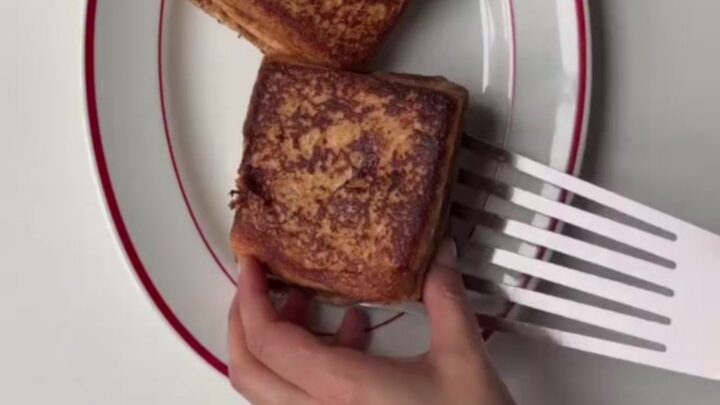
- Sear the Top and Bottom FacesAfter searing the edges, lay each mini-stack flat in the skillet. Sear the top and bottom faces for about 1-2 minutes per side, until golden brown and crisp. Use a spatula to flip carefully. The entire exterior should be uniformly crisp and golden.Look for The faces should be golden brown and crisp, with no soft spots.Tip Press gently with the spatula to ensure even contact with the pan.
The exterior should be deeply golden brown and shatteringly crisp. The edges should be firm to the touch, and the faces should be evenly browned.
The interior should remain soft and pillowy. The kitchen should smell of warm cinnamon and butter.
Glaze and Serve
- Make the Cream Cheese GlazeIn a medium bowl, beat the softened cream cheese until smooth. Add the confectioners' sugar and vanilla extract, and beat until combined. Add milk, 1 tablespoon at a time, until the glaze reaches a pourable consistency. It should be thick but flow easily from a spoon.Look for The glaze should be smooth, glossy, and pourable.Tip For a thinner glaze, add a little more milk; for thicker, add more sugar.
- Warm the GlazeTransfer the glaze to a small saucepan or microwave-safe bowl. Warm gently over low heat or in 15-second increments in the microwave, stirring between, until warm to the touch. Do not overheat, as it can thin out too much.Look for The glaze should be warm and slightly more fluid than at room temperature.Tip Warming the glaze makes it easier to drizzle and enhances the flavor.
- Assemble and ServeArrange the crispy French toast stacks on a serving plate. Drizzle the warm cream cheese glaze generously over the top, allowing it to cascade down the sides. Serve immediately while the exterior is crisp and the glaze is warm.Look for The glaze should coat the crispy edges and pool slightly on the plate.Tip For an extra touch, sprinkle with a little extra cinnamon before serving.
The glaze should be warm, smooth, and pourable. When drizzled over the stacks, it should coat the crispy edges and pool slightly on the plate. The contrast between the crunchy exterior and the creamy glaze should be visually appealing.
Common mistakes
One common mistake is using bread that is too thin or flimsy, which can tear or become soggy. Another is searing over too high heat, which can burn the exterior before the interior warms through.
Use medium heat and be patient. Also, don't skip trimming the crusts—this ensures even searing and a neat appearance. Finally, avoid overcrowding the pan, which lowers the temperature and prevents crisping.
How to tell it’s done
The French toast is done when all exterior surfaces are deeply golden brown and crisp to the touch. The interior should be soft and warm, with the cinnamon butter fully melted.
If using a thermometer, the center of the stack should reach at least 160°F (71°C) to ensure the butter is fully melted and the bread is heated through. The glaze should be warm and pourable.
Up next · Part 3 of 3
4 variations · storage & make-ahead · 5 answers · printable card
Tips, FAQ & printable recipe (Part 3)← Back to the ingredients (Part 1)