Dinner · Part 2 of 3: Instructions
Crispy Chicken Milanese with Creamy Burrata Step-by-step instructions
- Prep
- Cook
- Total
- Serves
- 2
Before you start
Before you begin, ensure your workspace is clean and organized. Remove the chicken from the refrigerator about 20 minutes before cooking to take the chill off, which helps it cook more evenly.
Set up your breading station with three shallow bowls and prepare your ingredients by measuring them out. Ensure you have your meat mallet, skillet, and tongs ready to go, as the cooking process moves quite quickly once the heat is turned on.
Ingredients at a glance (11)
- 2 bone-in chicken breasts
- 1/2 cup all-purpose flour
- 2 large eggs, beaten
- 2 cups fine Italian breadcrumbs
- 1/2 cup grated pecorino cheese
- 2 tsp fresh thyme
- 1/2 cup olive oil
- 3 tbsp unsalted butter
- 1 lemon, juiced
- 1 burrata ball
- 1 cup baby arugula
Instructions
Preparation and Breading
- Prepare the chickenRemove the bones from the chicken breasts if necessary and trim any excess fat. Place the chicken between two sheets of plastic wrap and use a meat mallet to pound them until they are paper-thin and uniform in thickness. This ensures they cook quickly and evenly in the pan.Look for Chicken should be uniform and very thin.Tip Work from the center outwards to avoid tearing the meat.
- Dredge the cutletsSet up a breading station with three shallow bowls. Place the flour in the first bowl, the beaten eggs in the second, and a mixture of the breadcrumbs, grated pecorino, and fresh thyme in the third. Dredge each chicken cutlet first in the flour, shaking off any excess, then dip into the egg wash, and finally coat thoroughly with the breadcrumb mixture, pressing gently to ensure the crumbs adhere well.Look for The chicken should be fully coated in breadcrumbs.Tip Ensure the breading is even to prevent burning.
The chicken should be pounded to a uniform thickness and coated evenly in the breadcrumb mixture. Check that the breading is firmly adhered to the meat and that there are no bare spots. The station should be ready so that you can move quickly from the flour to the egg to the breadcrumbs without any delay, ensuring the coating remains light and consistent.
Pan-frying the Cutlets
- Pan-fry the chickenHeat the olive oil in a large skillet over medium-high heat until it reaches 365°F (185°C). Carefully add the breaded cutlets to the pan. Fry for 3 minutes per side until the crust is deep golden brown and the internal temperature reaches 165°F (74°C). Remove the chicken from the pan and let it rest on a wire rack or paper-lined plate.Look for The crust should be deep golden brown and crispy.Safe temperature 165°F (74°C) internal temperature (poultry)Tip Do not crowd the pan; fry in batches if necessary.
The cutlets should be a vibrant, deep golden brown on both sides. The oil should be sizzling steadily but not smoking. When you lift a cutlet with tongs, it should feel firm and the crust should appear crisp. Use a thermometer to confirm the internal temperature has reached 165°F (74°C) to ensure the poultry is fully cooked and safe to consume.
Basting and Finishing
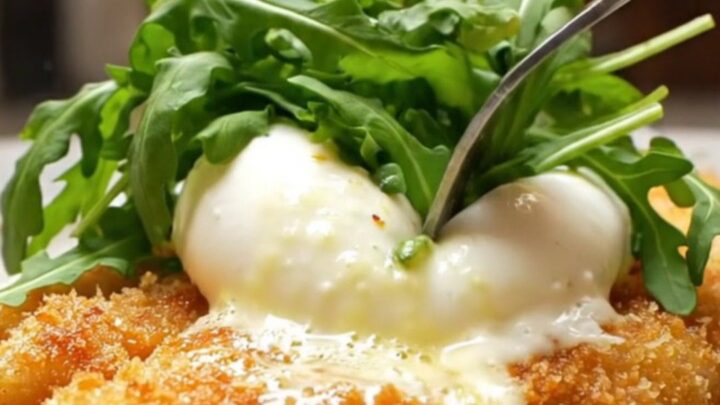
- Baste and serveIn the same skillet, melt the butter and add the lemon juice. Swirl the pan to create a foaming brown butter sauce. Return the chicken cutlets to the pan briefly to coat with the sauce, or pour the foaming butter directly over the plated chicken. Top each cutlet with a fresh ball of burrata and a handful of baby arugula. Serve immediately while the chicken is hot and the cheese is cool.Look for The butter should foam and smell nutty.Tip Use fresh, high-quality burrata for the best texture.
The butter should be bubbling and have turned a light golden brown color with a nutty aroma. Once the lemon juice is added, the sauce should emulsify slightly.
The final dish should be assembled immediately by placing the burrata on the hot chicken, allowing the cool cream to begin to soften slightly from the heat of the cutlet, and garnishing with fresh, crisp arugula.
Common mistakes
A common mistake is failing to pound the chicken thinly enough, which leads to uneven cooking. If the chicken is too thick, the crust may burn before the center is safe to eat.
Another error is overcrowding the pan, which lowers the oil temperature and results in soggy, oily breading rather than a crispy crust. Finally, ensure the oil is fully heated before starting; adding the chicken to cold oil will cause the breading to separate and soak up excessive grease.
How to tell it’s done
The chicken is done when the internal temperature reaches 165°F (74°C) as measured by a meat thermometer inserted into the thickest part of the breast. Visually, the crust should be deep golden brown and crispy, and the meat should be opaque and tender.
Because the chicken is pounded thin, it will cook rapidly, so keep a close watch to avoid overcooking. Once removed from the heat, the residual heat will keep it warm while you assemble the final toppings.
- Poultry: 165°F (74°C) in the thickest part
Up next · Part 3 of 3
2 variations · storage & make-ahead · 3 answers · printable card
Tips, FAQ & printable recipe (Part 3)← Back to the ingredients (Part 1)