Dinner · Part 2 of 3: Instructions
Crispy Chicken Cordon Bleu with Molten Swiss Cheese Step-by-step instructions
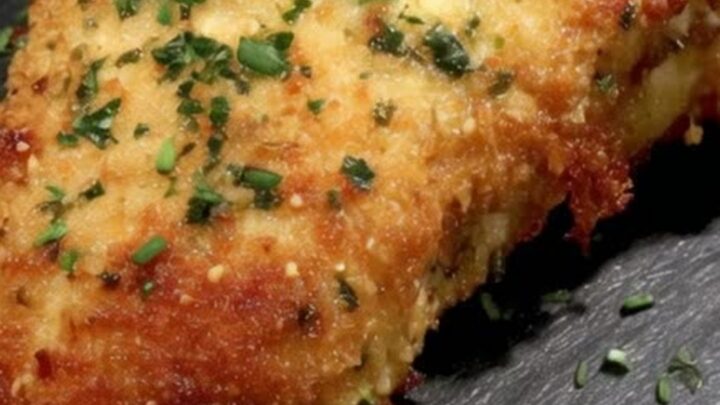
- Prep
- Cook
- Total
- Serves
- 4
Before you start
Before starting the cooking process, organize the workspace to ensure a smooth workflow. Clear a large cutting board and set up a clean surface for pounding the chicken. Slice the chicken breasts horizontally to butterfly them, then place them between sheets of plastic wrap.
Set out the deli ham and Swiss cheese slices so they are easily accessible. Arrange three shallow bowls side-by-side for the breading station: one with seasoned flour, one with beaten eggs, and one with seasoned panko breadcrumbs. Heat the frying oil in a heavy skillet.
Ingredients at a glance (10)
- 4 boneless, skinless chicken breasts
- 1 tsp kosher salt and black pepper, divided
- 1/2 tsp garlic powder
- 8 slices deli ham
- 8 slices Swiss cheese
- 1/2 cup all-purpose flour
- 2 large eggs, beaten
- 1 1/2 cups panko breadcrumbs
- 2 cups vegetable oil, for frying
- 2 tbsp finely chopped fresh chives, for garnish
Instructions
Prep and Roll
- Flatten and Season the ChickenPlace the chicken breasts between sheets of plastic wrap. Use a meat mallet to gently pound them to an even thickness of about one-quarter inch. Season both sides of the chicken with the kosher salt, black pepper, and garlic powder.Look for The chicken should be uniform in thickness without any tears.Tip Pound from the center outward to avoid tearing the meat.
- Roll the Ham and CheeseLay two slices of Swiss cheese and two slices of deli ham over each flattened chicken breast. Roll the chicken tightly around the filling, tucking in the sides to fully enclose the cheese and ham inside the meat.Look for The chicken rolls should be firm, compact, and completely sealed.Tip Chilling the rolled chicken for 15 minutes helps it hold its shape.
At the end of this prep phase, the chicken breasts should be pounded to an even thickness of one-quarter inch, seasoned well, and rolled tightly around the ham and cheese.
The rolls must feel secure and compact, with the filling completely enclosed inside the chicken meat, ensuring no cheese can easily escape during the breading process.
Breading
- Dredge and Bread the RollsSet up a breading station with three shallow bowls: one with flour, one with beaten eggs, and one with panko breadcrumbs. Roll each chicken bundle in the flour, dip completely in the beaten eggs, and coat thoroughly with panko, pressing gently to adhere.Look for The entire surface of the chicken must be evenly crusted in panko.Tip Use one hand for wet ingredients and one for dry to keep clean.
After breading, each chicken roll must be fully and evenly coated in panko breadcrumbs, with no bare spots of chicken showing. The panko should adhere firmly to the egg layer, creating a dry, textured exterior that is ready to hit the hot frying oil immediately for maximum crispness.
Frying and Garnishing
- Fry Until Golden and Cooked ThroughHeat the vegetable oil in a deep skillet to 350°F (177°C). Carefully lower the breaded chicken rolls into the hot oil. Fry for 8 to 10 minutes, turning occasionally, until the crust is deep golden brown and the internal temperature of the chicken reaches 165°F (74°C) on an instant-read thermometer.Look for The crust should be hard, crunchy, and deep golden-brown.Safe temperature 165°F (74°C) internal temperature (poultry)Tip Do not crowd the skillet; fry in batches if necessary to keep heat stable.
- Garnish, Slice, and ServeTransfer the fried chicken rolls to a wire rack to drain for 5 minutes. Place the warm chicken on a serving board, garnish with the finely chopped fresh chives, and slice diagonally to serve.Look for The cheese should be molten and ooze out gently upon slicing.Tip Use a sharp serrated knife to slice clean through the crispy crust.
At the end of frying, the chicken rolls will feature a deep, uniform golden-brown crust that sounds hollow and incredibly crunchy when tapped with tongs. The interior must reach a safe internal temperature of 165°F (74°C), and the cheese inside should be fully melted and hot.
Common mistakes
One common mistake is pounding the chicken too thin or too unevenly, which causes the meat to tear and allows the cheese to leak out during frying. Another frequent error is frying in oil that is either too hot or too cold.
If the oil is too hot, the panko crust will burn before the chicken cooks through; if it is too cold, the breading will absorb excessive oil and become greasy rather than crispy. Always maintain the frying oil temperature around 350°F (177°C) and use a thermometer to check the chicken's internal temperature.
How to tell it’s done
Accurate doneness is crucial for both safety and texture. The chicken is perfectly cooked when an instant-read meat thermometer inserted into the thickest part of the roll, avoiding the cheese pocket, registers exactly 165°F (74°C).
At this temperature, the poultry is completely safe to consume, the chicken remains remarkably juicy, the ham is heated through, and the Swiss cheese is completely melted and ready to ooze out beautifully when sliced. Let the chicken rest for 5 minutes before cutting.
- Poultry: 165°F (74°C) in the thickest part
Up next · Part 3 of 3
3 variations · storage & make-ahead · 4 answers · printable card
Tips, FAQ & printable recipe (Part 3)← Back to the ingredients (Part 1)