Appetizers · Part 2 of 3: Instructions
Crispy Cheesy Meatball Pockets with Flaky Puff Pastry Step-by-step instructions
- Prep
- Cook
- Total
- Serves
- 4
Before you start
Before beginning the assembly, gather all ingredients and equipment on a clean workspace. Thaw the puff pastry sheet in the refrigerator for about two hours or on the counter for forty minutes until pliable but still cold.
Thaw the pre-cooked meatballs completely if they were frozen, and pat them dry with a paper towel to remove excess moisture. Line a large baking sheet with parchment paper, and whisk the egg in a small bowl to create the egg wash.
Ingredients at a glance (5)
- 1 sheet puff pastry, thawed but cold
- 4 cooked meatballs, thawed
- 1/2 cup shredded mozzarella cheese
- 1 large egg, beaten
- 1 tbsp chopped fresh parsley
Instructions
Preparation and Pastry Shaping
- Preheat and PreparePreheat the oven to 400°F (204°C) to ensure it reaches the correct temperature for pastry expansion. Line a large baking sheet with parchment paper to prevent sticking and catch any escaping cheese.Look for The oven should be fully preheated before the pastries go in.Tip A hot oven is essential for the steam action that makes puff pastry rise.
- Roll and Cut PastryUnroll the cold puff pastry sheet onto a lightly floured surface. Use a rolling pin to gently roll it into a 10-inch square, then cut it into four equal squares using a sharp knife.Look for The pastry should feel cool and hold its shape without sticking.Tip If the pastry gets too warm or soft, place it in the freezer for five minutes.
At the end of this phase, the puff pastry sheet is rolled out evenly and sliced into four neat, cold squares. The workspace remains cool, and the pastry is pliable but firm enough to handle easily without tearing or sticking to the surface.
Assembly and Sealing
- Assemble the PocketsPlace a portion of shredded mozzarella cheese in the center of each pastry square. Top the cheese with one cooked meatball, then fold the corners of the pastry over the filling, pressing the edges firmly to seal.Look for Ensure the edges are completely sealed to prevent the cheese from leaking.Tip Do not overfill the pockets, or they will burst open during baking.
- Apply Egg WashArrange the assembled pockets on the prepared baking sheet. Using a pastry brush, coat the top and sides of each pocket evenly with the beaten egg.Look for The egg wash should form a thin, even layer without pooling on the pan.Tip Avoid letting the egg wash drip down the cut edges, which can glue the layers together.
At this stage, the pockets are fully formed with the meatballs and cheese securely enclosed. The pastry edges are pressed tightly together, and the tops are completely coated with a glossy, thin layer of egg wash, ready for the oven.
Baking and Garnishing
- Bake to Golden PerfectionBake the pockets at 400°F (204°C) for 18 to 20 minutes. The pastry must puff up significantly and turn a deep, glossy golden brown, while the egg wash cooks thoroughly to a safe internal temperature of 160°F (71°C).Look for The pastry should be puffed, crisp, and deep golden brown.Safe temperature 160°F (71°C) internal temperature (egg dishes)Tip Rotate the baking sheet halfway through for an even color.
- Garnish and RestRemove the baking sheet from the oven and let the pockets cool on the pan for 5 minutes to allow the cheese to set. Sprinkle with chopped fresh parsley before serving.Look for The cheese inside should remain hot but not runny when split open.Tip Letting the pockets rest prevents the hot cheese from burning your mouth.
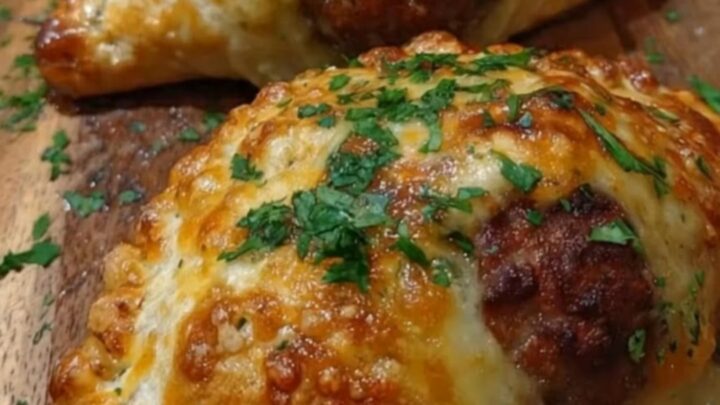
The pockets emerge from the oven puffed to twice their original height, displaying a beautiful golden-brown color. The pastry is dry and crisp to the touch, with small flecks of bubbling cheese visible at the seams, and a fresh sprinkle of green parsley completes the dish.
Common mistakes
One common mistake is using warm puff pastry, which prevents the layers from rising and results in a flat, greasy crust. Always keep the pastry cold.
Another error is failing to seal the edges securely; if the seams are loose, the mozzarella will melt and run out onto the baking sheet, leaving the pockets empty.
Lastly, do not skip the egg wash, as it is essential for achieving that professional, shiny golden-brown finish.
How to tell it’s done
The pockets are perfectly done when the pastry is puffed, extremely crisp, and a deep, uniform golden brown.
If you split one open, the mozzarella cheese should be fully melted and stretchy, and the meatball inside should be hot all the way through. The egg wash must be cooked to a safe temperature of 160°F (71°C).
- Egg dishes: 160°F (71°C) in the thickest part
Up next · Part 3 of 3
2 variations · storage & make-ahead · 4 answers · printable card
Tips, FAQ & printable recipe (Part 3)← Back to the ingredients (Part 1)