Dinner · Part 2 of 3: Instructions
Crispy Bacon-Wrapped Stuffed Chicken Breasts Step-by-step instructions
- Prep
- Cook
- Total
- Serves
- 4
Before you start
Before you begin cooking, gather all your ingredients and equipment to ensure a smooth process. Soften the cream cheese at room temperature for at least thirty minutes so it is easy to mix.
Butterfly the chicken breasts on a clean plastic cutting board dedicated to raw poultry, and pat them completely dry with paper towels to help the bacon adhere. Preheating your oven to 400°F (204°C) ensures it is ready to go as soon as the chicken is seared.
Ingredients at a glance (4)
- 4 boneless skinless chicken breasts, butterflied
- 4 oz cream cheese, softened
- 2 tbsp finely chopped fresh herbs
- 8 slices bacon
Instructions
Prep and Stuffing
- Mix the Creamy Herb FillingIn a small mixing bowl, combine the softened cream cheese and finely chopped fresh herbs. Use a spoon or spatula to blend the ingredients thoroughly until the mixture is smooth, creamy, and the herbs are evenly distributed throughout the cheese.Look for The filling is uniform in color with no lumps of unmixed herbs.Tip Ensure the cream cheese is fully softened at room temperature for easy mixing.
- Prepare the ChickenPlace the chicken breasts on a clean cutting board. Using a sharp chef's knife, slice horizontally through the thickest part of each breast, stopping just before cutting all the way through. Open the breasts flat like a book.Look for The chicken breasts lay flat and are ready to be stuffed.Tip Pat the chicken completely dry with paper towels before slicing to prevent slipping.
- Stuff the Chicken BreastsSpoon an equal portion of the creamy herb filling into the center of each butterflied chicken breast. Fold the top half of the chicken back over the filling, pressing the edges gently to enclose the cream cheese mixture as completely as possible.Look for The filling is tucked neatly inside the folded chicken breasts.Tip Avoid overfilling the chicken to prevent the cheese from leaking out during cooking.
The chicken breasts should be neatly butterflied, opening flat like a book without being cut completely in half. The creamy herb filling should be evenly distributed inside each breast, and the sides folded back over to enclose the rich mixture completely. The chicken is now ready for its bacon jacket.
Wrap and Sear
- Wrap Tightly with BaconWrap two slices of bacon tightly around each stuffed chicken breast, overlapping the slices slightly to cover as much of the chicken surface as possible. Secure the loose ends of the bacon with toothpicks if necessary to keep the wrap tight and secure.Look for The bacon clings snugly to the chicken without any loose flaps.Tip Wrapping the bacon tightly is key because it shrinks as it cooks.
- Sear in the SkilletPlace the wrapped chicken breasts in a cold cast-iron skillet, then turn the heat to medium. Sear the chicken for about 3 to 4 minutes per side, turning carefully with tongs, until the bacon fat begins to render and the exterior develops a light golden color.Look for The bacon is lightly browned and has started to shrink and crisp.Tip Starting in a cold skillet helps render the bacon fat more efficiently.
The bacon should be wrapped tightly around each chicken breast, overlapping slightly to seal in the cheese filling.
During the brief sear in the skillet, you will hear a lively sizzle and smell the rich aroma of rendering bacon fat. The bacon should begin to shrink, cling tightly to the meat, and develop a light golden color.
Bake to Perfection
- Bake in the OvenTransfer the cast-iron skillet directly into an oven preheated to 400°F (204°C). Bake for 15 to 20 minutes until the bacon is deeply golden and crispy, and the chicken reaches an internal temperature of 165°F (74°C) when checked with a meat thermometer. Remove from the oven and let rest for 5 minutes before serving.Look for The bacon is crispy and glistening, and the chicken registers 165°F (74°C).Safe temperature 165°F (74°C) internal temperature (poultry)Tip Do not skip the resting step; it keeps the chicken juicy and sets the cheese.
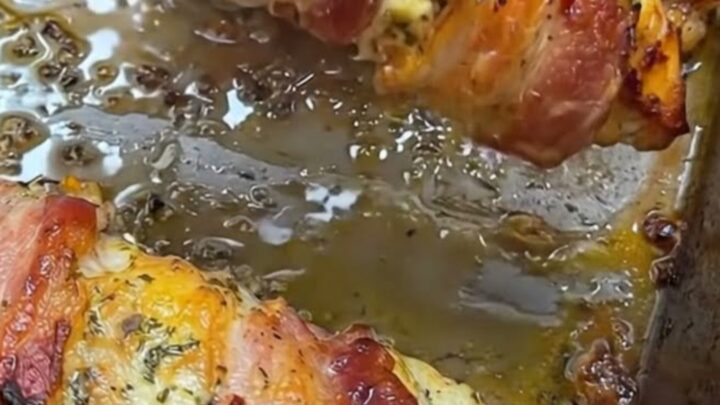
After baking, the skillet juices will be bubbling vigorously, and the bacon will turn a deep, glistening golden-brown. The chicken breasts will feel firm to the touch, and when sliced, a fragrant steam will escape alongside a rich, molten cheese filling that is perfectly hot and creamy.
Common mistakes
One common mistake is wrapping the bacon too loosely. As bacon cooks, it shrinks; if it is not wrapped tightly or secured with toothpicks, it will unravel in the pan, letting the delicious cream cheese filling leak out into the skillet.
Another mistake is using high heat during the initial searing phase, which burns the bacon before the fat has a chance to render properly.
How to tell it’s done
To guarantee the chicken is safe and perfectly cooked, always use a digital meat thermometer. Insert the probe into the thickest part of the chicken breast, making sure not to touch the molten cheese pocket or the hot pan.
The chicken is fully done and safe to eat when it registers an internal temperature of 165°F (74°C).
- Poultry: 165°F (74°C) in the thickest part
Up next · Part 3 of 3
3 variations · storage & make-ahead · 4 answers · printable card
Tips, FAQ & printable recipe (Part 3)← Back to the ingredients (Part 1)