Dinner · Part 2 of 3: Instructions
Crispy Bacon Wrapped Garlic Parmesan Chicken Step-by-step instructions
- Prep
- Cook
- Total
- Serves
- 4
Before you start
Before you begin cooking, ensure all your ingredients are prepped and ready to go. Soften the unsalted butter to room temperature so it blends easily with the herbs and garlic.
Clean your work surface thoroughly and pat the chicken breasts completely dry with paper towels to help the bacon adhere better. Set up your cutting board, a sharp chef knife, and a small bowl for the butter mixture, and preheat your oven so it is ready for the baking phase.
Ingredients at a glance (6)
- 4 boneless skinless chicken breasts
- 8 slices thick-cut bacon
- 4 tbsp unsalted butter, softened
- 3 cloves garlic, minced
- 1/2 cup grated parmesan cheese
- 1 tbsp chopped fresh herbs
Instructions
Prep and Stuffing Phase
- Prepare the Garlic Herb ButterIn a small bowl, combine the softened butter, minced garlic, chopped fresh herbs, and grated parmesan cheese. Use a fork to mash and blend the ingredients together until they form a smooth, uniform paste. Set this seasoned garlic herb butter mixture aside at room temperature while you prepare the chicken.Look for The butter mixture should be smooth and completely integrated.Tip Make sure the butter is fully softened to room temperature for easy mixing.
- Slice and Stuff the ChickenPlace the boneless, skinless chicken breasts on a clean cutting board. Using a sharp chef knife, carefully slice a horizontal pocket into the thickest side of each chicken breast, being careful not to cut all the way through to the other side. Evenly divide the prepared garlic parmesan butter mixture and stuff it into the pocket of each breast.Look for The pockets should be stuffed but still able to close flat.Tip Hold the top of the chicken breast flat with your palm while slicing to control the knife.
By the end of the prep phase, the chicken breasts should have clean, neat pockets stuffed securely with the garlic parmesan herb butter. The breasts are neatly closed, and the seasoned butter mixture is fully enclosed inside. The chicken should look plump and ready to be wrapped, with no butter leaking out from the seams before cooking begins.
Wrapping and Searing Phase
- Wrap with BaconWrap two slices of thick-cut bacon tightly around each stuffed chicken breast, overlapping the edges slightly to secure the pocket and prevent the garlic butter from leaking during cooking. Tuck the loose ends of the bacon strips underneath the chicken breasts to keep them firmly in place during the searing process.Look for The bacon should snugly cover the entire surface of each breast.Tip Stretch the bacon slightly as you wrap to ensure a tight, secure hold.
- Sear in a Hot SkilletHeat a large oven-safe skillet over medium-high heat. Place the bacon-wrapped chicken breasts seam-side down in the hot pan. Sear for about three to four minutes per side, allowing the bacon fat to render and the edges to bubble vigorously until the bacon becomes crisp and golden-brown on all sides.Look for The bacon should look crispy and golden with bubbling fat.Tip Do not crowd the skillet; cook in batches if necessary to maintain high heat.
At the end of the wrapping and searing phase, the bacon should be wrapped tightly around each chicken breast, overlapping slightly to seal the pocket.
In the hot skillet, the bacon edges should be bubbling vigorously in the rendered fat, turning a beautiful golden-brown color and releasing an incredibly savory, smoky aroma as the garlic butter begins to heat up.
Baking and Resting Phase
- Bake to PerfectionTransfer the skillet, or transfer the chicken to a metal baking pan, into an oven preheated to 400°F (200°C). Bake for fifteen to twenty minutes until the bacon is deeply caramelized and the poultry reaches a safe internal temperature of 165°F (74°C) when checked with a meat thermometer in the thickest part.Look for The bacon should be deeply golden and crispy.Safe temperature 165°F (74°C) internal temperature (poultry)Tip Insert the meat thermometer into the meat, not the butter pocket.
- Rest and SliceRemove the baking pan from the oven. Let the cooked chicken rest in the pan juices for five minutes before serving. This resting period allows the savory juices and melted cheese inside to settle. Transfer to a cutting board, slice through the crispy bacon and tender chicken, and serve immediately.Look for The sliced chicken should release hot, savory juices.Tip Use a sharp serrated knife to slice cleanly through the crispy bacon.
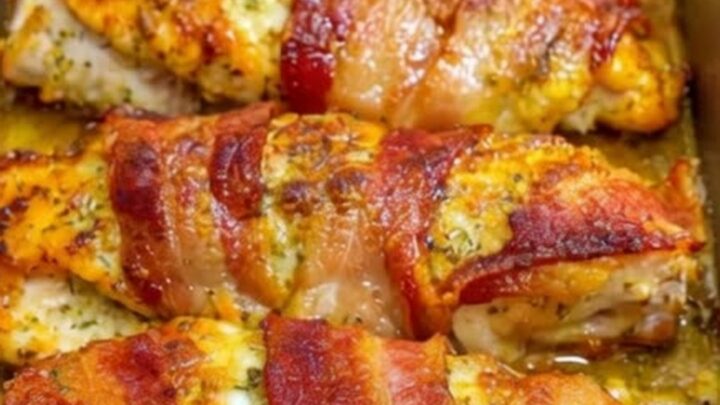
At the end of the baking phase, the bacon-wrapped chicken breasts will have a deeply caramelized, crispy golden crust. The pan juices will be bubbling in the baking pan, and a small amount of melted cheese may peek out from the edges. When sliced, the chicken will release hot, savory juices and a stream of perfectly melted garlic parmesan cheese.
Common mistakes
One common mistake is cutting too deep into the chicken breast when creating the pocket, which causes the garlic parmesan filling to leak out completely during cooking. Always leave a secure border around the edges.
Another mistake is skipping the pan-searing step; searing the bacon-wrapped chicken in a hot skillet before baking is crucial to rendering the bacon fat and achieving that signature crispy exterior. Lastly, do not use cold butter, as it will not blend smoothly with the garlic and herbs.
How to tell it’s done
To ensure the chicken is perfectly cooked and safe to consume, always rely on a digital meat thermometer rather than visual cues alone. Insert the thermometer probe into the thickest part of the chicken breast, avoiding the pocket of melted cheese.
The poultry is fully cooked and safe when it reaches an internal temperature of 165°F (74°C). Once this temperature is achieved, remove the chicken from the oven and let it rest to allow the juices to redistribute throughout the meat.
- Poultry: 165°F (74°C) in the thickest part
Up next · Part 3 of 3
2 variations · storage & make-ahead · 3 answers · printable card
Tips, FAQ & printable recipe (Part 3)← Back to the ingredients (Part 1)