Desserts · Part 2 of 3: Instructions
Crispy Apple Pie Chimichangas Ready in Ten Minutes Step-by-step instructions
- Prep
- Cook
- Total
- Serves
- 4
Before you start
Set up the whole station before the first apple hits the butter, because the frying moves fast. Peel and dice the apples, measure the butter, brown sugar, cinnamon, and cornstarch into small bowls, and stir the cinnamon sugar for the coating together in a shallow dish. Line a plate with paper towels for draining, set a slotted spoon beside the stove, and clip a deep-fry thermometer to the edge of the heavy skillet. Have the four tortillas ready on the counter and the dulce de leche standing by in its jar.
Ingredients at a glance (10)
- 3 Honeycrisp apples, peeled and diced (about 3 cups)
- 2 tbsp unsalted butter
- 1/3 cup brown sugar, packed
- 1 tsp ground cinnamon
- 1 tbsp cornstarch
- 4 (8-inch) flour tortillas
- 2 cups neutral oil, such as vegetable or canola, for pan-frying (about 1/2 inch deep)
- 1/2 cup cinnamon sugar (stir together 1/2 cup granulated sugar and 1 tsp ground cinnamon)
- 1/3 cup dulce de leche, warmed, for drizzling
- Vanilla bean ice cream, for serving
Instructions
Cook the apple filling
- Dice the applesPeel the apples, quarter them, and cut into 1/2-inch dice, discarding the cores. Aim for pieces of even size so they soften at the same rate. Honeycrisp keeps some bite after cooking; cut smaller if a saucier filling is preferred. Set the diced fruit next to the stove so it goes straight into the butter the moment it foams.Look for An even half-inch dice with no large chunks that would stay firm inside the tortilla.Tip Toss the diced apples with a squeeze of lemon juice if they must sit more than a few minutes before cooking.
- Sauté in butterMelt the butter in a large skillet over medium heat. Add the diced apples and sauté, stirring often, for about 4 minutes, until the edges soften and the pieces glisten. The fruit should smell fragrant and buttery but still hold its shape; it softens further once sealed inside the tortilla.Look for Edges turning translucent and glossy, with a buttery cinnamon-free aroma before the sugar goes in.Tip Keep the heat at medium; higher heat browns the butter and the apples before they have softened through.
- Thicken with sugar and cornstarchSprinkle the brown sugar, cinnamon, and cornstarch over the apples and stir until every piece is coated. Cook 1 to 2 minutes more, until the juices thicken into a glossy, spoon-coating sauce with no watery pooling. Pull the skillet off the heat and let the filling cool a few minutes while the oil heats.Look for The sauce clings to the spoon in a glossy sheet and no thin liquid pools at the pan's edge.Tip The cornstarch needs a full minute of bubbling to lose its starchy taste, so stir through the thicken point.
At the end of this phase the filling should look like thick apple pie compote: the apples tender at the edges, the sauce glossy and clinging to every piece, with no thin juice pooling in the bottom of the pan. It should smell of butter, brown sugar, and warm cinnamon, and a spoon dragged through the pan should leave a clean trail that fills back slowly. Taste a small spoonful — the fruit should be sweet-tart and fully cooked, since it will not cook further inside the tortilla.
Fill, fold, and fry
- Fill and fold the tortillasSpoon the warm filling down the center of each tortilla, dividing it evenly among all four. Fold the two sides in over the filling, then roll each one up tightly into a sealed packet, setting them seam side down. A snug roll keeps everything inside; loose ends leak caramel into the oil and burn.Look for Tight, uniform packets with the seams tucked underneath and no filling peeking out at the ends.Tip Warm the tortillas for 15 seconds in the microwave first so they flex without cracking at the folds.
- Heat the oil to 365°FPour the oil into a wide, heavy skillet to a depth of about 1/2 inch and set it over medium-high heat. Bring it to 365°F, checking with a deep-fry thermometer. At that temperature, a scrap of tortilla dropped in should sizzle immediately and rise in brisk, steady bubbles around the edges.Look for The thermometer holds steady at 365°F and a test scrap sizzles vigorously on contact.Tip Shallow oil means easy turning; resist adding more depth, which only raises the risk of splatter.
- Pan-fry until blistered and goldenLay the packets in the oil seam side down, without crowding the pan. Fry for 2 minutes per side, turning once, until blistered and deep golden on both sides. Work in two batches if needed, lifting each chimichanga out with a slotted spoon and draining it on a paper towel–lined plate.Look for Deep golden, blistered surfaces on both sides, with a crisp tap when the shell is flicked.Tip Turn with tongs rather than a fork; piercing the shell lets oil creep into the seam and soften it.
The packets should be tight and symmetrical, seams tucked underneath, with no filling visible at the folds. The oil holds steady at 365°F, and each chimichanga fries to a deep, even gold in two minutes per side — blistered, crisp to the tap, and drained on paper towels within moments of leaving the pan.
When the first one is cut open, steam should rise and the caramel should flow slowly, not flood. If the shell looks greasy or pale, the oil ran cool; if it is mahogany-dark in under two minutes, lower the heat before the next batch goes in. Every chimichanga should sound crisp when the shell is tapped.
Sugar, caramel, and serve
- Roll in cinnamon sugarStir the granulated sugar and cinnamon together for the coating while the chimichangas fry. Roll each one in the cinnamon sugar while it is still hot, so the coating melts slightly against the shell and clings in a crackly, spiced layer. Coat every side, then transfer to a serving plate.Look for The sugar clings instantly and forms an even, sparkly coat with no bare, dry patches.Tip Roll on a shallow plate or pie dish to catch the excess, then press stray sugar back onto the shell.
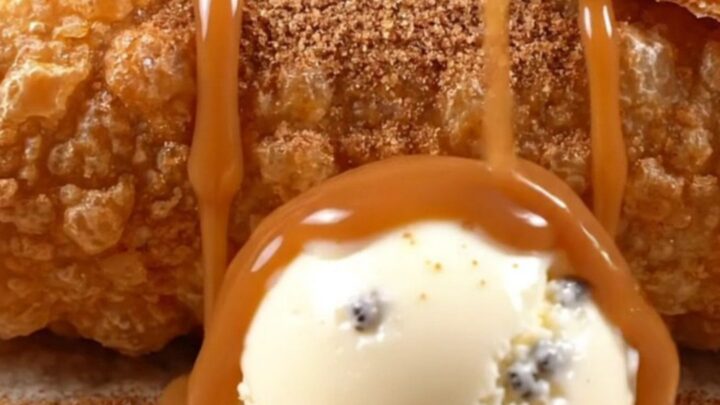
- Drizzle with caramel and top with ice creamWarm the dulce de leche in a small saucepan for a few seconds, stirring, until it drizzles smoothly off the spoon. Spoon it generously over the crispy chimichangas, then top each with a scoop of vanilla bean ice cream and serve at once, while the shell still crackles against the melting cream.Look for The caramel ribbons slowly over the crust and the ice cream starts to slump within a minute.Tip Ten seconds in the microwave loosens thick dulce de leche; overheating makes it grainy and hard to drizzle.
Every chimichanga now wears an even, crackly cinnamon sugar coat with no bare patches, fused to the shell rather than scattered on the plate. The dulce de leche drizzles in smooth ribbons that hold their shape for a few seconds before settling, and the ice cream sits as a firm scoop that begins to slump against the hot crust within a minute.
Cut one open: the filling should still steam, the sauce should glisten rather than run, and the shell should shatter audibly under the knife. Serve immediately — this is a dish measured in minutes, and the contrast between hot shell and cold cream is the whole point.
Common mistakes
The two most common failures are oil at the wrong temperature and tortillas rolled too loosely. Oil below 350°F soaks into the tortilla before it can crisp, leaving the shell pale, heavy, and greasy; oil much above 375°F browns the outside while the filling barely warms.
Overfilling is the next trap — a heaping spoonful of apples forces the seams open, and caramel leaking into hot oil burns fast and darkens every batch after it. Crowding the pan drops the oil temperature in a rush, so fry in two batches rather than squeezing all four packets in at once.
How to tell it’s done
A finished chimichanga is deep golden and visibly blistered on every fried face, with a shell that taps crisp and crackles when cut open. Inside, the apples are tender but not mushy, coated in a thick, glossy caramel sauce that moves slowly rather than running freely.
The cinnamon sugar coat should look fused to the surface, slightly glassy where it met the hot shell, not dusty and loose. There is no raw protein in this recipe, so no internal temperature applies — judge by color, sound, and the texture of the filling.
Up next · Part 3 of 3
4 variations · storage & make-ahead · 5 answers · printable card
Tips, FAQ & printable recipe (Part 3)← Back to the ingredients (Part 1)