Breakfast · Part 2 of 3: Instructions
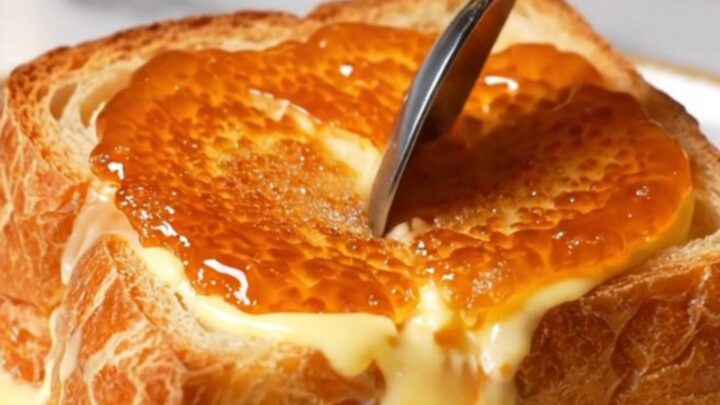
Decadent Crème Brûlée French Toast with a Glassy Caramel Crust Step-by-step instructions
- Prep
- Cook
- Total
- Serves
- 1
Before you start
Before beginning, ensure your brioche is sliced to a uniform 4-centimeter thickness. If the bread is fresh, place it on a wire rack for an hour to dry out. Prepare your custard base by whisking the ingredients until completely emulsified.
Have your blowtorch ready, filled, and tested. Clear your workspace to allow for the quick transition from the skillet to the plate, as the caramelization step requires your full attention to achieve the perfect, even finish without burning the sugar.
Ingredients at a glance (7)
- 4 egg yolks
- 180 ml heavy cream
- 25 g sugar
- 1 scraped Tahitian vanilla bean pod
- 1 thick slice of day-old brioche
- 25 g clarified butter
- 20 g sugar
Instructions
Custard Preparation and Soaking
- Prepare the CustardIn a mixing bowl, combine the egg yolks, heavy cream, sugar, and the seeds from the scraped Tahitian vanilla bean pod. Whisk the mixture thoroughly until the ingredients are fully incorporated and the custard is smooth and uniform in texture.Look for The mixture should be perfectly smooth and pale yellow with visible specks of vanilla bean.Tip Ensure the eggs are at room temperature to help the custard emulsify more effectively.
- Soak the BriochePlace the 4-centimeter thick slice of day-old brioche into a shallow dish. Pour the prepared custard over the bread and let it soak for exactly two minutes. Carefully flip the bread halfway through the soaking process to ensure the custard penetrates deeply into the center.Look for The bread should feel heavy and saturated but still hold its structure without falling apart.Tip Using day-old bread is essential as it absorbs the custard without turning into mush.
The custard should be perfectly emulsified with tiny, visible specks of vanilla bean throughout. The brioche slice should be fully saturated, heavy, and holding its shape well without showing signs of breaking apart.
Check that the bread is completely submerged to ensure even flavor distribution before it moves to the skillet.
Searing the Brioche
- Sear the BriocheMelt the clarified butter in a non-stick skillet over medium heat at 175°C (347°F). Once the butter is shimmering, carefully add the soaked brioche slice. Cook for 3 minutes per side until the exterior is deeply golden brown and the interior is cooked through to a safe internal temperature of 160°F (71°C) for the egg-based custard.Look for The bread should be soufflé-puffed and firm to the touch.Safe temperature 160°F (71°C) internal temperature (egg dishes)Tip Maintain a steady heat to prevent the exterior from burning before the center is cooked.
The toast should be a deep, rich golden brown on both sides. It will feel firm to the touch and appear slightly soufflé-puffed, indicating the custard has set properly. Ensure the internal temperature has reached 160°F (71°C) before removing it from the skillet to guarantee safety and the correct texture.
Caramelizing the Crust
- Caramelize the CrustRemove the cooked French toast from the skillet and place it on a heat-safe plate. Evenly sprinkle the remaining 20 grams of sugar across the top surface of the toast. Using a kitchen blowtorch, carefully move the flame over the sugar in a steady motion until it melts and transforms into a bubbling, crackling amber glass crust.Look for The sugar will turn from a white powder into a deep, glossy amber color.Tip Keep the torch moving to ensure even caramelization without scorching the sugar into a bitter state.
The sugar on top should transform from a crystalline white to a uniform, glossy, and bubbling amber liquid. Once the torch is removed, the layer will solidify into a brittle, glass-like surface. It should smell intensely fragrant, like toasted sugar and vanilla, with no burnt or acrid odors present.
Common mistakes
A common mistake is using bread that is too fresh, which results in a soggy, unappealing texture. Another error is heating the skillet too high, which burns the exterior before the custard in the middle can set.
Ensure the heat is consistent at 175°C (347°F). Finally, do not rush the torching process; holding the flame in one spot for too long will result in charred, bitter sugar rather than a sweet, glassy caramel crust.
How to tell it’s done
The French toast is done when it is puffed and golden brown, with the custard center reaching an internal temperature of 160°F (71°C) to ensure the eggs are fully cooked. The surface should be firm and spring back slightly when pressed.
After torching, the sugar must be completely melted into a smooth, amber-colored layer that hardens into a glass-like shell upon cooling for a few seconds. The final test is the audible crack when tapped with a spoon.
- Egg dishes: 160°F (71°C) in the thickest part
Up next · Part 3 of 3
2 variations · storage & make-ahead · 3 answers · printable card
Tips, FAQ & printable recipe (Part 3)← Back to the ingredients (Part 1)