Desserts · Part 2 of 3: Instructions
Crème Brûlée Cheesecake with a Crispy Caramelized Crust Step-by-step instructions
- Prep
- Cook
- Total
- Serves
- 8
Before you start
Before starting, ensure the oven rack is positioned in the center. All ingredients should be measured and laid out on the counter. The cream cheese must be softened, and the eggs should be at room temperature for even mixing. Prepare the springform pan by greasing the sides lightly.
Have the kitchen torch and butane fuel ready. Clear a space in the refrigerator for the cheesecake to chill for several hours once it has cooled to room temperature, as this is a non-negotiable step for achieving the right set.
Ingredients at a glance (3)
- 1 1/2 cups graham cracker crumbs
- 24 oz cream cheese
- 1/4 cup granulated sugar
Instructions
Crust and Filling Preparation
- Prepare the CrustCombine the graham cracker crumbs with binding ingredients in a medium bowl until the mixture resembles wet sand. Press the mixture firmly into the bottom of a 9-inch springform pan. Bake at 350°F (175°C) for 10 minutes, then remove from the oven and set aside to cool completely.Look for The crust should be firm and lightly golden.Tip Use the bottom of a flat measuring cup to press the crumbs evenly into the pan for a professional finish.
- Mix the FillingIn a large bowl, beat the cream cheese until smooth and creamy. Incorporate the binding agents and flavorings, beating on low speed until combined. Pour the batter over the cooled crust and spread it evenly with a spatula.Look for The mixture should be completely smooth and free of lumps.Tip Ensure the cream cheese is at room temperature to prevent lumpy batter.
The crust should be pressed firmly into the pan and lightly toasted. The cheesecake batter must be perfectly smooth, with no visible lumps of cream cheese. Once the batter is poured over the crust, it should be level and smooth, ready for the oven. Ensure the oven is preheated correctly before proceeding to the baking stage, as consistency is key for the initial structure of the custard base.
Baking and Cooling
- Bake the CheesecakeBake the cheesecake at 325°F (160°C) for 50 minutes. The center should be set but still have a slight wobble. To ensure the eggs are fully cooked to 160°F (71°C), verify the internal temperature with a thermometer. Let the cheesecake cool at room temperature for an hour, then refrigerate for at least 4 hours until fully chilled.Look for The edges should be set and the center slightly jiggly.Safe temperature 160°F (71°C) internal temperature (egg dishes)Tip Avoid overbaking to prevent cracks in the cheesecake surface.
The cheesecake is baked until the edges look set and the center has a gentle, uniform movement. The internal temperature must be verified at 160°F (71°C). Once removed from the oven, the cake must be cooled completely at room temperature.
The surface should look smooth and pale, without excessive browning. After the initial cooling, it must be chilled in the refrigerator to firm up the internal structure completely.
Caramelizing the Finish
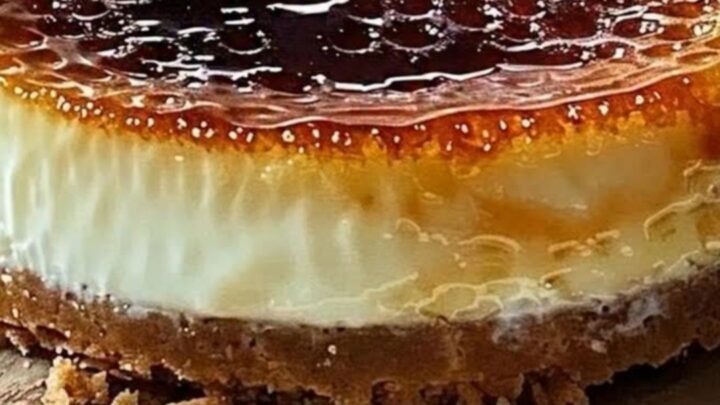
- Caramelize the ToppingJust before serving, sprinkle the remaining granulated sugar evenly over the top of the chilled cheesecake. Use a kitchen torch to melt and caramelize the sugar until it forms a deep golden, glossy, and brittle crust. Allow the caramel to set for a few minutes before serving with a spoon.Look for The sugar should bubble and turn a deep amber color.Tip Move the torch constantly to avoid burning the sugar, which can become bitter.
The final stage involves applying a thin, even layer of granulated sugar to the chilled cheesecake. The surface of the sugar should be dry. As the torch flame is applied, the sugar will melt, bubble, and turn into a golden-brown liquid. Once the entire surface is covered in a glossy, uniform caramel, it should be allowed to sit for a moment to harden into a brittle, glass-like shell.
Common mistakes
A common mistake is rushing the cooling process, which can lead to a cracked center or an unstable texture. Always allow the cake to cool gradually at room temperature before moving it to the fridge.
Another error is adding the sugar topping too early; the sugar must be applied immediately before serving to prevent the moisture from the cheesecake from dissolving the brittle crust. Finally, avoid over-mixing the batter after adding the eggs, as incorporating too much air can cause the cheesecake to puff up and then collapse, resulting in an uneven surface.
How to tell it’s done
The cheesecake is done when the edges are set and firm, but the center retains a slight, uniform wobble when the pan is gently shaken. Using an instant-read thermometer, ensure the center of the custard has reached 160°F (71°C) to safely cook the eggs.
After baking, the cheesecake should be allowed to cool completely on a wire rack before it is transferred to the refrigerator for the final setting process, which ensures the texture is perfect for slicing.
- Egg dishes: 160°F (71°C) in the thickest part
Up next · Part 3 of 3
2 variations · storage & make-ahead · 3 answers · printable card
Tips, FAQ & printable recipe (Part 3)← Back to the ingredients (Part 1)