Desserts · Part 2 of 3: Instructions
Creamy Ube Basque Cheesecake with Caramelized Crust Step-by-step instructions
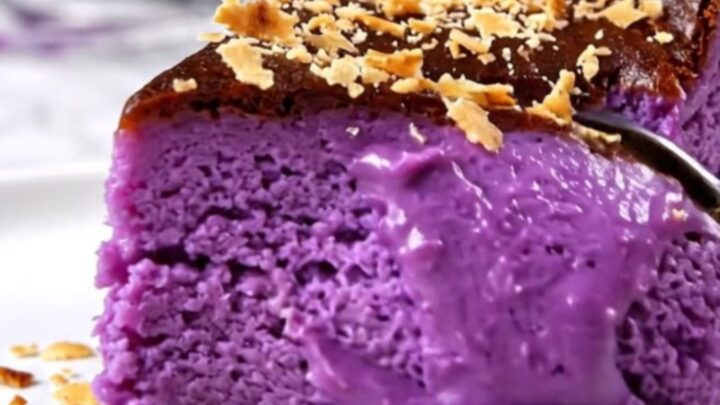
- Prep
- Cook
- Total
- Serves
- 8
Before you start
Before beginning, ensure all ingredients are at room temperature to facilitate a smooth, integrated batter. Preheat the oven to 425°F (218°C) to ensure it reaches the necessary high temperature for the signature charred top.
Prepare the cake pan by lining it with crumpled parchment paper, ensuring the paper extends well above the pan sides to hold the cheesecake as it rises and settles during the baking process.
Ingredients at a glance (7)
- 700 g cream cheese, softened
- 250 g ube halaya jam
- 150 ml coconut cream
- 180 g sugar
- 4 eggs, room temperature
- 1 tsp ube extract
- 1/4 cup toasted golden coconut flakes, for serving
Instructions
Batter Preparation
- Prepare the batterIn a large mixing bowl, combine the softened cream cheese, ube halaya jam, coconut cream, and sugar. Whisk the mixture vigorously until completely smooth and free of lumps. Add the eggs one at a time, whisking well after each addition to ensure they are fully incorporated. Finally, stir in the ube extract until the color is vibrant and uniform throughout the batter.Look for The mixture should be perfectly smooth with a vibrant purple color.Tip Ensure all ingredients are at room temperature to avoid lumps in the batter.
The batter should be thick, smooth, and a vibrant, uniform purple color. Check that there are no visible lumps of cream cheese or streaks of ube jam.
The consistency should be pourable but heavy, coating the back of a spoon evenly without dripping too quickly, indicating that all ingredients have been properly emulsified into a stable, cohesive mixture.
High-Heat Baking
- Bake the cheesecakeLine a 9-inch cake pan with crumpled parchment paper, allowing the edges to rise above the rim. Pour the batter into the prepared pan, smoothing the top with a spatula. Place the pan in a preheated oven at 425°F (218°C). Bake for exactly 27 minutes. The top should be blistered and dark bronze, while the center remains slightly jiggly. To ensure the eggs are fully cooked through, they must reach 160°F (71°C).Look for The top will appear dark and charred while the center wobbles slightly.Safe temperature 160°F (71°C) internal temperature (egg dishes)Tip Do not overbake, as the residual heat will continue to set the cheesecake.
Observe the cheesecake through the oven window as it bakes. The top should begin to blister and turn a dark, caramelized brown within the first 20 minutes.
By the end of the 27-minute bake, the edges should be set and slightly pulled away from the parchment, while the center retains a soft, gentle wobble, confirming the custard is perfectly cooked.
Cooling and Garnish
- Cool and garnishRemove the cheesecake from the oven and allow it to cool completely in the pan on a wire rack for at least one hour. This resting period is critical for the custard to set properly. Once cooled, carefully remove the cheesecake from the pan using the parchment paper edges. Sprinkle the top generously with toasted golden coconut flakes before serving.Look for The cake should be firm to the touch but still creamy in the center.Tip Wait for the cake to reach room temperature before slicing for the cleanest edges.
During the cooling phase, the cheesecake will settle and shrink slightly, which is a normal part of the process. The center will firm up as it reaches room temperature. Before serving, the surface should be cool to the touch. Once the toasted coconut flakes are added, the cake is ready to be sliced and enjoyed for its contrast of textures.
Common mistakes
Avoid over-whisking the batter after the eggs have been added, as this can introduce too much air, causing the cake to puff excessively and crack during baking.
Another common mistake is failing to let the cheesecake cool fully; cutting into it too soon will result in a runny, unstable mess rather than the desired firm but creamy texture. Always allow the cake to rest for at least one hour.
How to tell it’s done
The cheesecake is done when the top is deeply blistered and dark bronze in color. The center should still exhibit a slight, intentional jiggle when the pan is gently shaken, which signifies the custard is perfectly set but still creamy. The internal temperature of the egg-based custard should reach 160°F (71°C) to ensure food safety.
- Egg dishes: 160°F (71°C) in the thickest part
Up next · Part 3 of 3
2 variations · storage & make-ahead · 3 answers · printable card
Tips, FAQ & printable recipe (Part 3)← Back to the ingredients (Part 1)