Dinner · Part 2 of 3: Instructions
Creamy Spicy Korean Ramen Carbonara in 10 Minutes Step-by-step instructions
- Prep
- Cook
- Total
- Serves
- 1
Before you start
Read the ramen package before anything else and confirm it contains a liquid or paste sauce packet, not just a powder sachet; that packet is the backbone of the dish. Set out a large skillet, a medium saucepan, a small bowl and whisk, a fine grater, tongs and an instant-read thermometer.
Mince the garlic, dice the bacon into small even pieces and grate the Parmesan finely, keeping it in a small pile near the stove. Separate the egg yolk into the bowl with the cream so it is ready to whisk the moment the water boils.
Ingredients at a glance (9)
- 1 package spicy Korean ramen noodles (any fire-noodle style), seasoning discarded or reserved
- 1 spicy sauce packet from the ramen package
- 3.5 oz diced smoky bacon (about 100 g)
- 3 garlic cloves, minced
- 1 large egg yolk
- 1/4 cup heavy cream (60 ml)
- 1/3 cup finely grated Parmesan (40 g), plus more for topping
- 1/4 cup starchy noodle water (50 ml)
- Nori, torn or cut into strips, to taste for serving
Instructions
Prep the noodles and glaze
- Set up the noodle stationBring a medium saucepan of water to a rolling boil for the noodles. While it heats, mince the garlic cloves finely and dice the bacon into small, even pieces so every bite carries some crispness. Grate the Parmesan on the finest holes of the grater; fine shreds melt smoothly into the glaze instead of staying stringy.Look for The water is rolling with big bubbles and the garlic smells sharp and fresh when minced.Tip Reserve the noodle seasoning for another use; the sauce packet alone brings all the heat this dish needs.
- Whisk the carbonara glazeIn a small bowl, whisk the egg yolk with the heavy cream until completely smooth and pale. Add the grated Parmesan and whisk again into a thick, pourable glaze with no streaks of yolk left. This mixture will become the creamy blanket that tames the fiery sauce, so take a full thirty seconds here and whisk harder than feels necessary.Look for The glaze looks uniform, pale gold and slightly thick, coating the whisk in a thin film.Tip Cold cream straight from the fridge whisks in fine; there is no need to temper anything at this stage.
By the end of this phase, the kitchen is staged and nothing is left to do mid-cook. The glaze in the small bowl should look completely smooth, pale gold and slightly thick, with no streaks of yolk and no floating shreds of cheese, and it should coat the whisk in a thin film. The bacon is diced small and even, the garlic is minced fine, and the saucepan is at a full rolling boil with big, lively bubbles. Check that the sauce packet is opened and standing by, the tongs are within reach and the thermometer is zeroed.
Crisp, boil and toss
- Crisp the bacon with garlicSet a large skillet over medium heat and add the diced bacon. Cook, stirring now and then, until the pieces are deep golden and the fat has rendered, about 4 minutes. Stir in the minced garlic during the last minute so it turns fragrant and just golden without browning. Keep the heat at medium so the drippings never scorch.Look for The bacon is crisp-edged, the pan holds a shimmer of rendered fat, and the garlic smells sweet and toasty.Tip If the garlic threatens to darken, pull the pan off the heat for a few seconds and keep stirring.
- Boil the noodles chewySlide the ramen noodles into the boiling water and cook for 3 to 4 minutes, loosening them with chopsticks or tongs as they soften. Pull them while they still have a firm, bouncy center; they will finish in the warm sauce. Before draining, ladle out about 1/4 cup of the starchy water and set it aside, then drain the noodles well.Look for The noodles bend without snapping and show a pale, chewy core at the thickest point.Tip The starchy water is the glue that makes the sauce cling, so never skip reserving it before draining.
- Build the fiery pink sauceTake the skillet off the heat and let it sit for about 30 seconds so the residual heat settles to roughly 155°F (68°C). Add the noodles, the spicy sauce packet, the egg-yolk glaze and the starchy water, then toss constantly with tongs. The off-heat pan keeps the yolk from scrambling while the sauce turns glossy, thick and pink. For fully set yolks, return the pan to low heat and stir until the sauce reaches 160°F (71°C).Look for Every strand wears a velvety pink glaze that clings and slowly stretches when lifted, with no watery pooling in the pan.Safe temperature 160°F (71°C) internal temperature (egg dishes)Tip Toss in a circular motion rather than stirring; the noodles stay intact and the sauce emulsifies faster.
The bacon should be deep golden with crisped edges and a shimmer of rendered fat in the pan, and the garlic should smell fragrant and nutty, never bitter or dark. The noodles pull out of the water bendable but with a firm, chewy core, and the reserved starchy water sits in a cup looking faintly cloudy.
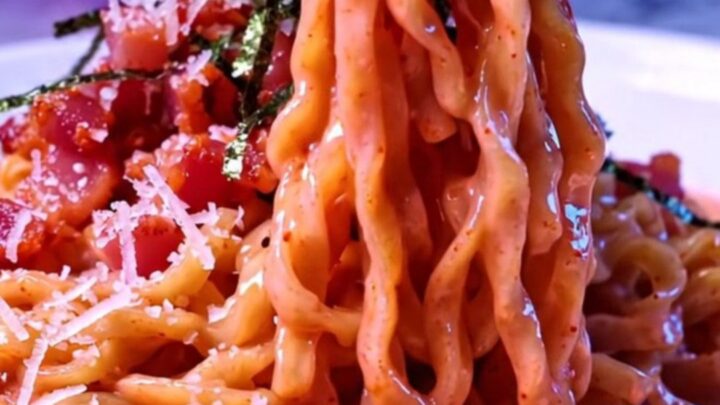
After the off-heat toss, the transformation is unmistakable: the noodles wear a thick, velvety pink glaze that clings to every strand and stretches slowly when lifted, with no watery liquid pooling at the pan's edge.
Top, twirl and serve
- Twirl and top the bowlTwist the sauced noodles with a fork or tongs into a tight nest and lift them into a warm bowl, letting the extra glaze drape over the top. Scatter the reserved crisp bacon over the noodles, then finish with an extra snowfall of grated Parmesan and strips of torn nori. Serve immediately while the sauce is at its glossiest and the bacon is still audibly crisp.Look for The glaze shines under the light, the Parmesan softens slightly on contact, and the nori smells faintly of the sea.Tip Warm the bowl under hot tap water first; a cold bowl thickens the sauce too fast and dulls the shine.
- Serve at full glossSet the bowl down with a final fork-twist to show off the strands, and eat right away. The sauce is at its silkiest in the first two minutes; the noodles keep drinking it up as they sit. If the glaze tightens before serving, loosen it with a spoonful of hot tap water and toss once more until it flows again.Look for A forkful pulls away in long, glossy strands coated edge to edge in pink sauce.Tip Keep a cup of hot water nearby; one spoonful revives the glaze if it sits longer than a minute.
The finished bowl should look like the video's hero shot: a tight nest of glossy pink noodles draped in extra glaze, crowned with crisp bacon, a snowfall of Parmesan that is just starting to soften and ribbons of nori holding their shape. The shine is the tell; a properly emulsified glaze reflects light and moves as one piece when the bowl is tilted. The first forkful should pull away in long strands, chewy at the core with a rounded, creamy heat rather than a sharp chili sting.
Common mistakes
The most common failure is scrambled egg: it happens when the pan is still searing hot when the glaze goes in, so always pull the skillet off the burner and give it half a minute to settle.
The second mistake is overcooked noodles; boiling them to full softness means they keep drinking sauce in the bowl and turn the dish dry and clumpy, so pull them while the centers are still firm. Forgetting to reserve the starchy water before draining is the third; without that starch, the sauce breaks into a greasy puddle instead of emulsifying.
How to tell it’s done
The dish is done when every noodle strand is coated in a glossy, pink, velvety glaze that clings without pooling, and the sauce has thickened enough to stretch slowly when lifted with tongs. Taste a strand: it should be chewy with a gentle burn rounded out by cream and cheese, not a raw chili slap.
For fully cooked egg yolk, check the sauce with an instant-read thermometer and confirm it has reached 160°F (71°C) at the center of the pan; stir for another 20 to 30 seconds over low heat if it reads short. The bacon topping should stay crisp right up to serving, and the nori should still hold a slight snap.
- Egg dishes: 160°F (71°C) in the thickest part
Up next · Part 3 of 3
4 variations · storage & make-ahead · 5 answers · printable card
Tips, FAQ & printable recipe (Part 3)← Back to the ingredients (Part 1)