Dinner · Part 2 of 3: Instructions
Creamy Slow Cooker Spinach and Potato Soup Step-by-step instructions
- Prep
- Cook
- Total
- Serves
- 4
Before you start
Before beginning, ensure your slow cooker is clean and positioned on a level, heat-resistant surface near a power outlet. Wash the potatoes thoroughly to remove any dirt, then peel and dice them into uniform pieces to ensure consistent cooking.
Prepare the fresh spinach by washing and drying it carefully. Have your measuring tools ready to ensure accuracy with the liquid and bouillon. Clearing your workspace will help make the assembly process efficient and tidy.
Ingredients at a glance (4)
- 4 cups diced potatoes
- 4 cups fresh spinach leaves
- 1 cube bouillon cube
- 3 cups water
Instructions
Assembly Phase
- Prepare the BasePlace the diced potatoes into the bottom of the slow cooker basin. Ensure the potatoes are cut into uniform pieces to allow for even cooking throughout the process.Look for Potatoes should be evenly distributed at the bottom of the cooker.Tip Cut potatoes into 1-inch cubes for the best texture.
- Add Aromatics and LiquidLayer the fresh spinach leaves over the potatoes. Crumble the bouillon cube over the spinach, then pour in the water until the ingredients are partially submerged.Look for The water should just reach the top of the potato layer.Tip Distribute the bouillon evenly to ensure consistent seasoning.
At the end of the assembly phase, the slow cooker should contain a neat, layered arrangement of diced potatoes, fresh spinach, and the bouillon cube. The water should be poured in, ensuring all ingredients are partially submerged. Check that the lid is securely in place and that the slow cooker is plugged in and set to the high setting. Everything should look organized and ready to begin the gentle, slow cooking process.
Cooking Phase
- Slow CookCover the slow cooker with its lid and set to cook on high for 4 hours. Allow the potatoes to soften completely and the spinach to wilt into the broth.Look for Potatoes must be fork-tender when pierced.Tip Avoid lifting the lid during the first few hours to maintain heat.
During the cooking phase, the contents of the slow cooker will settle as the potatoes soften and the spinach wilts. By the end of this phase, the aroma of the cooking vegetables should be noticeable, and the liquid base will have turned into a flavorful broth.
Use a fork to test the largest potato pieces; they should be extremely soft and tender, indicating that the ingredients have successfully reached the optimal state for blending.
Finishing Phase
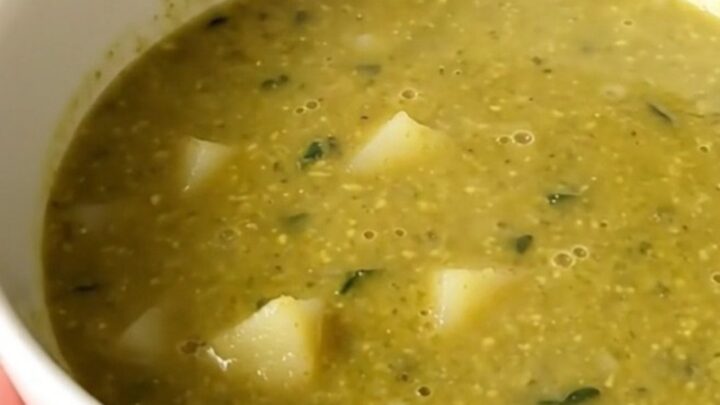
- Blend and ServeOnce the cooking cycle is complete, use an immersion blender to process the mixture directly in the slow cooker until smooth and velvety. Serve warm in bowls.Look for The soup should appear glossy and uniform in color.Tip Use a standard blender if an immersion blender is unavailable.
The final phase involves using an immersion blender to transform the cooked components into a smooth, creamy soup. The mixture should become a vibrant, consistent green color with a glossy finish.
After blending, check the consistency to ensure it is smooth and free of any large chunks. Once achieved, the soup is ready to be portioned into bowls and served immediately, showcasing its velvety texture and fresh, earthy flavor profile.
Common mistakes
A common mistake is failing to dice the potatoes into uniform sizes, which results in some pieces remaining undercooked while others disintegrate. Avoid overcrowding the slow cooker, as this can prevent the ingredients from cooking evenly.
Another error is neglecting to blend the soup thoroughly; take the time to ensure every piece of potato and spinach is fully incorporated to achieve the desired velvety texture. Finally, resist the urge to open the lid frequently, as this causes significant heat loss.
How to tell it’s done
The soup is done when the potatoes are completely tender and can be easily mashed with a fork against the side of the slow cooker. At this stage, the spinach should be fully wilted and integrated into the liquid base. When blending, the mixture should transform into a smooth, glossy, and uniform puree. If the soup appears too thick after blending, you may add a small amount of warm water or broth to reach your preferred consistency.
Up next · Part 3 of 3
2 variations · storage & make-ahead · 3 answers · printable card
Tips, FAQ & printable recipe (Part 3)← Back to the ingredients (Part 1)