Dinner · Part 2 of 3: Instructions
Creamy Pepper Jack Pasta with Chicken and Sausage Step-by-step instructions
- Prep
- Cook
- Total
- Serves
- 4
Before you start
Before starting the cooking process, ensure all components are prepped and ready for use. Dice the chicken breast into bite-sized cubes and slice the sausage into rounds of equal thickness to ensure they cook at the same rate.
Grate the pepper jack cheese. Have the pasta pot filled and ready to boil, as the timing for the sauce is quite quick. Having these items organized near the stove will keep the cooking process smooth and stress-free throughout the entire preparation.
Ingredients at a glance (4)
- 1 lb penne pasta
- 1 lb chicken breast, diced
- 1/2 lb sausage, sliced
- 2 cups pepper jack cheese, shredded
Instructions
Protein and pasta prep
- Prepare the proteins and pastaBoil the penne in a large pot of salted water until al dente. Meanwhile, heat a large skillet over medium-high heat. Add the diced chicken breast and sliced sausage. Sauté until the chicken is cooked through and reaches an internal temperature of 165°F (74°C). Remove the proteins from the skillet and set aside.Look for The chicken should be golden brown on the outside and opaque throughout.Safe temperature 165°F (74°C) internal temperature (poultry)Tip Ensure the chicken is cut into uniform sizes for even cooking across all pieces.
The proteins should be nicely browned and cooked through, with the chicken reaching 165°F (74°C). The pasta should be drained while still al dente, ready to be incorporated into the sauce.
Everything should smell savory and slightly smoky from the sausage, and the kitchen should be organized for the final assembly phase.
Sauce development
- Create the cheesy sauceIn the same skillet, reduce the heat to medium. Gradually add the shredded pepper jack cheese, stirring constantly until the cheese is completely melted and forms a smooth, thick sauce. Do not let the mixture boil vigorously, as this can cause the cheese to separate.Look for The sauce is ready when it is uniform in consistency and pulls when lifted.Tip Grate the cheese from a block rather than using pre-shredded varieties for a much smoother sauce.
The sauce should be smooth, thick, and have a consistent color from the melting pepper jack. It should smell savory and slightly spicy. There should be no lumps of cheese remaining, and the texture should be velvety. Check the consistency; it should be thick enough to coat the back of a spoon.
Final assembly
- Combine and serveAdd the cooked penne and the browned chicken and sausage back into the skillet with the cheese sauce. Toss everything together until the pasta is thoroughly coated and the mixture is heated through. Serve immediately while the sauce is warm and pulling perfectly.Look for The dish should be steaming and the sauce should cling to every piece of pasta.Tip If the sauce becomes too thick, stir in a tablespoon of the reserved pasta cooking water to loosen it.
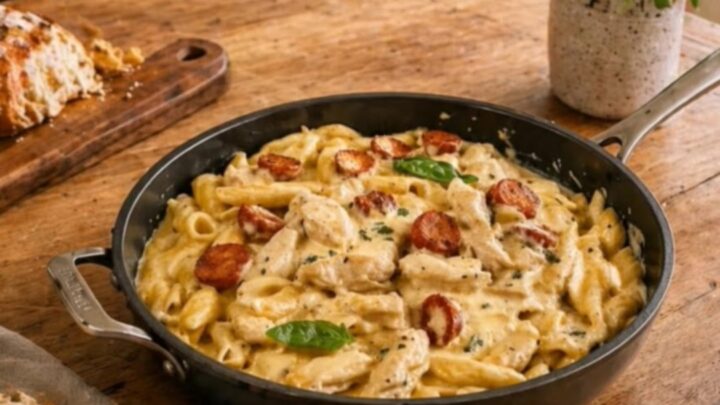
The pasta, chicken, and sausage should be fully integrated with the sauce, creating a cohesive and visually appealing dish. The pasta should look glossy and be uniformly coated. The aroma will be rich and cheesy, indicating that the flavors have melded together perfectly and the dish is ready to be plated.
Common mistakes
A common mistake is overcrowding the skillet while searing the chicken and sausage, which leads to steaming rather than browning. Ensure there is enough space in the pan to achieve a nice sear.
Another error is adding the cheese to a pan that is too hot; this causes the fat to separate and results in a broken, greasy sauce. Always keep the heat at a gentle level when melting the cheese. Finally, do not overcook the pasta; it should retain a slight bite.
How to tell it’s done
The dish is considered done when the chicken is fully cooked through and the pasta is tender yet firm to the bite. The sauce should be thickened, smooth, and glossy, clinging to the pasta without pooling at the bottom of the skillet.
The internal temperature of the chicken must reach 165°F (74°C) to ensure food safety. If the sauce appears too thick, a splash of pasta water will help adjust the consistency to a perfect, creamy coating that is ready to serve immediately.
- Poultry: 165°F (74°C) in the thickest part
- Ground meat: 160°F (71°C) in the thickest part
Up next · Part 3 of 3
2 variations · storage & make-ahead · 3 answers · printable card
Tips, FAQ & printable recipe (Part 3)← Back to the ingredients (Part 1)