Desserts · Part 2 of 3: Instructions
Creamy Peanut Butter and Brownie Trifle for Easy Entertaining Step-by-step instructions
- Prep
- Cook
- Total
- Serves
- 8
Before you start
Before beginning the assembly, ensure all components are prepared and brought to the appropriate temperature. The brownies should be completely cooled before cutting into uniform cubes to prevent crumbling.
The peanut butter mousse should be whipped until it reaches a stable, spreadable consistency and kept chilled in the refrigerator.
Have the whipped cream ready in a piping bag and the chocolate peanut butter cups chopped. Clear a workspace large enough to accommodate the trifle bowl and all prepared ingredients to ensure a smooth assembly process.
Ingredients at a glance (5)
- 8 cups fudgy brownies, cubed, store-bought or made ahead
- 2 cups creamy peanut butter mousse
- 1 cup crumbly cookie topping
- 1 cup whipped cream
- 1/2 cup chopped chocolate peanut butter cups
Instructions
Layering the base
- Layering the baseBegin by placing a generous layer of brownie cubes into the bottom of a large glass trifle bowl. Ensure the brownies are spread evenly to create a stable foundation for the subsequent layers of mousse and cream.Look for brownies form a solid base layerTip Avoid pressing the brownies down too firmly so the texture remains light.
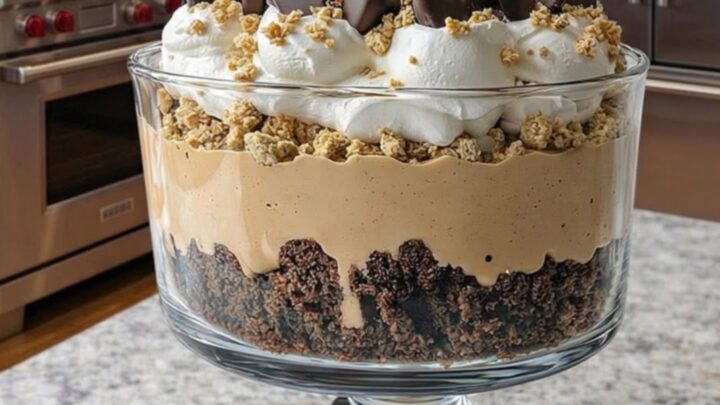
The brownie cubes should fill the bottom of the bowl evenly without large gaps. The brownies should look moist and dark, providing a strong aesthetic contrast against the clear glass of the trifle bowl. Check that the layer is level before proceeding to the mousse.
Adding the mousse
- Adding the mousseSpread a smooth, even layer of the creamy peanut butter mousse over the brownie base. Use a spoon or spatula to ensure it reaches the edges of the bowl, creating a clean visual line against the glass.Look for mousse is spread to the glass edgesSafe temperature 160°F (71°C) internal temperature (egg dishes)Tip Clean the edges of the bowl with a damp paper towel if any mousse smears during assembly.
The peanut butter mousse should be smooth and hold its shape against the side of the bowl. It should be thick enough that it does not slide down the sides. Ensure the layer is uniform in thickness to create the signature striped look of a traditional trifle.
Garnishing the trifle
- Garnishing the trifleContinue alternating layers of brownies and mousse until the bowl is nearly full. Finish the top with decorative swirls of piped whipped cream, a sprinkle of crumbly cookie topping, and chopped chocolate peanut butter cups for a final touch.Look for whipped cream holds its shape wellTip Add the final garnish just before serving to keep the cookie topping crunchy.
The final garnish should look deliberate and appetizing. The whipped cream peaks should be distinct, and the toppings should be distributed evenly across the surface. Once the final garnish is applied, the trifle is ready for its final chill before being brought to the table.
Common mistakes
A common mistake is using brownies that are too warm, which causes the mousse to melt and the layers to bleed into one another. Another error is overfilling the bowl, which makes it difficult to scoop without creating a mess.
Finally, adding the crunchy toppings too early can cause them to soften; always add the cookie topping and chocolate pieces immediately before serving to maintain the contrast in texture.
How to tell it’s done
The trifle is ready when all layers are neatly stacked and the top is garnished. Because this is an assembly-based dessert, there is no cooking involved for the final assembly.
If you are preparing your own mousse, ensure the egg-based custard base reaches 160°F (71°C) to ensure safety. The final trifle should be chilled for at least one hour to allow the layers to settle and the flavors to integrate perfectly before serving.
- Egg dishes: 160°F (71°C) in the thickest part
Up next · Part 3 of 3
2 variations · storage & make-ahead · 3 answers · printable card
Tips, FAQ & printable recipe (Part 3)← Back to the ingredients (Part 1)