Dinner · Part 2 of 3: Instructions
Creamy Garlic Parmesan Chicken Skillet Step-by-step instructions
- Prep
- Cook
- Total
- Serves
- 4
Before you start
Before starting your skillet, prepare all of your ingredients to ensure a smooth and stress-free cooking process. Pat the chicken cutlets completely dry with paper towels; removing surface moisture is absolutely essential for achieving a deep, golden-brown sear rather than steaming the meat.
Mince the garlic cloves finely and grate the parmesan cheese from a fresh block. Measure out the heavy cream, butter, and dried herbs so they are ready to add to the skillet immediately when needed, as the cooking process moves very quickly once the pan is hot.
Ingredients at a glance (6)
- 1 1/2 lbs boneless skinless chicken breasts, sliced into thin cutlets
- 2 tbsp unsalted butter
- 4 cloves garlic, minced
- 1 cup heavy cream
- 1/2 cup grated Parmesan cheese
- 1 tsp dried Italian seasoning
Instructions
Searing the Chicken
- Prepare the Chicken CutletsPat the chicken cutlets completely dry with paper towels to ensure they are ready for searing.Look for The chicken should be dry to the touch.Tip Drying the meat is essential for a good sear.
- Sear the ChickenMelt the unsalted butter in a heavy cast iron skillet over medium-high heat. Add the chicken cutlets to the pan and sear for about 3 to 4 minutes per side until they develop a beautiful golden-brown crust. Remove the chicken from the skillet and set aside on a plate.Look for Look for a deep golden crust on both sides.Tip Do not crowd the pan; sear in batches if necessary.
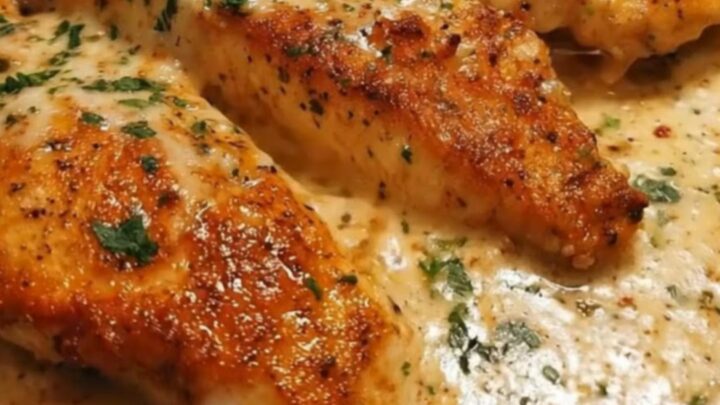
The chicken cutlets should have a beautiful, deep golden-brown crust on both sides, and the kitchen will smell of rich, browning butter.
The chicken will not be fully cooked through at this stage, which is completely correct, as it will finish simmering in the sauce later. Remove the chicken to a warm plate and cover it loosely with foil to keep it juicy.
Building the Sauce
- Sauté the GarlicReduce the heat to medium. Add the minced garlic to the same skillet with the remaining melted butter and chicken drippings. Cook, stirring constantly, for about 30 seconds to 1 minute until fragrant, being careful not to let the garlic burn.Look for The garlic should be soft and highly fragrant.Tip Stir continuously to prevent burning.
- Build the Cream SaucePour the heavy cream into the skillet, stirring to scrape up any browned bits from the bottom of the pan. Stir in the dried Italian seasoning and grated Parmesan cheese. Bring the mixture to a gentle simmer, stirring frequently until the cheese is fully melted and the sauce begins to thicken.Look for The sauce should bubble gently and become smooth.Tip Keep the heat medium-low to prevent the cream from separating.
The minced garlic should be fragrant and soft, having cooked in the remaining butter without turning brown or burning. The heavy cream and herbs will be bubbling gently, and the sauce will begin to thicken slightly as it reduces. The parmesan cheese should be fully melted, creating a smooth, cohesive, and glossy cream base that smells deeply savory.
Finishing and Simmering
- Simmer and FinishReturn the seared chicken cutlets and any accumulated juices back to the skillet, spooning the creamy sauce over the chicken. Simmer gently for 3 to 5 minutes until the chicken is heated through and reaches a safe internal temperature of 165°F (74°C) on an instant-read thermometer.Look for The sauce will coat the chicken and bubble thickly.Safe temperature 165°F (74°C) internal temperature (poultry)Tip Always check the thickest part of the meat for doneness.
The cream sauce will be thick enough to coat the back of a spoon, and the seared chicken cutlets will be hot, juicy, and fully cooked. When tested with an instant-read thermometer inserted into the thickest part of the meat, the chicken must register a safe internal temperature of 165°F (74°C). The sauce should be bubbling gently around the chicken.
Common mistakes
One extremely common mistake is burning the garlic, which happens very quickly if the skillet is too hot when the garlic is added. To prevent this, lower the heat slightly after removing the chicken and stir the garlic constantly for just thirty seconds until fragrant.
Another error is using cold heavy cream, which can cause the sauce to separate or curdle when it hits the hot pan. Let the cream sit at room temperature for a few minutes before cooking, or warm it slightly to ensure a perfectly smooth and stable emulsion.
How to tell it’s done
To determine if the chicken is fully cooked and safe to eat, insert an instant-read food thermometer into the thickest part of the largest cutlet. The internal temperature must reach 165°F (74°C).
Visually, the chicken should feel firm to the touch when pressed, and any juices that escape when pierced should run completely clear, with no traces of pink meat remaining. The cream sauce should have a luscious, velvety consistency that easily clings to the chicken and neatly coats the back of a wooden spoon.
- Poultry: 165°F (74°C) in the thickest part
Up next · Part 3 of 3
2 variations · storage & make-ahead · 3 answers · printable card
Tips, FAQ & printable recipe (Part 3)← Back to the ingredients (Part 1)