Dinner · Part 2 of 3: Instructions
Creamy Crockpot Pesto Goat Cheese Chicken Penne Step-by-step instructions
- Prep
- Cook
- Total
- Serves
- 6
Before you start
Before beginning, ensure your slow cooker is clean and ready for use. Prepare the ingredients by draining the artichoke hearts and measuring your broth and sun-dried tomatoes.
If using fresh basil for the garnish, wash and pat the leaves dry, and ensure your pine nuts are lightly toasted in a dry pan until golden brown before you begin assembling the dish.
Ingredients at a glance (10)
- 2 lb chicken breasts
- 14 oz quartered artichoke hearts
- 1/2 cup sun-dried tomatoes
- 2 cups chicken broth
- 10 oz chèvre cheese log
- 1/2 cup basil pesto
- 16 oz penne pasta
- 1 cup shredded mozzarella
- 1/4 cup toasted pine nuts, for serving
- 1/4 cup fresh basil leaves, for serving
Instructions
Layering the slow cooker
- Layering the slow cookerPlace the chicken breasts into the base of the slow cooker. Add the quartered artichoke hearts, sun-dried tomatoes, chicken broth, and the chèvre cheese log on top of the chicken.Look for Ingredients should be arranged in an even layer to ensure consistent heat distribution during the cooking cycle.Tip Do not stir the ingredients at this stage to allow the cheese log to melt slowly into the broth.
At the start of the cooking process, the ingredients should look organized and layered inside the slow cooker. Ensure the chicken breasts are at the bottom so they are fully immersed in the broth and chèvre cheese, which will act as the braising liquid to keep the meat moist throughout the cooking period.
Slow cooking and shredding
- Slow cooking and shreddingCook the mixture on the LOW setting for 3.5 hours. Once the time is up, use two forks to shred the chicken breasts directly in the slow cooker until it reaches the desired consistency.Look for The chicken is done when it shreds easily with a fork and reaches an internal temperature of 165°F (74°C).Safe temperature 165°F (74°C) internal temperature (poultry)Tip Ensure the chicken reaches 165°F (74°C) to guarantee it is fully cooked through.
After 3.5 hours, the chicken should be incredibly tender and pull apart easily with the gentle pressure of two forks.
The broth will have reduced slightly, and the chèvre cheese log will have melted into a creamy, aromatic base. The chicken should be shredded into bite-sized pieces before moving to the final stage.
Finishing the pasta
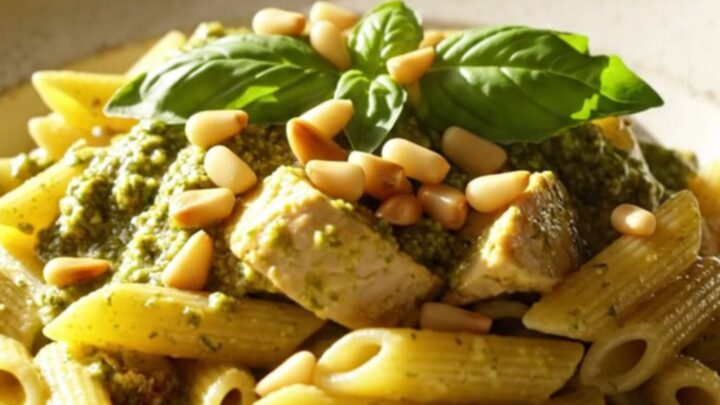
- Finishing the pastaStir in the basil pesto, penne pasta, and shredded mozzarella. Continue to cook until the pasta is tender and the sauce is glossy and well-combined, then garnish with toasted pine nuts and fresh basil leaves.Look for The dish is finished when the mozzarella is fully melted and the sauce coats the pasta uniformly.Tip If the sauce appears too thick, add a small splash of additional chicken broth before serving.
In the final phase, the dish transforms as the pesto and pasta are introduced. The sauce should turn a beautiful pale green from the pesto, and the mozzarella should melt completely into the mixture, creating a thick, glossy, and indulgent coating that clings to every piece of penne and shredded chicken.
Common mistakes
A common mistake is adding the pasta too early, which can cause it to become mushy and lose its structure during the long cooking time.
Another error is failing to ensure the chicken is completely submerged in the liquid at the start, which can lead to uneven cooking. Always layer the ingredients carefully to ensure the chèvre cheese and broth create the base for the sauce.
How to tell it’s done
The chicken is fully cooked when it reaches an internal temperature of 165°F (74°C). Use a meat thermometer to check the thickest part of the breast before shredding.
The pasta should be tender but still have a slight bite, known as al dente, and the sauce should be smooth and glossy with the cheese fully melted throughout.
- Poultry: 165°F (74°C) in the thickest part
Up next · Part 3 of 3
2 variations · storage & make-ahead · 3 answers · printable card
Tips, FAQ & printable recipe (Part 3)← Back to the ingredients (Part 1)