Dinner · Part 2 of 3: Instructions
Creamy Chicken Philly Cheesesteak Pasta Bake Step-by-step instructions
- Prep
- Cook
- Total
- Serves
- 6
Before you start
Preheat your oven to 375°F (190°C) before you begin assembling the dish. Prepare your ingredients by slicing the chicken into thin, uniform strips to ensure they cook evenly. Have the creamy sauce, peppers, and onions combined in a pitcher for easy pouring.
Clear your workspace to allow for steady assembly, as the dish will be heavy once filled with liquid. Ensure your baking dish is clean and dry before you start layering the components, as this prevents any sticking and allows the heat to distribute evenly from the start.
Ingredients at a glance (4)
- 1 lb penne pasta, uncooked
- 1 lb chicken breast, thinly sliced
- 2 cups creamy sauce with sliced peppers and onions
- 8 slices provolone cheese
Instructions
Layering the ingredients
- Prepare the baseArrange the dry, uncooked penne pasta in the bottom of a large rectangular ceramic baking dish. Distribute the thinly sliced raw chicken strips evenly over the pasta layer.Look for The chicken strips should be spread out in a single layer to ensure even cooking throughout the bake.Tip Ensure the pasta is spread into an even layer to prevent clumping during the baking process.
The pasta and chicken should be distributed in a single, even layer across the bottom of the dish. There should be no large clumps of pasta, as these will not cook through properly. Ensure the chicken strips are well-distributed so that every portion contains enough protein. The base is now ready for the liquid, which will provide the necessary moisture to steam the pasta and gently cook the chicken during the baking process.
Adding liquids and topping
- Add liquids and toppingsPour the creamy sauce containing sliced peppers and onions over the chicken and pasta. Arrange the provolone cheese slices in a single layer across the entire top of the dish.Look for The liquid should mostly cover the pasta and chicken to facilitate proper hydration and cooking of the noodles.Tip Distribute the peppers and onions evenly while pouring to ensure every serving has plenty of vegetables.
The sauce should be poured evenly over the contents, ensuring that the liquid reaches the bottom corners of the dish. The provolone slices should cover the entire surface, overlapping slightly if necessary, to create a consistent cheese layer. At this stage, the dish should look uniform, with the liquid level just visible between the pasta. Check that no stray pieces of chicken are poking out of the top, as they might dry out during baking.
Baking to perfection
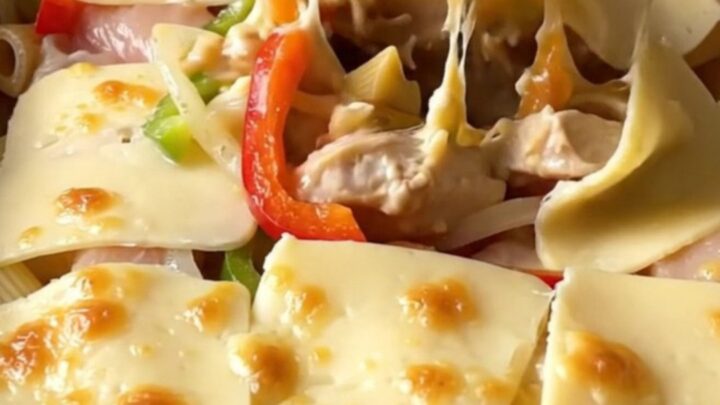
- Bake until goldenPlace the dish in a preheated oven at 375°F (190°C). Bake until the pasta is tender, the sauce is bubbling, and the internal temperature of the chicken reaches 165°F (74°C). Remove from the oven and let rest for 10 minutes before serving.Look for The cheese should be melted and golden brown, and the sauce should be thick and bubbling around the edges.Safe temperature 165°F (74°C) internal temperature (poultry)Tip Avoid overbaking to keep the chicken tender and the sauce creamy.
The finished dish should have a beautiful, bubbling, golden-brown crust of melted provolone. The sauce will have thickened significantly, coating the pasta and chicken in a rich, creamy layer.
The aroma should be savory and inviting, with the scent of roasted peppers and onions coming through. Ensure the chicken is fully cooked by verifying the temperature before removing the dish from the oven. Let it rest for 10 minutes to allow the sauce to set before serving.
Common mistakes
A common mistake is using chicken pieces that are too thick, which results in uneven cooking where the pasta is overdone by the time the chicken reaches a safe temperature. Another error is overcrowding the dish, which prevents the heat from circulating and leads to uneven browning of the cheese.
Always ensure the liquid level is sufficient; if the pasta is not mostly submerged, it will not rehydrate properly, leading to crunchy, uncooked sections that ruin the final texture of the entire bake.
How to tell it’s done
The dish is finished when the pasta is al dente and the chicken has reached an internal temperature of 165°F (74°C). You can check this by inserting a meat thermometer into the largest piece of chicken.
The top should be bubbling with a golden-brown provolone crust, and the sauce should be thick rather than watery. If the sauce is still too thin, you can let it sit for a few extra minutes, as the starch from the pasta will continue to thicken the liquid as it rests.
- Poultry: 165°F (74°C) in the thickest part
Up next · Part 3 of 3
2 variations · storage & make-ahead · 3 answers · printable card
Tips, FAQ & printable recipe (Part 3)← Back to the ingredients (Part 1)