Dinner · Part 2 of 3: Instructions
Creamy Chicken Cordon Bleu Lasagna Step-by-step instructions
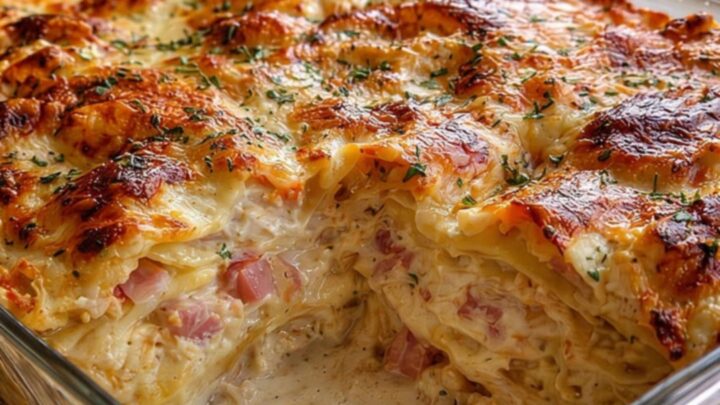
- Prep
- Cook
- Total
- Serves
- 8
Before you start
Before starting, ensure that all your ingredients are prepped and ready for assembly. Dice the cooked chicken breast and ham into uniform pieces, ensuring they are small enough to distribute evenly throughout the layers.
If you are making the béchamel sauce from scratch, prepare it in advance and keep it warm or at room temperature so it is easy to spread. Have your cheese shredded and your oven preheated to 375°F (190°C) to ensure an immediate start to the baking process once the dish is assembled.
Ingredients at a glance (6)
- 12 ounces lasagna sheets, oven-ready
- 2 cups cooked chicken breast, diced
- 1 cup diced ham
- 3 cups béchamel sauce, store-bought or made ahead
- 2 cups Swiss cheese, shredded
- 1 cup mozzarella cheese, shredded
Instructions
Filling Preparation
- Prepare the fillingIn a large bowl, combine the diced cooked chicken and the diced ham. Toss them together until evenly distributed. This mixture will form the hearty base of your lasagna layers. Ensure the chicken pieces are bite-sized for a consistent texture in every single forkful.Look for The chicken and ham are thoroughly combined.Tip Using rotisserie chicken saves significant time.
The chicken and ham mixture should be thoroughly combined and ready for layering. Ensure the pieces are uniform to allow for consistent bites. If the mixture appears too dry, you can add a tablespoon or two of the béchamel sauce to help bind the ingredients together before adding them to the pasta layers.
Layering the Casserole
- Assemble the lasagnaSpread a thin layer of the béchamel sauce on the bottom of a 9x13 inch glass casserole dish. Place a layer of lasagna sheets over the sauce. Top with a portion of the chicken and ham mixture, a drizzle of béchamel, and a generous sprinkle of shredded Swiss cheese. Repeat these layers until all ingredients are used, finishing with a final layer of pasta, béchamel, and the mozzarella cheese.Look for The casserole dish is filled to the top.Tip Ensure the pasta edges are fully covered in sauce to prevent them from drying out.
Each layer should be constructed with precision, starting with a base of sauce to prevent sticking. Ensure that the pasta sheets are placed in a single, overlapping layer and that the cheese is distributed evenly to create a cohesive bond across the entire surface of the lasagna once it melts.
Baking and Browning
- Bake until goldenCover the dish with aluminum foil and bake at 375°F (190°C) for 30 minutes. Remove the foil and continue baking for another 15 minutes, or until the cheese is bubbling and golden-brown. Ensure the center reaches an internal temperature of 165°F (74°C) to verify the poultry components are thoroughly heated throughout. Let the lasagna rest for 10 minutes before slicing to allow the layers to set properly.Look for The cheese is bubbling and golden-brown.Safe temperature 165°F (74°C) internal temperature (poultry)Tip Watch the broiler closely during the last few minutes to avoid burning the cheese.
The lasagna is ready when the cheese is fully melted and golden, and the entire dish is heated through to 165°F (74°C).
The aroma should be rich and savory, signaling that the flavors have melded perfectly. Let the dish rest, which is crucial for achieving those signature clean, impressive layers upon serving.
Common mistakes
A common mistake is using too little sauce, which can result in dry pasta layers. Ensure each layer is generously covered. Another error is failing to rest the lasagna after baking, which causes the layers to slide apart when sliced.
Finally, do not overcrowd the dish; leave a small gap at the top to prevent the sauce from bubbling over onto the oven floor. Always use a rimmed baking sheet underneath the casserole dish to catch any potential drips during the final browning phase.
How to tell it’s done
The lasagna is done when the internal temperature reaches 165°F (74°C) for the poultry and the top is beautifully golden-brown and bubbling. The edges of the pasta should be tender, and the sauce should be thick and clinging to the sheets.
Use a reliable kitchen thermometer to check the center of the dish, ensuring it is thoroughly hot before removing it from the oven. Let it rest for 10 minutes to ensure clean slices.
- Poultry: 165°F (74°C) in the thickest part
Up next · Part 3 of 3
2 variations · storage & make-ahead · 3 answers · printable card
Tips, FAQ & printable recipe (Part 3)← Back to the ingredients (Part 1)