Desserts · Part 2 of 3: Instructions
Creamy Baked Cornmeal Custard Cake Step-by-step instructions
- Prep
- Cook
- Total
- Serves
- 8
Before you start
Preheat your oven to 350°F (175°C) and place the oven rack in the center position for balanced heat exposure. Lightly grease an 8-inch metal baking pan across the bottom and sides so the delicate custard releases effortlessly.
Have a blender clean, dry, and ready on the counter, along with a sturdy wire cooling rack and a sharp knife set aside for final slicing.
Ingredients at a glance (2)
- 1 cup cornmeal
- 3 cups custard batter, store-bought or made ahead
Instructions
Phase 1: Blending the Mixture
- Blend the BatterPlace the cornmeal and prepared custard batter into a blender jar. Blend on medium speed until completely smooth, uniform, and free of any gritty clumps.Look for The mixture runs completely smooth and pourable with no dry streaks remaining.Tip Scrape down the sides of the blender jar halfway through blending to incorporate all grains.
The blended liquid should be entirely smooth, uniform in color, and completely fluid with no visible sediment or clumps gathered along the bottom of the blender jar.
The cornmeal must be fully dispersed throughout the custard base before transferring.
Phase 2: Baking the Custard
- Bake in the Metal PanPour the smooth batter directly into an 8-inch metal pan. Transfer the pan to an oven preheated to 350°F (175°C) and bake for approximately 45 minutes until the surface puffs into a deep golden crust while the middle stays soft. To cook the eggs through, ensure the center registers 160°F (71°C) on a digital thermometer.Look for The surface is puffed, glossy, and deep golden brown with a gentle jiggle in the center.Safe temperature 160°F (71°C) internal temperature (egg dishes)Tip Keep the oven door shut during the first 30 minutes of baking to allow the crust to puff evenly.
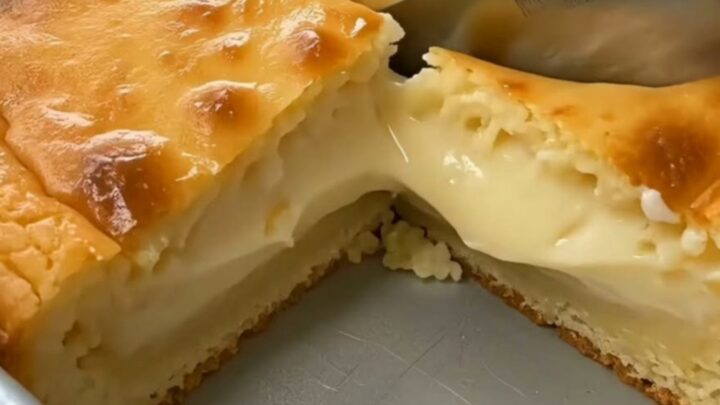
The cake should display a pronounced puff around the rim, a glossy sheen across the surface, and an enticing deep golden-brown hue. The edges will be set and taut, while the exact center sways with a soft, supple jiggle when gently tapped.
Phase 3: Resting and Slicing
- Rest and SliceRemove the hot metal pan from the oven and set it onto a wire cooling rack. Allow the cake to rest for 10 minutes at room temperature so the outer edges settle while the center stays molten. Use a sharp kitchen knife to slice the cake into neat squares, then pull each piece back gently to reveal the oozing interior.Look for A knife cuts cleanly through the crust while a warm, velvety center slowly flows outwards.Tip Wipe the knife blade with a clean towel between slices for the sharpest presentation.
After sitting on the wire rack, the puff will settle slightly into an even square slab. Slicing with a sharp knife should feel crisp on top, yielding immediately to a rich, warm custard core that slowly oozes without completely collapsing the slice.
Common mistakes
The most frequent mistake is overbaking the cake in pursuit of a fully firm center; doing so cooks the custard through completely, eliminating the signature molten, oozing texture.
Another misstep is slicing into the cake immediately out of the oven. Without a brief ten-minute rest, the structural edges lack stability and the liquid custard will spill out prematurely over the pan base.
How to tell it’s done
The cake is ready when the surface has puffed high into a deep golden, glossy crust that feels firm and delicate to a light tap near the edges.
The middle portion should still exhibit a distinct, gentle wobble when the pan is nudged. To verify the eggs are cooked completely through, an instant-read probe inserted directly into the core must reach 160°F (71°C).
- Egg dishes: 160°F (71°C) in the thickest part
Up next · Part 3 of 3
2 variations · storage & make-ahead · 3 answers · printable card
Tips, FAQ & printable recipe (Part 3)← Back to the ingredients (Part 1)