Desserts · Part 2 of 3: Instructions
Caramelized Vanilla Mille-Feuille with Crisp Inverted Puff Pastry Step-by-step instructions
- Prep
- Cook
- Total
- Serves
- 8
Before you start
Before starting, make sure the inverted puff pastry is thawed if frozen, and the vanilla bean diplomat cream is prepared and chilled. Gather all equipment: baking sheets, parchment paper, a serrated knife, a piping bag with a plain tip, and a wire rack. Preheat the oven to 375°F (190°C) and line two baking sheets with parchment paper.
If using a store-bought pastry, roll it out to an even thickness. Have the confectioners' sugar ready for dusting. The chocolate glaze should be made or warmed to a pourable consistency. Clear space in the refrigerator for chilling the assembled dessert.
Ingredients at a glance (4)
- 400 g inverted puff pastry (store-bought or made ahead)
- 1/4 cup confectioners' sugar, for dusting
- 400 g vanilla bean diplomat cream (pastry cream lightened with whipped cream)
- 1/2 cup chocolate glaze, for feathering
Instructions
Prepare the Pastry
- Preparing the PastryPreheat the oven to 375°F (190°C). On a lightly floured surface, roll the inverted puff pastry into a rectangle about 1/8 inch thick. Dust the top generously with confectioners' sugar, then place the pastry between two baking sheets lined with parchment paper. This weight keeps the pastry flat and compressed during baking.Look for The pastry is thinly rolled and evenly dusted with sugar.Tip Chill the pastry for 15 minutes before baking if it becomes too soft.
The pastry is rolled thin and dusted with sugar, then placed between two baking sheets. At this stage, the pastry should be even and cold, with a light coating of sugar. The oven is preheating, and the baking sheets are ready.
The sugar will melt during baking, creating a caramelized crust, so the pastry should be completely covered with a thin layer. If the pastry is too soft, chill it for 15 minutes before baking to ensure it holds its shape. The goal is a flat, even sheet that will bake into a crisp, shattering layer.
Bake the Pastry
- Baking the Crisp LayersBake the weighted pastry for 28 minutes, until deeply caramelized and wafer-crisp. The sugar will melt into a thin amber glaze, and the pastry will be shatteringly crisp. Remove from the oven and let cool completely on a wire rack, still between the sheets, for at least 30 minutes.Look for The pastry is golden amber, crisp, and completely cool.Tip If the edges brown too fast, tent loosely with foil.
After 28 minutes, the pastry should be deeply caramelized, with a glossy amber sheen and a firm, crisp texture. It should not be soft or bendable. Let it cool completely on a wire rack—this is crucial for the crunch to set. The sugar will harden as it cools, creating the signature shatter. Check that the pastry is uniformly golden; if some spots are pale, return it to the oven for a few more minutes. Once cool, the pastry should be easy to cut with a serrated knife without crumbling.
Assemble and Chill
- Assembling the Mille-FeuilleOnce the pastry is cool, use a serrated knife to trim the edges and cut into three equal rectangles. Whip the vanilla bean diplomat cream until stiff peaks form, then transfer to a piping bag. Pipe an even layer of cream onto the first pastry rectangle. Top with the second rectangle, pipe another layer, and finish with the third rectangle. Spread a thin layer of chocolate glaze on the top, then feather it with a toothpick or skewer. Chill for at least 1 hour before serving.Look for The layers are even, and the top is feathered with chocolate.Safe temperature 160°F (71°C) internal temperature (egg dishes)Tip For clean slices, use a warm serrated knife and wipe between cuts.
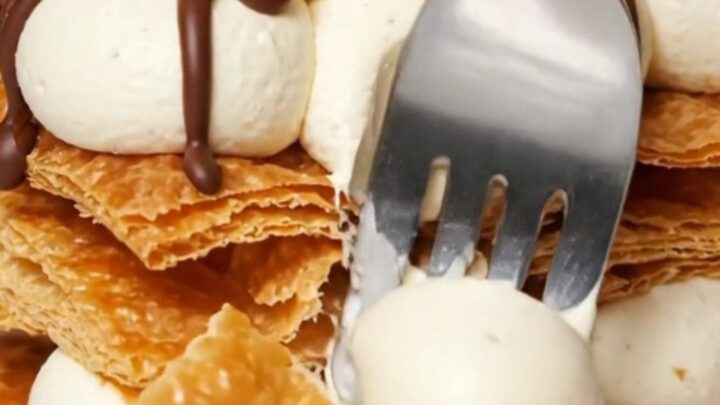
The assembled mille-feuille should have straight, even sides and a smooth top with feathered chocolate. The cream layers should be visible between the pastry, and the whole thing should feel firm when gently pressed. Chill for at least 1 hour to allow the cream to set and the flavors to meld. When you slice it, the layers should hold together, and the pastry should crack cleanly. The top should be glossy, and the feathered pattern should be distinct. Serve chilled for the best contrast of textures.
Common mistakes
One common mistake is not pressing the pastry enough during baking, which allows it to puff unevenly and lose its flat, crisp texture. Ensure the baking sheets are heavy or weigh them down with an ovenproof dish. Another pitfall is overwhipping the mousseline, which can cause it to curdle or become grainy; whip just until stiff peaks form.
When cutting the pastry, use a serrated knife and gentle sawing motion to avoid crushing the layers. If the chocolate glaze is too thick, it will be difficult to spread; thin it with a little warm cream. Finally, don't skip the chilling step—it's essential for clean slices.
How to tell it’s done
The pastry is done when it is deeply caramelized, a rich amber color, and crisp to the touch. It should sound hollow when tapped. The vanilla mousseline should be firm enough to hold its shape when piped, and the assembled mille-feuille should be thoroughly chilled—at least 1 hour—so the cream sets and the layers hold together.
When slicing, the knife should glide through the pastry with a clean crack, and the cream should stay in place. If the pastry feels soft or bends, it needs more baking; if the cream is too runny, it needs more chilling. The finished dessert should have a shattering crunch and a creamy, cool interior.
- Egg dishes: 160°F (71°C) in the thickest part
Up next · Part 3 of 3
4 variations · storage & make-ahead · 5 answers · printable card
Tips, FAQ & printable recipe (Part 3)← Back to the ingredients (Part 1)