Dinner · Part 2 of 3: Instructions
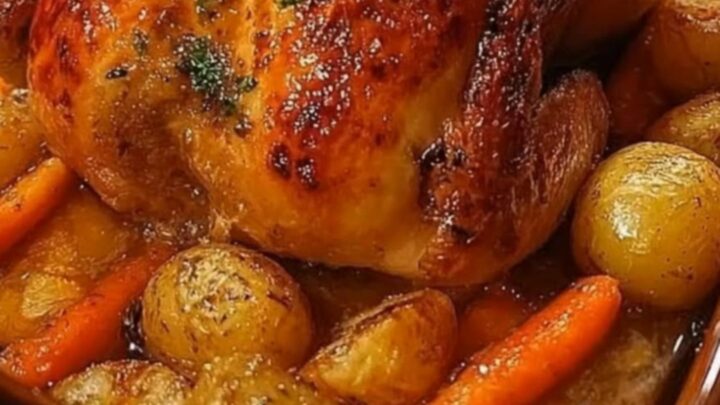
Classic Roast Chicken with Potatoes and Carrots Step-by-step instructions
- Prep
- Cook
- Total
- Serves
- 4
Before you start
Before starting, remove the whole chicken from the refrigerator about thirty minutes prior to roasting to take the chill off, which promotes even cooking. Pat the chicken completely dry inside and out with paper towels, and place it on a clean cutting board.
Wash and dry the baby potatoes, leaving them whole, and peel the carrots before cutting them into thick, uniform chunks. Preheat the oven to 400°F (204°C) and gather the baking dish, herbs, and fresh rosemary so everything is ready for assembly.
Ingredients at a glance (5)
- 1 whole chicken (4 to 5 pounds)
- 1 1/2 lbs baby potatoes, washed
- 1 lb carrots, peeled and cut into thick chunks
- 1 tbsp herbs
- 3 fresh rosemary sprigs
Instructions
Prepping and Seasoning the Chicken
- Prep the Chicken and VegetablesPreheat the oven to 400°F (204°C). Pat the raw chicken dry thoroughly with paper towels on a clean cutting board to ensure the skin gets crispy. Arrange the washed baby potatoes and thick carrot chunks in a large baking dish, leaving space in the center for the bird.Look for The chicken skin must be completely dry before proceeding.Tip Patting the skin dry is the secret to achieving a crackling golden crust.
- Season the ChickenRub the herbs thoroughly all over the dry skin of the chicken, ensuring the seasoning is evenly distributed across the entire surface of the bird and inside the cavity for maximum flavor.Look for The chicken should be evenly coated with no dry spots.Tip Rubbing some seasoning inside the cavity adds flavor from the inside out.
At the end of this phase, the chicken should be thoroughly coated in a layer of herbs, with the seasonings evenly distributed across the skin and inside the cavity.
The baby potatoes and carrots should be arranged in the baking dish, ready to absorb the roasting juices. No dry patches of skin should remain uncovered by herbs, ensuring a uniform golden color starts to develop immediately once the heat is applied.
Roasting and Basting the Ingredients
- Arrange and Start RoastingPlace the seasoned chicken in the center of the baking dish, surrounded by the baby potatoes and carrots. Tuck the fresh rosemary sprigs around the chicken and vegetables. Roast in the preheated oven for forty minutes.Look for The vegetables should form a single layer around the chicken.Tip Tucking the rosemary under the chicken prevents the leaves from burning too quickly.
- Baste the VegetablesCarefully pull the baking dish out of the oven. Use a large spoon to baste the baby potatoes and carrots with the bubbling juices rendering from the roasting chicken. Return the dish to the oven and roast for another twenty to thirty minutes.Look for The vegetables should look glossy and coated in the savory chicken fat.Tip Basting helps the vegetables cook evenly and prevents them from drying out.
During this phase, the kitchen will fill with a rich, savory aroma as the chicken skin begins to turn a light golden-brown. The pan juices should be actively bubbling and sizzling in the bottom of the baking dish. When you baste the baby potatoes, they should look glossy and partially tender, while the carrots begin to soften and caramelize around the edges.
Finishing, Resting, and Carving
- Finish RoastingContinue roasting until the chicken skin is golden-brown and crackling. Insert a meat thermometer into the thickest part of the thigh, ensuring it reaches a safe internal temperature of 165°F (74°C) to fully cook the poultry before removing it from the oven.Look for The skin should be deeply golden and the juices must run clear.Safe temperature 165°F (74°C) internal temperature (poultry)Tip Avoid touching the bone with the thermometer probe to get an accurate reading.
- Rest and CarveTransfer the roast chicken to a carving board and let it rest for fifteen minutes to allow the juices to redistribute. Keep the roasted potatoes and carrots warm in the baking dish. Carve the chicken and serve hot.Look for The chicken meat should be incredibly moist and easy to carve.Tip Resting is crucial; cutting too early causes the juices to escape.
At the final checkpoint, the chicken skin must be deeply golden, crisp, and crackling to the touch. Slicing into the meat should release clear juices and steam. The potatoes must be fork-tender with crispy edges, and the carrots beautifully caramelized. Most importantly, a meat thermometer inserted into the thickest part of the thigh must register a safe internal temperature of 165°F (74°C).
Common mistakes
One common mistake is crowding the roasting pan with too many vegetables, which traps steam and prevents both the chicken skin and the potatoes from getting crisp. Ensure there is some space around the ingredients for air to circulate.
Another error is skipping the resting period after cooking; carving the chicken immediately causes all the precious juices to run out onto the cutting board, resulting in dry meat. Always let the bird rest for at least fifteen minutes to allow the juices to redistribute throughout the tissues.
How to tell it’s done
To accurately determine doneness, insert an instant-read kitchen thermometer into the thickest part of the chicken thigh, taking care not to touch the bone. The poultry is safe and fully cooked when it reaches an internal temperature of 165°F (74°C).
In addition to the temperature reading, the skin should be exceptionally crisp and golden-brown, and any juices that run out when the thigh is pierced should be completely clear, with no traces of pink near the joints.
- Poultry: 165°F (74°C) in the thickest part
Up next · Part 3 of 3
2 variations · storage & make-ahead · 3 answers · printable card
Tips, FAQ & printable recipe (Part 3)← Back to the ingredients (Part 1)