Dinner · Part 2 of 3: Instructions
Classic Greek Pastitsio with a Rich Meat Sauce and Velvety Béchamel Step-by-step instructions
- Prep
- Cook
- Total
- Serves
- 8
Before you start
Before beginning the assembly process, organize all ingredients and equipment to ensure a smooth workflow. Ensure the pre-made rich spiced beef sauce and velvety white béchamel are warmed slightly to make them easier to spread.
Grate the cheese and set it aside in a bowl. Bring the cooked tubular bucatini pasta to room temperature. Grease a 9x13-inch baking dish with cooking spray or butter, and preheat the oven to 375°F (190°C) so it is ready for baking.
Ingredients at a glance (4)
- 1 lb tubular bucatini pasta, cooked
- 4 cups rich spiced beef sauce, made ahead
- 3 cups velvety white béchamel, made ahead
- 1 1/2 cups cheese, grated
Instructions
Layering the Pasta and Beef
- Arrange the Pasta BasePreheat the oven to 375°F (190°C). Place the cooked tubular bucatini pasta into the bottom of a greased baking dish, arranging the tubes evenly to create a solid base layer for the casserole.Look for The pasta should form a neat, compact layer covering the bottom of the dish.Tip Aligning the tubes in the same direction helps create beautiful, clean cuts later.
- Spread the Spiced Beef SaucePour the warm, rich spiced beef sauce over the arranged pasta layer. Use a spatula to spread the sauce evenly, ensuring it fills any gaps between the pasta tubes.Look for The meat sauce should completely cover the pasta in an even, flat layer.Tip Press down gently with the spatula to compact the layers and prevent air pockets.
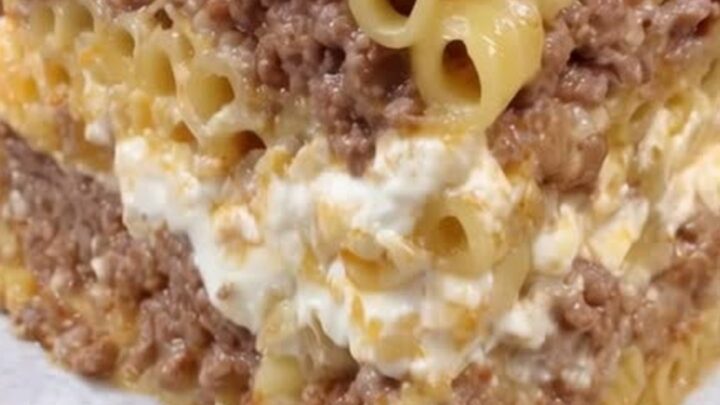
At the end of this phase, the cooked tubular bucatini pasta is arranged in a neat, compact layer at the bottom of the baking dish.
The rich spiced beef sauce is spread evenly over the pasta, filling any gaps between the tubes. The base is sturdy, flat, and ready for the creamy topping, with no excess liquid pooling at the edges.
Adding the Béchamel and Cheese
- Pour the BéchamelGently pour the velvety white béchamel over the spiced beef sauce layer. Smooth the top with a clean spatula, spreading the sauce all the way to the edges of the baking dish.Look for The béchamel should form a thick, smooth, and uniform white blanket over the beef.Tip Pour slowly to avoid disturbing the meat layer underneath.
- Top with CheeseSprinkle the grated cheese evenly over the velvety white béchamel layer, covering the entire surface to ensure a beautiful, uniform crust when baked.Look for The cheese should be distributed in a thin, even layer across the top.Tip Use a sharp cheese like Parmesan or Pecorino for the best flavor and browning.
At the end of this phase, the velvety white béchamel is spread into a smooth, thick blanket over the meat layer, completely covering it to the edges. The grated cheese is sprinkled evenly over the top, creating a uniform layer that is ready to blister and brown beautifully in the hot oven.
Baking and Resting
- Bake until GoldenPlace the baking dish in the preheated oven. Bake for 40 to 45 minutes until the cheese topping is blistering, deeply browned, and bubbling at the edges.Look for The top should have a deeply browned, bubbly cheese crust.Tip If the top is not browned enough, broil for the last 2 minutes.
- Rest and SliceRemove the pastitsio from the oven. Let the dish rest at room temperature for 20 to 30 minutes before slicing into towering square portions.Look for The layers should feel set and firm when gently pressed.Tip A long rest is crucial for clean, neat slices that show off the pasta tubes.
At the end of this phase, the pastitsio is beautifully baked with a deeply browned, bubbly cheese crust on top. The edges are sizzling, and the center is set. After resting on a wire rack, the layers have firmed up, allowing the dish to be sliced into clean, neat squares that showcase the vertical tubes of pasta.
Common mistakes
One common mistake is slicing the pastitsio too soon after it comes out of the oven. Slicing immediately will cause the hot béchamel and meat layers to run, turning the beautiful structured squares into a messy heap on the plate.
Allow the dish to rest for at least 20 to 30 minutes to let the layers set. Another mistake is using a watery meat sauce, which seeps into the pasta and makes the bottom soggy.
How to tell it’s done
The pastitsio is perfectly done when the top béchamel layer is puffed, deeply golden-brown, and blistered in spots, and the edges of the dish are bubbling vigorously.
Since the components are already cooked before assembly, the main goal is to heat the casserole thoroughly and melt the cheese into a beautiful crust. Ensure the center is hot and set before removing the dish from the oven.
Up next · Part 3 of 3
2 variations · storage & make-ahead · 3 answers · printable card
Tips, FAQ & printable recipe (Part 3)← Back to the ingredients (Part 1)