Appetizers · Part 2 of 3: Instructions
Classic French Pissaladière with Caramelized Onions and Anchovies Step-by-step instructions
- Prep
- Cook
- Total
- Serves
- 6
Before you start
Start by preparing all ingredients before turning on the oven. Slice the onions into thin, uniform strips to ensure they caramelize consistently. Ensure the dough is at room temperature to make it easier to roll out.
Have your anchovies and olives ready to go so that you can assemble the tart quickly once the onions are finished. A clean, floured workspace is essential for handling the dough effectively, and having a preheated stone or pan ready is critical for the final bake.
Ingredients at a glance (6)
- 800 grams yellow onions, thinly sliced
- 1 tbsp fresh thyme leaves
- 1 lb artisan pizza dough, store-bought or made ahead
- 1 tin anchovy fillets, drained
- 1/3 cup Niçoise olives, pitted
- 2 tbsp herb-infused olive oil
Instructions
Onion Caramelization
- Caramelize the OnionsPlace the sliced onions into a heavy-bottomed skillet over medium-low heat with a drizzle of olive oil. Cook slowly, stirring frequently, until the onions become soft, jammy, and deep amber in color. Stir in the fresh thyme leaves during the final minutes of cooking to infuse the mixture with aromatics.Look for Onions should be reduced significantly and hold a dark, golden-brown jam-like consistency without burning.Tip Adding a tiny pinch of salt helps draw out moisture from the onions to speed up the caramelization process.
The onions should have reduced in volume by more than half, appearing soft, translucent, and finally developing a deep, rich amber color. They should smell sweet and fragrant, with no sharp raw onion notes. If they look too dry, add a tiny splash of water to deglaze the pan and incorporate the brown bits from the bottom before proceeding to the assembly phase.
Assembly of Tart
- Assemble the TartPreheat your oven to 425°F (218°C) with a baking stone or sheet pan inside. Roll out the pizza dough on a floured surface to your desired thickness. Spread the prepared onion jam evenly across the dough, leaving a small border around the edges. Arrange the anchovy fillets in a decorative lattice pattern across the top, pressing them gently into the onions, and scatter the pitted Niçoise olives in the spaces between.Look for Ensure the onion layer is spread thinly and evenly to allow the crust to puff up properly during the bake.Tip Use a lattice pattern to ensure every slice of the finished tart receives a balanced portion of the salty anchovies.
The dough should be rolled out evenly to the desired thickness, ensuring the edges are slightly thicker to form a border. The onion jam must be spread in an even layer that does not pool excessively.
The anchovies should be arranged in a clear, consistent lattice pattern, and the olives should be distributed evenly, ensuring every potential square has a balanced amount of each topping.
Baking and Finishing
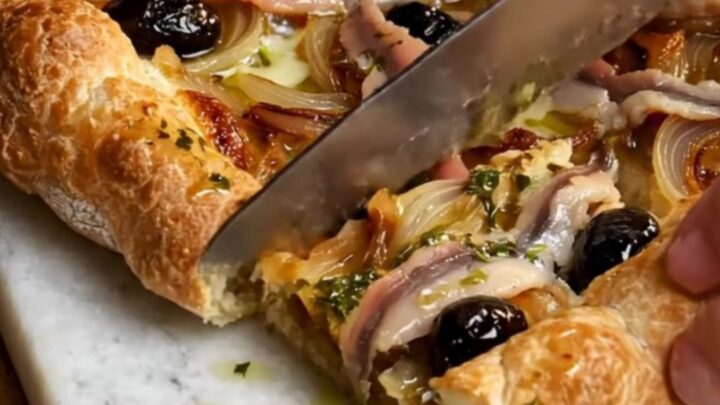
- Bake and FinishCarefully slide the assembled tart onto the preheated stone or pan. Bake at 425°F (218°C) until the crust is golden brown and the edges are crisp. Remove the tart from the oven and immediately brush the crispy border with the herb-infused olive oil. Let it cool for five minutes on a wire rack before cutting into neat bistro-style squares to serve warm.Look for The crust should sound hollow when tapped, and the edges should look deeply golden and blistered.Tip Brushing the crust with oil immediately after baking adds a final layer of shine and aromatic herb flavor.
The tart is ready when the crust has puffed up, turned a uniform golden brown, and feels crisp to the touch. The aroma of baked dough and roasted onions should be prominent in the kitchen. After brushing with the herb-infused oil, let the tart rest briefly to allow the crust to set, ensuring that the slices remain intact and the textures are perfectly crisp when served.
Common mistakes
A common mistake is rushing the onion caramelization process. If the heat is too high, the onions will brown on the outside but remain raw on the inside, lacking the necessary sweetness.
Another error is over-loading the dough with too much onion jam, which can prevent the crust from rising and lead to a soggy center. Finally, failing to preheat the baking stone or sheet pan often results in a pale, soft crust that lacks the signature bistro-style crunch expected in a traditional Pissaladière.
How to tell it’s done
The Pissaladière is done when the crust is deeply golden brown and shows distinct signs of blistering around the edges. The onions should appear dark, jammy, and caramelized, with no signs of raw texture.
The anchovies should be slightly shriveled and fragrant, and the olives should be warmed through. When lifted slightly, the bottom of the crust should be firm and crisp to the touch, indicating it has baked through completely without any sogginess.
Up next · Part 3 of 3
2 variations · storage & make-ahead · 3 answers · printable card
Tips, FAQ & printable recipe (Part 3)← Back to the ingredients (Part 1)