Dinner · Part 2 of 3: Instructions
Classic Beef Lasagna with Epic Cheese Pull Step-by-step instructions
- Prep
- Cook
- Total
- Serves
- 8
Before you start
Before cooking, get the mise in place so assembly moves quickly once the oven is hot. Chop the onion and mince the garlic, shred the mozzarella from a block and grate the Parmesan, and drain the ricotta if it looks wet in the container. Set out the 9x13-inch dish, the skillet, a large pot and a cutting board for the cooked noodles.
Ingredients at a glance (14)
- 1 tbsp olive oil
- 1 yellow onion, finely chopped
- 4 garlic cloves, minced
- 1 lb ground beef (80/20)
- 28 oz crushed tomatoes (one large can)
- 2 tbsp tomato paste
- 2 tsp Italian seasoning
- 1 tsp kosher salt, plus more for the pasta water
- Black pepper, to taste
- 12 lasagna noodles (about 9 oz)
- 15 oz whole-milk ricotta cheese (one container)
- 3 cups shredded mozzarella, divided
- 1/2 cup grated Parmesan, divided
- 2 tbsp chopped fresh parsley
Instructions
Sauce and cheese filling
- Sweat the onion and garlicHeat the olive oil in a large skillet over medium heat. Add the chopped onion and cook, stirring now and then, until it turns translucent and the edges begin to soften, about 4 minutes. Stir in the minced garlic and cook just until fragrant, about 30 seconds, keeping the heat steady so nothing takes on color.Look for The onion looks glossy and translucent and the kitchen smells sweet and savory, with no browning on the garlic.Tip A pinch of salt on the onion now helps it release moisture and soften evenly.
- Brown the ground beefAdd the ground beef to the skillet and break it up with a spatula as it cooks. Let it sit undisturbed for a minute at a time so it browns in patches, then stir, until no pink remains anywhere in the pan, about 8 minutes. Cook it through to 160°F (71°C) measured with an instant-read thermometer, then drain the excess fat.Look for Every crumb of beef is deep brown with no pink spots, and the fat in the pan runs clear.Safe temperature 160°F (71°C) internal temperature (ground meat)Tip Drain the fat well here; a greasy sauce keeps the layers from holding together when sliced.
- Build and simmer the sauceStir the tomato paste into the beef and let it darken for 1 minute. Pour in the crushed tomatoes, then add the Italian seasoning, salt and a good grind of black pepper. Bring to a gentle bubble, lower the heat and simmer uncovered for 20 minutes, stirring occasionally, until the sauce thickens enough to hold a trail behind the spatula.Look for The sauce is thick and brick red, mounds on the spatula, and smells of cooked tomatoes and herbs rather than sharp raw tomato.Tip A thick sauce is the secret to clean slices; watery sauce is the most common lasagna failure.
- Mix the cheese fillingWhile the sauce simmers, stir the ricotta, 1 cup of the mozzarella, 1/4 cup of the Parmesan and the chopped parsley together in a bowl until evenly combined. Taste and add a small pinch of salt if it needs it. The mixture should be thick enough to spread in a layer without sliding off the spoon.Look for The filling looks uniform and pale, flecked with green parsley, and holds its shape when scooped.Tip Mixing some cheese into the filling rather than layering it all on top helps every slice hold together.
At the end of this phase the sauce should be thick and brick red, mounding on the spatula and trailing behind it, with a deep cooked-tomato aroma and no sharp raw edge.
The beef is fully browned and cooked through to 160°F (71°C), and the fat has been drained. The ricotta filling is thick and uniform, flecked with parsley, and holds its shape on a spoon. If the sauce still pools, simmer five more minutes before moving on.
Layer and assemble
- Cook the noodlesBring a large pot of well-salted water to a rolling boil and cook the lasagna noodles until pliable but still firm, about 2 minutes less than the package directs. Lift them out with tongs, lay them in a single layer on a cutting board and drizzle lightly with olive oil so they do not stick together while the layers are built.Look for The noodles bend easily without cracking and still have a firm, chalky bite at the center.Tip Undercooking the noodles lets them finish absorbing sauce in the oven without going soft.
- Assemble the first layersPreheat the oven to 375°F (190°C). Spread a thin layer of meat sauce over the bottom of a 9x13-inch baking dish. Lay down 4 noodles, spread half of the remaining sauce over them, then dot and spread half of the ricotta filling across the sauce. Scatter 1 cup of mozzarella and 2 tbsp of Parmesan evenly over the top.Look for The sauce layer covers the noodles edge to edge, and the cheese filling sits in an even band with no bare corners.Tip Sauce under the first layer of noodles keeps them from sticking to the dish.
- Repeat and finish the topAdd a second layer of 4 noodles, the rest of the sauce, the rest of the ricotta filling, another cup of mozzarella and the remaining 2 tbsp of Parmesan. Top with the final 4 noodles, then cover them with the last cup of mozzarella so the whole surface is blanketed edge to edge with cheese.Look for The final layer of cheese covers every noodle completely, with no dry edges peeking through.Tip Cheese all the way to the edges is what gives that full-width golden crust and long cheese pull.
The assembled dish should look even and full: three layers of noodles, sauce and cheese filling edge to edge, topped with a complete blanket of mozzarella with no noodles showing through.
The corners are as filled as the center, the top cheese reaches the walls of the dish, and nothing is dry or bare. The oven should already be at 375°F (190°C), ready for the pan the moment it is finished.
Bake, rest and serve
- Bake until bubbling and goldenCover the dish with foil and bake at 375°F (190°C) for 25 minutes, then remove the foil and bake 15 to 20 minutes more, until the top is deeply golden and the sauce bubbles at the edges. If the cheese colors too fast, tent the foil loosely over the pan for the last few minutes.Look for The cheese is browned in spots, the sauce bubbles thickly around the edges, and the whole pan looks set rather than soupy.Tip Baking covered first steams the noodles tender; uncovering at the end builds the golden top.
- Rest, cut and serveTake the lasagna out of the oven and let it rest on a cooling rack for at least 15 minutes before cutting. Then run a metal spatula along one edge, cut straight down through the layers and lift a portion onto a plate, letting the cheese stretch. Serve hot, with extra Parmesan at the table.Look for The first slice holds its shape with visible layers, and the cheese stretches in long strands as it lifts.Tip The rest is not optional; cutting too early is what makes the layers slide apart.
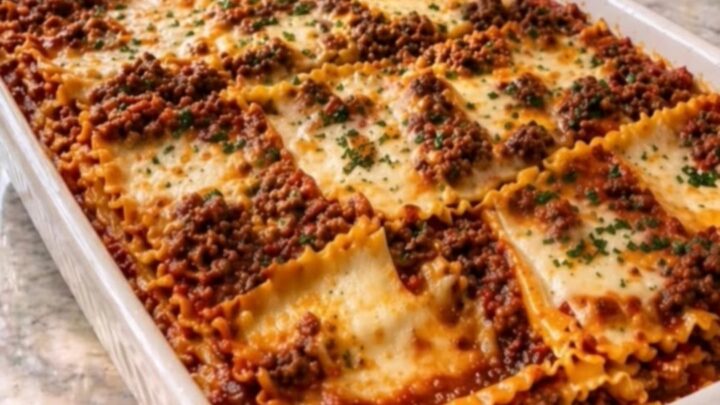
Out of the oven, the top is deeply golden in spots, the sauce bubbles thickly around the edges, and the pan looks set rather than soupy.
After 15 minutes of rest, a metal spatula cuts a clean slice that holds its layers, and lifting it produces a long, stretchy cheese pull. Steam rises from the cut, the layers stay in line on the plate, and the center is as hot and set as the edges.
Common mistakes
The three most common failures are a watery sauce, overcooked noodles and cutting too early. Simmer the sauce until it visibly thickens and mounds on the spatula — if it looks soupy, keep it on the heat.
Pull the noodles two minutes early so they stay firm enough to finish in the oven. And respect the 15-minute rest: straight from the oven the cheese and sauce are molten and will slide no matter how thick they went in.
How to tell it’s done
The lasagna is done when the top is deep golden brown in patches, the sauce bubbles thickly at the edges of the dish, and a knife inserted at the center meets no resistance from firm noodles. The internal temperature at the center should reach at least 160°F (71°C), the same safe temperature the beef finished at.
- Ground meat: 160°F (71°C) in the thickest part
Up next · Part 3 of 3
4 variations · storage & make-ahead · 5 answers · printable card
Tips, FAQ & printable recipe (Part 3)← Back to the ingredients (Part 1)