Desserts · Part 2 of 3: Instructions
Churro Cheesecake Tortilla Flautas: Crispy, Oozy, 20 Minutes Step-by-step instructions
- Prep
- Cook
- Total
- Serves
- 6
Before you start
Set the cream cheese out an hour ahead so it beats smooth without lumps, and pull the egg yolk from the fridge at the same time. Line up the six tortillas, load the piping bag, and mix the cinnamon sugar before any oil goes on the heat, because once frying starts there is no free hand.
Place the wire rack over a sheet pan next to the stove, with the cinnamon sugar bowl beside it. Fill the skillet with about two inches of oil and clip the thermometer to the side.
Ingredients at a glance (10)
- 8 oz cream cheese, softened
- 1/3 cup granulated sugar
- 1 large egg yolk
- 1 tsp vanilla bean paste
- 6 small flour tortillas (8-inch)
- 4 cups vegetable oil, for frying
- 1/2 cup granulated sugar
- 2 tbsp ground cinnamon
- 4 oz Mexican chocolate, chopped
- 1/2 cup heavy cream
Instructions
Build the filling and roll
- Beat the cream cheese basePut the softened cream cheese and 1/3 cup sugar in a mixing bowl and beat with a hand mixer on medium speed for about 1 minute, until completely smooth and glossy. Scrape the bowl and beaters so no firm lump survives, then mix in the egg yolk and vanilla bean paste until the filling looks uniform and thick enough to hold a soft peak.Look for The mixture should look silky, pale and lump-free, with no streaks of yolk and a thickness that pipes cleanly.Tip Cold cream cheese leaves lumps that never beat out, so let it sit at room temperature a full hour first.
- Load the filling into a bagScoop the filling into a piping bag or a zip-top bag and snip off one corner to make an opening about half an inch wide. Push the filling down toward the tip and twist the top closed so it does not creep back up your hand while you work down the line of tortillas.Look for A thick, slow ribbon of filling should fall from the snipped corner when you squeeze gently.Tip Stand the loaded bag tip-down in a tall glass to keep both hands free for the tortillas.
- Pipe and roll the flautasLay a tortilla flat and pipe a thick, even line of filling about an inch from the bottom edge, stopping an inch short of each side. Roll the tortilla up tightly away from you, tucking as you go, so the seam ends underneath. Repeat with the remaining tortillas, setting each roll seam-side down on a tray.Look for Each roll should feel snug and hold its shape with no visible gap along the seam.Tip A tight roll is everything here: loose flautas unwrap in the oil and leak filling everywhere.
- Mix the cinnamon sugarWhile the rolls sit, stir 1/2 cup sugar with 2 tbsp ground cinnamon in a shallow bowl until the color is even and no cinnamon streaks remain. Set the bowl next to the wire rack so a hot flauta can go from oil to rack to sugar in seconds, while the coating still clings.Look for The blend should be a uniform warm tan with no dry pockets of plain sugar.Tip Toss the flautas in this the moment they leave the oil, while the surface is still tacky with heat.
By the end of this phase you should have six tight, seam-down rolls on a tray and a bowl of even, tan-colored cinnamon sugar waiting beside the stove. The filling should have beaten out completely smooth, with no cream cheese lumps and no streaks of yolk, and it should pipe as a thick ribbon that holds its shape on the tortilla.
Squeeze each roll gently: it should feel snug and springy, with no loose flap or open end where filling could escape. If any roll looks slack, re-roll it now, while everything is still soft and forgiving.
Fry and sugar-coat
- Heat the oil to 360°FPour the vegetable oil into a deep heavy skillet to a depth of about 2 inches and clip a thermometer to the side. Heat over medium until it holds steady at 360°F. Adjust the flame as needed so the temperature stays between 355°F and 365°F before anything goes in.Look for A pinch of flour dropped in should fizz steadily, not violently, within two seconds.Tip Oil that is too cool soaks into the tortilla; too hot and it browns before the filling warms through.
- Fry until deeply goldenLower two or three flautas into the oil seam-side down, never crowding the pan. Fry about 2 minutes per side, turning once, until the tortillas are deep golden and blistered all over and the filling inside registers 160°F (71°C) at the center. Work in batches and let the oil return to 360°F between them.Look for Listen for a steady, lively sizzle and look for an even mahogany color on every face.Safe temperature 160°F (71°C) internal temperature (egg dishes)Tip Turn with tongs, not a fork, so the crisp shell is never pierced and the filling stays inside.
- Coat in cinnamon sugarLift each flauta from the oil, let it drip for two seconds, and set it on the wire rack for a count of five, just long enough for the surface to stop dripping but stay hot. Roll it through the cinnamon sugar, pressing gently so the coating builds a thick, crackly crust on all sides.Look for The sugar should melt slightly at the contact points and set into a sparkly, glassy shell.Tip Use tongs to tumble each roll in the bowl so your fingers stay clean and unburned.
The oil should have held between 355°F and 365°F through every batch, recovering within a minute between them. Finished flautas are a deep, even mahogany, blistered and crisp on all sides, and the center of the filling reads 160°F (71°C). The coating should be fused and sparkly, not loose and dusty, because each roll went from oil to rack to sugar while still hot. Tap one with tongs: a crisp, crackling sound means you are on track.
Ganache and serve
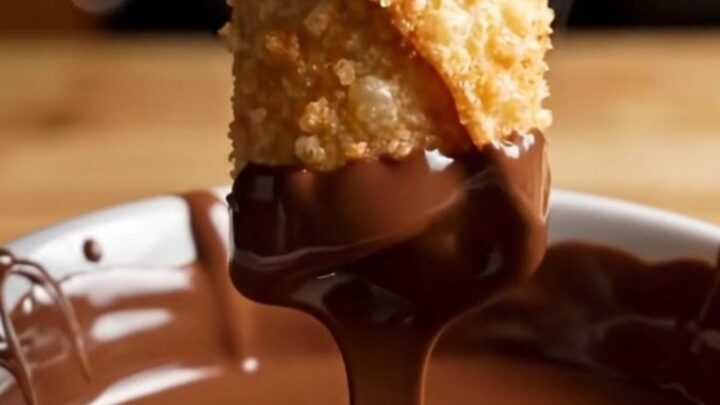
- Make the spiced ganacheWarm the heavy cream in a small saucepan over medium heat until it steams and bubbles at the edge, then pour it over the chopped Mexican chocolate in a heatproof bowl. Wait 1 minute, then whisk slowly from the center outward until the ganache is completely smooth, dark and glossy. Keep it warm.Look for The ganache should ribbon off the whisk in a slow, shiny stream with no graininess.Tip If any unmelted bits remain, set the bowl over barely simmering water and whisk for thirty seconds more.
- Serve hot with the dipHalve each flauta on the bias so the warm cream cheese filling shows, arrange them on a platter, and set the bowl of warm ganache alongside. Serve immediately, while the shell still crackles and the filling steams. Dunk, bite, and repeat until the platter is empty.Look for The filling should ooze slowly from the cut, glossy and thick, not pour out.Tip Cutting one flauta open at the table makes the whole platter disappear twice as fast.
The ganache should be completely smooth, dark and glossy, ribboning slowly off the whisk with no grain of unmelted chocolate, and still warm enough to flow when dunked. Cut one flauta open on the bias: the filling should ooze thickly from the center, steaming and glossy.
Serve everything within minutes of frying, because the shell loses its crackle as it cools. Keep any extra flautas on the wire rack, never stacked, until the moment they reach the table.
Common mistakes
The most common failure is rolling too loosely. A slack roll unwinds in the oil and the filling escapes in a cloudy stream, so tuck firmly and keep the seam underneath. Frying at the wrong temperature is the second trap: below 350°F the tortillas drink oil and turn greasy, above 370°F they brown before the filling warms through. Crowding the pan drops the temperature and glues the rolls together, so fry two or three at a time.
How to tell it’s done
A finished flauta is deep golden brown on every face, with a shell that sounds hollow and crackly when tapped with tongs. The filling at the very center should read 160°F (71°C) on an instant-read thermometer, which it reaches during the two-minute fry at 360°F; check the first batch and trust the timing after that.
When cut open, the cream cheese should be warm, thick and glossy. The cinnamon sugar coating should look sparkly and set, with no bare spots.
- Egg dishes: 160°F (71°C) in the thickest part
Up next · Part 3 of 3
4 variations · storage & make-ahead · 5 answers · printable card
Tips, FAQ & printable recipe (Part 3)← Back to the ingredients (Part 1)